
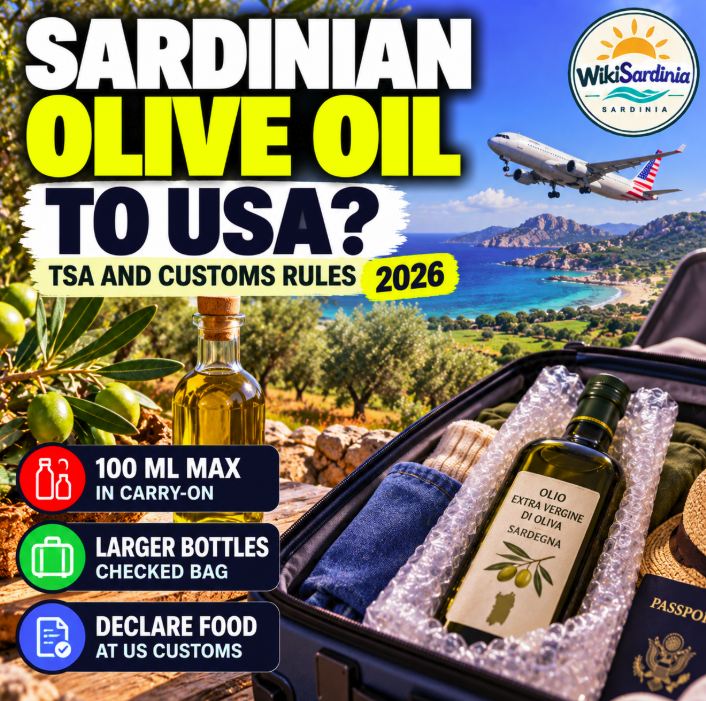
Yes, travelers can generally bring bottled Sardinian olive oil to the United States, but how you pack it matters. A regular 250 ml, 500 ml or one-liter bottle belongs in checked baggage rather than through a standard airport security checkpoint in carry-on luggage. And when you enter the United States, you must declare the olive oil as food or an agricultural product, even if it is a gift or just one bottle for personal use.
For visitors leaving Sardinia with extra-virgin olive oil, there are three separate sets of considerations: liquid limits at departure and transit security checkpoints, the airline's baggage rules, and U.S. Customs and Border Protection (CBP) agricultural declaration requirements.
Can you bring olive oil in your carry-on bag?
Under the standard liquid screening rule, individual containers in carry-on baggage must be 100 milliliters (3.4 US fluid ounces) or smaller and fit within the permitted liquids bag. A 500 ml bottle is too large for the ordinary carry-on screening allowance even if the bottle is only partly filled: the container's capacity is what matters.
The U.S. Transportation Security Administration (TSA) applies its 3-1-1 liquids rule at U.S. checkpoints. For flights departing Italy, the applicable airport security rules and any approved screening exceptions must also be checked. Do not assume that a particular Italian airport allows large liquids just because some airports have newer screening equipment.
Official sources: FAA — Nonflammable Oils, Including Olive Oil; TSA — Liquids Rule.
Can you pack a 500 ml or one-liter bottle in checked luggage?
Generally, yes. The U.S. Federal Aviation Administration explicitly identifies food oils such as olive oil as nonflammable oils permitted in carry-on or checked baggage, while noting that carry-on quantities remain subject to security liquid limits.
Checked luggage is usually the most practical place for normal retail-sized bottles. However, you must still comply with the airline's baggage weight limits, packaging rules and any conditions applied by departure or transit airports.
Quick reference: where does the olive oil go?
| Olive oil | Practical travel guidance |
|---|---|
| Small bottle of 100 ml or less | Normally eligible for carry-on within applicable liquids screening rules |
| 250 ml retail bottle | Use checked baggage unless a specific permitted security exception applies |
| 500 ml retail bottle | Pack in checked baggage |
| One-liter bottle | Pack in checked baggage and check baggage weight allowance |
| Olive oil bought after security | Follow duty-free, connection and destination screening rules; purchase after security does not remove U.S. customs declaration obligations |
Do you have to declare olive oil at U.S. customs?
Yes. Declare it. CBP instructs travelers entering the United States to declare all food and agricultural items. The U.S. Department of Agriculture's Animal and Plant Health Inspection Service (APHIS) likewise requires declaration of agricultural products and recommends retaining receipts and original packaging as evidence of origin.
Declaration is not the same as prohibition. An officer may inspect the product and determine whether it meets entry requirements. For ordinary commercially packaged olive oil intended for personal use, entry is generally possible, but the final admissibility decision belongs to U.S. authorities.
Official sources: CBP — What Items Must I Declare?; USDA APHIS — Traveling With Agricultural Products.
Is olive oil considered a liquid by TSA?
Yes. Olive oil is a liquid food product, so ordinary carry-on liquid screening limits apply. Its culinary use and nonflammable classification do not exempt a large bottle from security restrictions.
Do not confuse an airline's checked-bag allowance with the TSA liquid allowance for items passing through a passenger security checkpoint.
Does the TSA rule apply when flying from Italy?
The TSA operates security screening at U.S. airports. Your initial departure from Sardinia is subject to the rules applied at the Italian airport, while a connecting itinerary may involve additional screening in Europe or the United States.
Because airports may differ in screening procedures, travelers should check their specific departure airport and connection points. The conservative, dependable choice for a standard bottle of Sardinian olive oil is checked baggage.
What if you buy olive oil at the airport?
Liquids purchased after security may be treated differently from items carried through the initial checkpoint. However, onward connections can introduce additional checks. The TSA describes limited conditions for duty-free liquids over 100 ml in secure tamper-evident bags, including receipt and timing requirements for certain inbound international connections.
Do not assume any airport-shop purchase can be taken through every subsequent security checkpoint. Ask the retailer about secure packaging and verify your exact route.
How to pack olive oil without leaks or broken glass
- Choose a well-sealed bottle. Prefer intact retail packaging with a secure cap.
- Keep the label. Original labeling and a receipt help identify the product and its origin.
- Use a leakproof bag. Place the bottle in a sealed plastic bag to contain possible spills.
- Add cushioning. Wrap glass in protective material or use a purpose-made bottle sleeve.
- Pack in the center of the suitcase. Surround the bottle with clothing and avoid the hard outer edges.
- Separate bottles. Prevent glass containers from knocking together during baggage handling.
- Respect weight limits. Several liters of oil can add substantial weight.
Protective wrapping reduces risk but cannot guarantee that a bottle will survive baggage handling without damage.
Is a metal tin better than a glass bottle?
Food-grade tins can be lighter and less likely to shatter than glass, making them appealing for travel. They can still dent, leak or be damaged if packed poorly. Whatever the container, keep it sealed, protect it from pressure and ensure it complies with your airline's requirements.
Can you bring homemade Sardinian olive oil?
Homemade oil raises additional questions about labeling, traceability and inspection. U.S. authorities may examine agricultural products and determine admissibility case by case. A homemade container without a clear label or documented origin may be harder to assess than a sealed commercial bottle.
If the oil comes directly from a family farm or local producer, keep any available details about its origin and production. Declare it truthfully; do not relabel homemade oil as a commercial product.
Can you bring several bottles as gifts?
Several bottles for genuine personal or gift use may be treated differently from a shipment intended for resale. The quantity, total value, airline limits and U.S. customs requirements all matter. There is no universal 'unlimited bottles' rule established by the standard TSA liquids guidance.
For larger quantities or commercial import, separate customs, food import and regulatory requirements may apply. Check with CBP and the relevant agencies before traveling.
Do you have to pay U.S. customs duty?
Any duty depends on the applicable customs classification, value, traveler allowances and other relevant rules. Do not assume every bottle is automatically duty-free or that declaring the oil means duty must be paid.
Keep purchase receipts and declare the value accurately when requested by CBP.
What happens if you forget to declare it?
Failing to declare agricultural products can lead to confiscation and potential penalties. CBP and APHIS emphasize that travelers should declare their food and agricultural items even if they believe the products are permitted.
Declaring an item does not guarantee admission, but it allows inspectors to assess it and helps avoid penalties associated with undeclared agricultural products.
Does olive oil count as a dangerous or flammable liquid?
Ordinary food olive oil is classified by the FAA among nonflammable oils allowed in baggage. This is separate from the passenger security rule limiting liquid container sizes in carry-on bags.
Do not apply the rules for aerosol sprays or flammable fuels to ordinary edible olive oil.
Best Sardinian olive oil to take home
If you are shopping for a souvenir, look for clearly labeled extra-virgin olive oil from a reputable producer. Consider the harvest information, packaging, origin claims and container size. A small, sealed retail bottle may be easier to transport than a large unmarked container.
For long flights, avoid leaving olive oil in extreme heat before packing. Once home, store it away from direct sunlight and excessive warmth.
FAQ
Can I take Sardinian olive oil to the United States?
Generally yes, subject to airline, security and U.S. agricultural entry requirements. Declare it on arrival.
Can I take a 500 ml bottle of olive oil in hand luggage?
Not through an ordinary checkpoint applying the 100 ml liquid container limit. Put it in checked baggage unless a specific exception applies.
Can I pack one liter of olive oil in my suitcase?
Generally yes in checked baggage, provided it is securely packed and complies with airline limits and applicable customs requirements.
Does olive oil have to be declared at U.S. customs?
Yes. U.S. authorities require travelers to declare food and agricultural products.
Can I bring homemade olive oil?
It may be subject to inspection and admissibility requirements. Keep origin information and declare it; commercially labeled packaging is generally easier to document.
Can I buy olive oil after airport security and carry it onboard?
Sometimes, but connecting-flight screening rules may apply. Check your route and retain any required sealed packaging and receipt.
Will TSA confiscate olive oil?
A bottle exceeding the applicable carry-on liquid limit can be refused at a security checkpoint. Checked baggage is the safer choice for standard bottles.
Can I bring olive oil as a gift?
Generally yes for personal or gift purposes if entry requirements are met, but declare it and keep receipts.
The bottom line
To bring Sardinian olive oil to the USA in 2026, pack normal-sized bottles securely in checked baggage and declare them at U.S. customs. Small containers of 100 ml or less can usually meet standard carry-on liquid rules, but airport and transit screening requirements must be checked. Keep the original label and receipt, protect the bottle from leaks, and let U.S. officials make the final admissibility determination.
Official references: FAA — Oils, Nonflammable, Non-Aerosol; TSA — Liquids Rule; CBP — Declaration Requirements; USDA APHIS — Traveling With Agricultural Products.


