
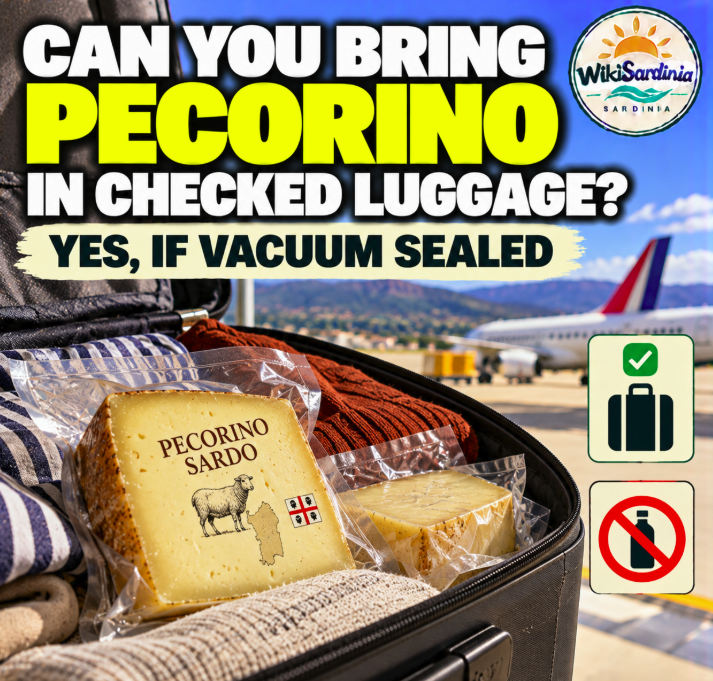
Can you bring Sardinian pecorino in checked luggage? Usually, yes. A solid, well-packed piece of pecorino sardo is generally suitable for checked baggage. Vacuum sealing is strongly recommended because it reduces odor, helps contain moisture and protects your clothes. But airline baggage rules and the destination country's food-import laws are two separate questions. A cheese that is fine to put in your suitcase may still be restricted at customs.
This guide focuses on traditional Sardinian sheep's milk cheese, especially firm and aged varieties, and explains how to pack it and what to check before flying to another European country, the United States or the United Kingdom.
Is pecorino allowed in checked baggage?
In general, solid cheese can travel in checked luggage if it is safely packed and does not violate the airline's baggage conditions. There is no universal ban on carrying a wedge of hard pecorino in a checked suitcase.
However, baggage acceptance is not the same as permission to import food. Customs and agricultural rules depend on where you are arriving, where the cheese was produced and whether it is intended for personal use or commercial sale.
Why vacuum-sealed pecorino is the best choice
Vacuum packaging is practical for travel because it limits leaks, odors and exposure to air. It also makes the product easier to identify if it retains its original label.
Ask the cheesemonger whether they can vacuum-seal your purchase and provide a label showing the product name, ingredients, producer and country of origin. If the cheese already comes in a factory-sealed pack, avoid opening it before travel.
Important: vacuum sealing does not sterilize cheese, eliminate the need for temperature control or override import restrictions. It is a packaging method, not a customs exemption.
Which Sardinian pecorino travels best?
Firm, aged pecorino is generally more convenient to pack than very fresh or soft cheese. It is less likely to leak or deform during handling. Sardinian shops may sell different styles, including Pecorino Sardo DOP and other sheep's milk cheeses with varying levels of aging.
Check the producer's storage instructions. Some products need refrigeration even when vacuum packed, and a long journey in warm conditions can compromise quality or safety. If the label says to keep refrigerated, plan accordingly rather than assuming a checked suitcase will stay cold.
Can you take pecorino on a domestic flight within Italy?
Generally, yes. A solid, properly packaged cheese is ordinarily compatible with checked baggage on domestic flights, subject to the carrier's conditions and general safety requirements. If you are flying from Cagliari, Olbia or Alghero to another Italian airport, there is no international customs border to cross.
Protect the cheese from pressure and temperature changes, and keep it away from toiletries or other items that could leak.
Can you bring pecorino from Sardinia to another EU country?
For ordinary personal consumption, food products such as cheese can generally be carried between EU countries under the rules for personal travel, provided no special animal-health restrictions apply. The European Union explains that travelers moving within the EU may carry meat and dairy products for personal consumption.
That does not authorize commercial resale or bypass temporary disease-control measures. Check current rules if traveling during an animal-health alert or carrying unusually large quantities.
Can you bring Sardinian pecorino to the United States?
Many solid, commercially packaged cheeses are admissible for personal use when arriving in the United States, but eligibility depends on the product and current USDA/APHIS and Customs and Border Protection rules. You must declare agricultural and food products to US customs officers, even when they are vacuum sealed and packed in checked luggage.
US authorities distinguish among cheeses based on characteristics such as consistency, ingredients and disease-related import restrictions. Do not assume that all fresh, soft, liquid-filled or homemade dairy products are treated the same as a firm aged pecorino.
For the smoothest inspection, bring the original packaging and receipt, and clearly identify the cheese as a commercially produced sheep's milk product from Italy. Customs officers make the final admissibility decision. Declaring it is essential; vacuum sealing does not remove that obligation.
What about flights to the United Kingdom?
Be particularly careful. Great Britain has introduced restrictions on bringing certain meat and dairy products from the EU for personal use in response to animal-disease risks. These rules can change and may differ from those for Northern Ireland.
As of the UK government's published guidance on restrictions introduced in April 2025, travelers entering Great Britain from the EU are not allowed to bring cheese and other dairy products for personal use under those restrictions. A vacuum-sealed wedge of pecorino is still cheese and is not exempt merely because it is packaged.
Do not pack pecorino for Great Britain without checking the current GOV.UK rules immediately before travel. Rules for Northern Ireland may differ, so check the specific destination rather than treating the entire UK as one customs regime.
Can you put pecorino in hand luggage instead?
Solid hard cheese is generally easier to carry through airport security than spreadable or liquid foods, but screening requirements can vary by airport and country. Soft, creamy or liquid-containing products may be treated differently under security rules.
For large purchases, checked luggage can be simpler, but neither checked nor cabin baggage avoids destination-country customs restrictions. If your itinerary includes connections, check the rules of any airport where you must pass security again.
How to pack pecorino in checked luggage
- Choose a firm, well-packaged cheese. A commercially labeled, vacuum-sealed wedge is convenient for travel.
- Check storage instructions. Keep refrigerated products cold according to the maker's guidance.
- Use a second protective layer. Place the sealed cheese inside a clean, leak-resistant food bag.
- Cushion the package. Wrap it in clothing or another protective layer to prevent crushing.
- Keep the label and receipt. They can help explain what the product is and where it came from.
- Verify customs rules. Check the official guidance for your destination, not just the airline's website.
- Declare it when required. Especially when entering the United States, declare all food and agricultural products.
Does pecorino need refrigeration during the flight?
That depends on the cheese and its packaging. Aged cheeses may tolerate short periods outside refrigeration better than fresh cheeses, but this is not a guarantee of safety during a long or hot journey.
Follow the manufacturer's storage label. Checked luggage may sit on a warm airport apron or in other uncontrolled conditions, so do not assume the aircraft hold provides refrigeration. For a product requiring cold storage, use an appropriate insulated solution that complies with airline rules, or avoid transporting it if you cannot maintain safe temperatures.
Can you freeze pecorino before traveling?
Freezing can change the texture of some cheeses and does not replace proper packing or food-import compliance. Ask the producer whether freezing is suitable for the specific variety. Never assume that a frozen cheese will remain frozen throughout a flight.
How much pecorino can you bring?
Airline baggage weight limits apply, and customs may distinguish reasonable personal-use quantities from commercial imports. There is no single worldwide allowance for cheese. If you plan to carry several kilograms, check the destination's official rules and be prepared to explain that it is for personal use.
Can you bring pecorino as a gift?
Often, yes, where the destination permits the product. A vacuum-sealed, labeled wedge makes a thoughtful Sardinian food souvenir. But calling it a gift does not exempt it from customs or agricultural restrictions.
For destinations with dairy-import bans, choose a different gift rather than risk confiscation.
What is Pecorino Sardo DOP?
Pecorino Sardo DOP is a protected designation of origin cheese made from sheep's milk under defined production rules in Sardinia. Different styles and aging levels are available. When shopping, look for authentic labeling and ask the cheesemonger which variety is best suited to your travel time and storage conditions.
Other Sardinian sheep's milk cheeses can also be excellent souvenirs, but they may have different ingredients, textures and storage requirements.
Where to buy travel-ready pecorino in Sardinia
Look for reputable cheese shops, food markets, dairies or specialty stores in places such as Cagliari, Alghero, Olbia and inland villages. Ask for pecorino stagionato sottovuoto—vacuum-sealed aged pecorino—and check the label before buying.
We cannot verify current stock at a particular shop, so contact the seller if you need a specific cheese or vacuum-packing service.
Useful Italian phrases
- Potete metterlo sottovuoto? — Can you vacuum-seal it?
- È un pecorino stagionato? — Is it an aged pecorino?
- Deve stare in frigorifero? — Does it need refrigeration?
- Mi può dare lo scontrino? — Can I have the receipt?
FAQ
Can I put Sardinian pecorino in checked luggage?
Usually, yes. Solid, properly packaged cheese is generally compatible with checked baggage, but customs rules depend on your destination.
Should pecorino be vacuum sealed for a flight?
Vacuum sealing is recommended for cleanliness, odor control and protection, but it does not make a prohibited product legal to import.
Can I bring pecorino from Sardinia to mainland Italy?
Generally, yes, subject to airline baggage and storage requirements.
Can I bring pecorino from Sardinia to another EU country?
Generally for personal consumption, subject to any applicable temporary animal-health restrictions.
Can I bring pecorino to the USA?
Many firm commercially produced cheeses may be allowed, but check USDA/APHIS and CBP guidance and declare the cheese on arrival.
Can I bring pecorino to England or Scotland?
Great Britain has restrictions on personal imports of cheese and other dairy products from the EU. Check current GOV.UK guidance; do not assume vacuum packaging creates an exception.
Is pecorino allowed in hand luggage?
Solid cheese is generally easier to carry than soft or spreadable cheese, but airport screening rules vary. Customs rules apply regardless of baggage type.
Does vacuum-packed pecorino need refrigeration?
Follow the producer's label. Vacuum sealing alone does not eliminate refrigeration requirements.
Can customs confiscate my cheese?
Yes, if it is prohibited or fails applicable import requirements. Declare it whenever required.
Can I bring several wedges as gifts?
Possibly, where imports are permitted. Quantity and commercial-use considerations vary by country.
The bottom line
Yes, you can usually pack Sardinian pecorino in checked luggage, and vacuum sealing is the most practical choice. But check two things before flying: the cheese's storage instructions and the food-import rules at your destination. Domestic Italian and most ordinary intra-EU personal travel is straightforward; the United States requires declaration and product-specific eligibility checks; and Great Britain has imposed restrictions on personal dairy imports from the EU. A well-packed cheese is a wonderful souvenir only when it can legally cross the border.
Official sources
Your Europe — Carrying animal products, food or plants; USDA APHIS — Traveling with agricultural products; US CBP — Prohibited and restricted items; GOV.UK — Bringing meat, dairy and other animal products into Great Britain. Import restrictions may change; verify official guidance immediately before departure.


