
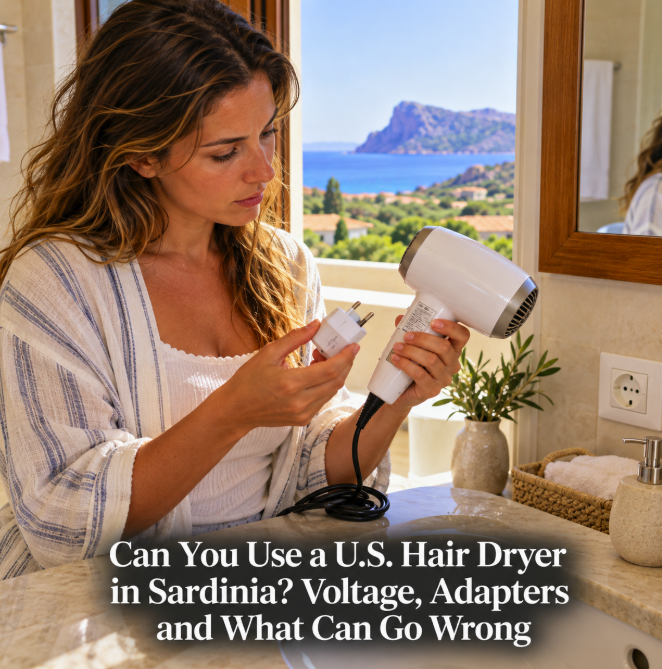
Yes: a U.S.-only 110–120V hair dryer can be damaged if you plug it directly into the electrical supply in Sardinia using only a simple travel plug adapter. Italy uses a nominal 230V, 50Hz supply, while standard U.S. appliances are commonly designed around roughly 120V, 60Hz. A plug adapter changes the physical shape of the plug; it does not reduce 230 volts to 120 volts.
For American travelers, the safest first step is therefore not buying an adapter. It is reading the electrical label on the hair dryer itself.
Check the voltage label before packing
Look on the dryer handle, body, plug, label or instruction manual for its input voltage. If it says only something such as 120V 60Hz or 110–120V, it is not designed to be connected directly to Italy’s 230V supply.
If the dryer is explicitly marked 100–240V, 50/60Hz, it is a dual-voltage or universal-voltage appliance. In that case, a suitable plug adapter may be all that is required.
Some travel hair dryers have a manual voltage selector rather than automatic universal voltage. These often show settings such as 125V and 250V. The selector must be placed in the correct high-voltage position before connecting the appliance in Italy, following the manufacturer’s instructions.
Do not assume that an expensive hair dryer is automatically dual voltage. Hair dryers are high-power heating appliances, and voltage compatibility varies by model.
Why a simple travel adapter is not enough
A travel adapter solves a mechanical problem: American flat blades do not directly match typical Italian sockets. International standards specifically distinguish travel adaptors as plug-and-socket accessories; they are not inherently voltage transformers.
This distinction is critical with a hair dryer. If a 120V-only heating appliance receives roughly 230V, the electrical stress can be severe. The appliance may overheat, fail quickly, trip protection or be permanently damaged. Continuing to use an incompatible appliance can also create a safety hazard.
In other words, an adapter can make the plug fit while leaving the voltage completely wrong.
What plugs are used in Sardinia?
Sardinia follows the same electrical system as the rest of Italy. Travelers can encounter Italian Type L sockets as well as European-compatible sockets that accept Type C plugs, and some accommodations may have sockets compatible with additional European plug formats.
A compact U.S.-to-Italy or U.S.-to-Europe travel adapter is therefore useful for compatible electronics. But the adapter should have appropriate ratings and should be used according to its instructions. IEC standards for travel adaptors cover devices intended for household travel use at voltages up to 250V.
Hair dryers are different from phone chargers
Many modern phone, laptop and camera chargers are designed for international travel and carry an input rating such as 100–240V, 50/60Hz. When that marking is present, the power supply can normally handle Italian voltage and only the plug shape needs adapting.
A hair dryer can be very different because its heating element and motor draw far more power. IEC’s current safety standard specifically includes hair dryers among household hair-care appliances operating at rated voltages up to 250V, but that does not mean every individual dryer is designed for every voltage within that range. The rating printed by the manufacturer on your appliance is what matters.
Can you use a voltage converter?
In principle, a properly specified step-down transformer or voltage converter can supply a 120V appliance from a 230V source. The problem is power. Hair dryers commonly consume much more wattage than phones, shavers or other small travel electronics, so a lightweight converter intended for low-power devices may be completely unsuitable.
If considering a converter, verify that it is specifically designed for the type of hair dryer you own and rated for at least the dryer’s power consumption, with an appropriate safety margin. Follow both manufacturers’ instructions. Do not rely on a generic claim such as “international converter” without checking its continuous or appliance-specific power rating.
For many travelers, carrying a heavy high-power converter simply to use a U.S.-only dryer is less convenient than using a dual-voltage travel dryer or the hair dryer supplied by the hotel, B&B or vacation rental.
The easiest solution for a Sardinia trip
Before leaving the United States, photograph the electrical label on the dryer and check it carefully. If it says 100–240V and 50/60Hz, bring the correct Italian/European plug adapter and follow any voltage-selector instructions. If it says only 110–120V, do not connect it directly to a Sardinian socket with a basic adapter.
Travelers staying in hotels should check the accommodation amenities before packing. Many properties provide a hair dryer, which removes the voltage issue entirely. For a longer trip through Italy or Europe, purchasing a genuine dual-voltage travel dryer can also be simpler than carrying a high-wattage transformer.
A quick rule for American travelers
The useful rule is straightforward: adapter changes the plug; converter changes the voltage. A dual-voltage dryer usually needs only the correct plug adapter. A 120V-only U.S. dryer needs suitable voltage conversion and should never be assumed safe on Italy’s 230V supply.
If the label is missing, damaged or unclear, do not experiment by plugging the dryer in. Check the exact model with the manufacturer or leave it at home. That small check can prevent a burned-out appliance—and a very inconvenient start to a Sardinian holiday.


