
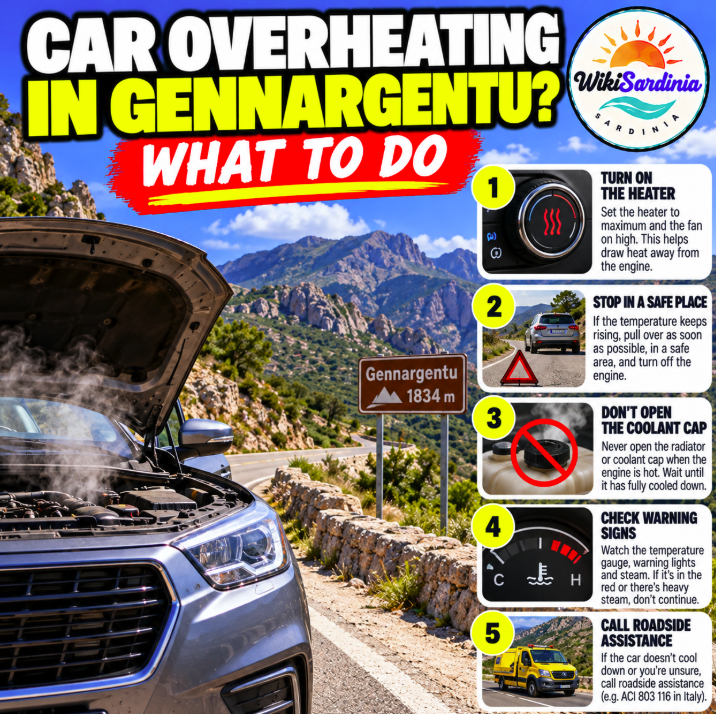
Driving through the Gennargentu mountains and your car's temperature gauge suddenly climbs? Take it seriously. Turning the cabin heater to hot can sometimes help draw heat away from the engine while you look for a safe place to stop, but it is only a temporary measure—not a repair. If the gauge enters the red, a warning light appears or steam comes from under the bonnet, stop as soon as it is safe and switch off the engine.
What to do immediately if your car overheats
- Reduce the engine load. Switch off the air conditioning. If you cannot pull over safely right away, set the cabin heater to hot and the fan high briefly; this may help reduce engine temperature while you reach a safe stopping place.
- Pull over safely. Choose a safe place away from moving traffic, use hazard lights and follow local road-safety rules. Do not stop in a blind bend or where visibility is poor.
- Switch off the engine. If the gauge is in the red, a warning appears, power drops or steam is visible, turn the engine off once safely stopped.
- Keep clear of steam. If steam or coolant is escaping, do not open the bonnet until it has stopped and it is safe to do so.
- Never open the coolant cap while hot. The cooling system can be pressurised; hot coolant or steam can cause severe burns. Do not pour cold water onto a hot engine.
- Call roadside assistance if needed. If the warning persists, coolant is leaking, steam appears or you are unsure what caused it, do not continue driving.
Does turning on the heater really help?
It can help temporarily because the cabin heater transfers some heat from the engine coolant into the passenger compartment. Turn off the air conditioning first. If you are still moving and cannot stop immediately, use the heater only as a short-term measure to reach a safe place. It is not a reason to keep driving with the temperature in the red.
Once safely stopped, switch off the engine if the car is overheating. Do not leave the engine running just to try to cool it unless your vehicle's owner manual or a qualified roadside professional specifically advises that for your situation.
Why can a car overheat on mountain roads?
Steep climbs, low-speed driving, a heavy load, high outside temperatures or a fault in the cooling system can all contribute. Possible mechanical causes include low coolant, a leak, a faulty thermostat, a cooling fan problem, a water-pump issue or a blocked radiator.
Watch for warning signs such as a rising temperature gauge, a coolant warning light, reduced engine power, unusual smells, steam or liquid under the car.
When is it safe to continue?
Do not decide based only on the gauge dropping after you switch on the heater. If the engine has reached the red zone, steam is present, coolant has leaked or a warning returns, arrange professional assistance. Continuing to drive an overheated engine can cause expensive damage.
If the temperature rose only briefly and all warnings disappear after stopping and cooling, consult your vehicle's manual and roadside assistance before deciding whether to continue. The cause still needs to be checked, especially if the problem recurs.
How long should you wait before checking coolant?
Allow the engine to cool completely; this can take 30 minutes or longer. Never remove the radiator or expansion-tank cap while the engine is hot. When the engine is fully cool, check the owner's manual for the correct coolant reservoir and procedure. If the level is low or you see a leak, seek help and use only the coolant specified for your vehicle.
Do not pour cold water over the engine or into a hot cooling system. If you are not confident about the procedure, wait for roadside assistance.
Mountain-road safety in Sardinia
- Before a trip through the Gennargentu, arrange maintenance if the car has recently run hot.
- On long climbs, monitor the temperature gauge and do not ignore a warning because the next village seems close.
- Carry a charged phone and know how to contact your breakdown service.
- If you stop, choose a place visible to other drivers and stay away from the traffic lane.
- Keep passengers away from the road and from steam or leaking coolant.
Useful Italian phrases
- La macchina si sta surriscaldando. — The car is overheating.
- La temperatura del motore è nella zona rossa. — The engine temperature is in the red zone.
- Mi serve il soccorso stradale. — I need roadside assistance.
- Perde liquido refrigerante. — It is leaking coolant.
- C'è un'officina nelle vicinanze? — Is there a garage nearby?
Frequently asked questions
Should I turn on the heater if my car overheats?
Switch off the air conditioning. If you cannot stop safely immediately, setting the heater to hot may help temporarily while you reach a safe place. Then stop and switch off the engine if it is overheating.
Can I keep driving if the temperature goes back down?
Not automatically. If the gauge reached the red zone, steam appeared or a warning returned, arrange professional assistance. A temporary drop does not fix the cause.
Can I open the coolant cap to check the level?
Never open it while the engine is hot. The pressurised system can release boiling coolant and steam. Wait until the engine is completely cool and follow the vehicle manual.
Can I pour cold water onto the engine?
No. Sudden cooling can cause damage, and hot components may burn you. Let the engine cool naturally and follow the manual or roadside professional's advice.
Why is the car overheating on a mountain climb?
Climbing puts the engine under load, but overheating can also signal low coolant, a leak or a cooling-system fault. Have the cause checked.
The bottom line
If your car overheats on the Gennargentu, turn off the A/C and use the cabin heater only briefly if you need to reach a safe stopping place. Then stop, switch off the engine and let it cool. Never open the cooling system while hot or pour cold water on the engine. If there is steam, a leak or a persistent warning, call roadside assistance rather than risking engine damage.
Further guidance
RAC — What to do if your car is overheating; AAA — What to do if your car is overheating; check your vehicle manufacturer's owner's manual for model-specific instructions.


