
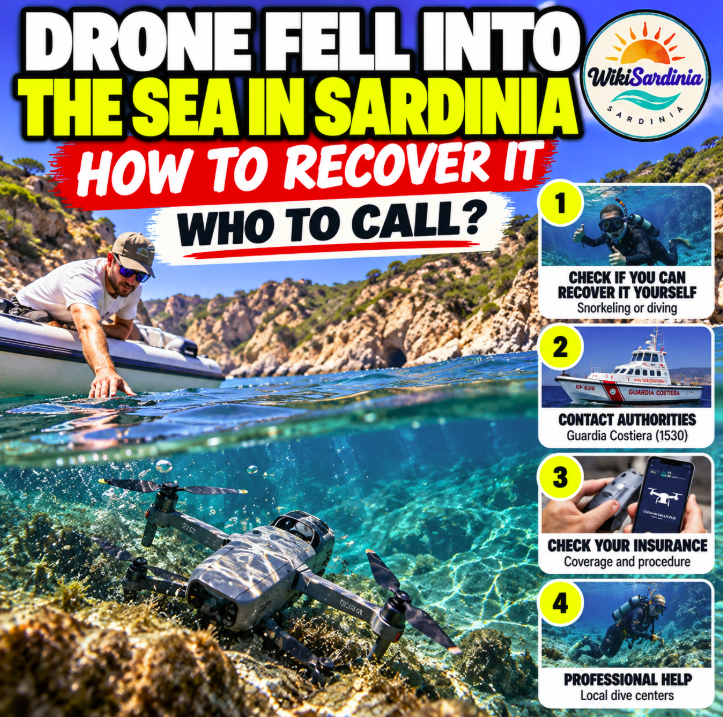
Your drone has fallen into the sea in Sardinia. Who should you call, and can you get it back? First, stay safe: do not swim out, climb onto rocks or enter rough water to retrieve it. A drone is replaceable; a person caught by waves or currents can be in serious danger.
If nobody is in danger and the drone has simply sunk or drifted away, there is no single public “drone recovery” hotline. Contact the local beach operator, lifeguard, marina or harbour office for advice about the location and whether a safe, authorized recovery is possible. The Italian Coast Guard's 1530 number is for maritime emergencies and danger at sea—not routine recovery of lost property.
Who should you call?
- Someone is in danger, or a boat/navigation hazard is involved: call Italy's emergency number 112 when there is immediate danger, or the Coast Guard's 1530 for a maritime emergency. Explain exactly what happened and follow their instructions.
- The drone fell into the water near a staffed beach: alert the lifeguard or beach operator. They can advise on local conditions and any safety restrictions.
- It fell near a marina, harbour or boat channel: contact the marina office or local harbour authority. Do not enter a restricted area or interfere with navigation.
- The drone is lost offshore, with no emergency: record the last known location and contact local professional recovery or diving services if a recovery is practical and lawful. Do not assume the Coast Guard will retrieve private equipment.
- The drone may have caused injury, damage or a safety incident: report the facts to the relevant authorities and preserve the flight records.
Official sources: the Italian Ministry of Infrastructure and Transport explains that 1530 is the Coast Guard maritime emergency number; the Civil Protection Department identifies 112 as the number for rescue requests and imminent danger.
Can you recover a drone from the sea yourself?
Only consider recovery from a safe, dry position where you do not need to enter the water, climb on slippery rocks or lean over a dangerous edge. Do not wade or swim after a drone, even in apparently calm water. Currents, sudden waves, cold water and underwater obstacles can change the situation quickly.
If the drone is floating close to shore, wait for conditions to be safe and ask the lifeguard or local operator for advice. Do not use a boat, snorkel or scuba gear unless you are qualified, equipped and permitted to do so. A private drone is not a reason to take a personal safety risk.
What if the drone is still visible on the app?
Take screenshots of the map, last known GPS coordinates, flight path, battery status and the last connection time. Save the flight log before closing or uninstalling the app. The displayed location may be the last recorded position rather than the drone's current location, especially if it drifted with wind or currents.
If the drone has a remote identification or serial number, keep those details available. Do not assume the GPS marker is accurate enough to justify entering the sea or approaching hazardous rocks.
What if the drone is floating?
Do not chase it into the water. Wind and current can carry it away, and waves may bring it back toward rocks or other hazards. Alert nearby staff if its position could create a hazard for swimmers or boats. If the device is drifting into a navigation channel, report that clearly to the harbour authority or Coast Guard as appropriate.
What if the drone has sunk?
A submerged drone may be difficult to locate, particularly in waves, turbid water or rocky areas. If you decide to explore professional recovery, provide the last known coordinates, estimated depth, time of loss, drone model and whether it had a battery installed. Ask the service about access, conditions, cost and whether any permissions are needed.
Do not attempt an unqualified dive or enter a restricted marine area. The cost and chance of recovery may not justify the risk.
Is a drone battery dangerous after a sea crash?
Damaged lithium batteries can short-circuit, heat up or catch fire, even after contact with water. Do not handle a swollen, hot, smoking or visibly damaged battery. If you recover the drone safely, keep it away from flammable materials and follow the manufacturer's guidance for damaged batteries and local disposal rules.
Do not charge or power on a drone that has been immersed in seawater. Salt water is corrosive and conductive; powering the device can cause further damage or an electrical fault. Have it inspected by a qualified repair service and treat the battery separately according to manufacturer instructions.
Will the drone work again after falling into salt water?
Do not count on it. Salt water can corrode electronics, motors, connectors and battery contacts. Even if the drone turns on after drying, internal corrosion can cause later failures.
Do not use a hairdryer, oven or other heat source to dry it, and do not connect it to a charger. Photograph the damage, record the circumstances and ask the manufacturer or a repair professional whether inspection is worthwhile.
Can insurance cover a drone lost at sea?
Possibly, but cover depends on the policy. Check whether your equipment insurance, travel policy or specialist drone policy covers accidental loss, water damage, retrieval costs and use over water. Third-party liability cover is different from cover for damage to your own drone.
Notify the insurer promptly, save the flight log and proof of ownership, and do not arrange an expensive recovery before checking whether the policy requires approval. Coverage exclusions may apply to unauthorized flights or breaches of policy conditions.
Were you allowed to fly the drone there?
After dealing with safety, review whether the flight complied with the applicable rules and local restrictions. Drone operations in Italy are governed by the European UAS framework and national requirements; restrictions may also apply around airports, protected areas, crowded beaches, ports and other sensitive locations.
Check the official D-Flight portal for Italian drone geographical zones and consult ENAC's drone guidance. The fact that a beach is open to the public does not automatically mean every drone flight is permitted.
How to reduce the risk next time
- Check wind, gusts and the manufacturer's operating limits before takeoff.
- Keep the drone within visual line of sight and maintain a safe margin from the sea, cliffs, swimmers and boats.
- Set a conservative return-to-home battery reserve and verify the home point before flight.
- Understand how return-to-home behaves when the signal is lost and account for headwinds on the return leg.
- Check local drone restrictions and any required permissions before flying.
- Avoid flying over people or crowds and do not take off in conditions that leave no safe landing option.
- Record the serial number and keep purchase and insurance documents.
Useful Italian phrases
- Il mio drone è caduto in mare. — My drone fell into the sea.
- Non c'è nessuno in pericolo. — Nobody is in danger.
- Il drone è vicino agli scogli. — The drone is near the rocks.
- È vicino al porto / alla spiaggia. — It is near the harbour / beach.
- Queste sono le ultime coordinate GPS. — These are the last GPS coordinates.
- Conoscete un servizio di recupero autorizzato? — Do you know an authorized recovery service?
Frequently asked questions
What number do I call if my drone falls into the sea in Sardinia?
For immediate danger or a maritime emergency, call 112 or the Coast Guard at 1530 as appropriate. For a lost drone with no danger to people or navigation, contact the local beach operator, marina or a professional recovery service; there is no single public drone-recovery hotline.
Will the Coast Guard recover my drone?
Do not assume so. The 1530 service is for maritime emergencies. Explain any actual hazard, but use local or professional recovery services for routine lost property.
Can I swim out to get my drone?
No. Do not put yourself at risk for equipment. Ask local staff for advice and use a qualified recovery service if appropriate.
What if the drone is floating just offshore?
Do not chase it into the water. Alert beach staff if it poses a hazard and wait for safe, authorized recovery options.
Can salt water destroy a drone?
Yes. Salt water can corrode electronics and damage batteries. Do not power on or charge a submerged drone.
Can insurance pay for a lost drone?
It depends on your policy and exclusions. Contact the insurer before authorizing costly recovery work.
Where can I check whether drone flights are allowed?
Consult D-Flight for Italian geographical zones and ENAC's official drone guidance, then check any local restrictions.
The bottom line
If your drone falls into the sea in Sardinia, do not swim after it. Call 112 or the Coast Guard's 1530 only if there is immediate danger or a genuine maritime safety issue. Otherwise, notify the lifeguard, beach operator or marina, save the last GPS location and consider a qualified recovery service. If recovered, keep the drone switched off and do not charge it until it has been inspected.
Official sources
Italian Ministry of Infrastructure and Transport — 1530 maritime emergencies; Italian Civil Protection — emergency contacts; D-Flight — drone geographical zones; ENAC — drone rules and safety.


