
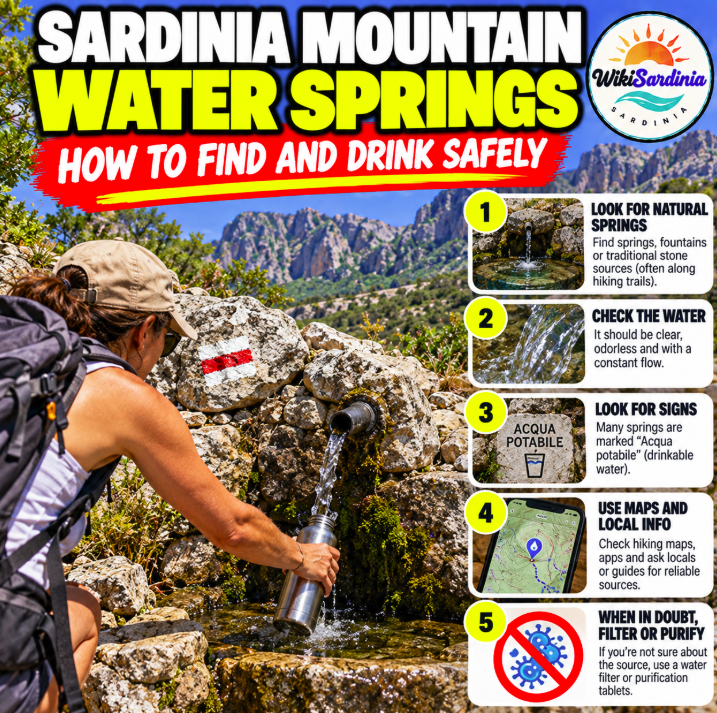
Hiking in the Supramonte or Sardinian mountains and looking for a spring to drink from? The most important rule is simple: you cannot tell whether spring water is safe to drink just by looking at it. Clear, cold water flowing over rock can still contain bacteria, viruses or parasites. Use a source explicitly marked as drinking water and follow local notices; if its status is unknown, treat the water before drinking it.
Sardinia has famous springs and karst landscapes, including Su Gologone in the Supramonte area. But a beautiful natural spring is not automatically an approved drinking-water point, and water quality can change after rain, animal activity or other contamination.
How to recognize a spring that is safe to drink
Do not rely on colour, clarity, smell, taste, coldness or the fact that local people have used a spring for years. These clues cannot confirm microbiological safety.
- Look for explicit drinking-water signage, such as “acqua potabile”, at an established fountain or maintained public water point.
- Check for warnings such as “acqua non potabile”, temporary closure notices or signs saying the water is unsuitable for drinking.
- Ask the local municipality, park authority, refuge or trail operator whether the source is currently approved for drinking.
- Do not assume a natural spring is tested simply because it appears on a hiking map or is mentioned in a travel guide.
- If you cannot confirm its status, use sealed drinking water or treat the water correctly before drinking it.
Why clear mountain water can still be unsafe
Water can be contaminated upstream by animal droppings, wildlife, grazing livestock, people, damaged infrastructure or runoff after heavy rain. Many disease-causing organisms are invisible and do not change the water's smell or taste.
That is why a clear stream, dripping rock face or remote spring is not a reliable indicator of drinkability. “Looks pure” is not the same as tested and potable.
Is water from Su Gologone potable?
Su Gologone, near Oliena, is a well-known natural spring and landmark in the Supramonte. Its importance as a natural water source does not mean every part of the site is an approved drinking-water tap. Do not drink directly from the spring or surrounding water unless local authorities clearly indicate that the specific point is safe for drinking.
For a hike, check current local information about available drinking-water points and carry enough water for the planned route. Natural monuments, pools and springs can have conservation or access rules, so follow posted signs and local instructions.
What should you do if you cannot confirm the source is potable?
The safest choice is to drink water from a sealed bottle or a verified potable fountain. If you need to use untreated backcountry water, choose an appropriate treatment method and follow the product instructions carefully.
- Boiling: Bring clear water to a rolling boil for one minute to kill disease-causing germs. Let it cool in a clean, covered container.
- Filter then disinfect: A suitable portable filter can remove some germs, but many filters do not remove viruses. Combining filtration with an appropriate disinfectant provides broader protection.
- Use a treatment product designed for drinking water: Follow the exact dosage and contact time on the label. Not all tablets or filters work against every pathogen.
These methods do not make water safe if it may contain harmful chemicals, fuel or other toxins. In that situation, use another source. Official guidance: CDC — treating water while hiking and travelling.
Does a portable water filter make any spring safe?
No. Filters vary in what they remove. Some reduce protozoa but not viruses or all bacteria; others provide broader protection. Read the specifications, pore size and certification, and follow the manufacturer's instructions. When the water is cloudy, pre-filter it as directed before disinfection.
Do not assume a basic bottle filter or taste-improving filter is designed to make untreated spring water microbiologically safe. If you are not sure what a device removes, do not rely on it as your only protection.
Can you tell from the taste or smell?
No. Water that tastes fresh, smells neutral and looks crystal clear can still carry pathogens. Conversely, unusual taste or smell is a reason to avoid drinking it, but normal taste and smell do not prove safety.
How much water should you carry in the Supramonte?
Plan your water supply before setting off, considering route length, elevation, weather, shade, pace and the availability of verified refill points. Hot weather and exposed limestone terrain can increase the need for water. Do not build your plan around an unverified spring that you hope will be flowing.
Check whether refuges, trailheads or villages on your route have potable water and confirm opening hours or seasonal availability. Carry extra water if there is uncertainty, and turn back or shorten the route if your supply is running low.
What if you already drank from an unknown spring?
Do not panic, but avoid drinking more until you have confirmed the source or treated the water. Watch for symptoms such as diarrhoea, vomiting, stomach cramps or fever. Seek medical advice if you become unwell, symptoms are severe or persistent, or you are in a higher-risk group. Tell the clinician when and where you drank the water.
Useful Italian phrases on a mountain trail
- Quest'acqua è potabile? — Is this water safe to drink?
- La sorgente è controllata? — Is the spring tested/monitored?
- Dove trovo una fontana di acqua potabile? — Where can I find a drinking-water fountain?
- C'è un cartello che indica se l'acqua è potabile? — Is there a sign indicating whether the water is drinkable?
- Questa fontana è fuori servizio? — Is this fountain out of service?
Frequently asked questions
How can I recognize potable spring water in Sardinia?
Do not judge by appearance. Look for explicit “acqua potabile” signage at an established source and check local notices or ask the relevant authority.
Is clear water from a mountain spring safe to drink?
Not necessarily. Microorganisms may be present even when the water looks clean.
Can I drink directly from Su Gologone?
Do not assume the natural spring itself is an approved drinking-water point. Drink only from a specific point clearly identified as potable by the responsible authority.
Will boiling make unknown spring water safe?
Boiling kills many disease-causing germs, but it does not remove harmful chemicals or toxins. Use another source if chemical contamination is possible.
Is a portable filter enough?
Not always. Filters differ in which bacteria, parasites and viruses they remove. Check specifications and consider filtration followed by disinfection.
Should I carry water even if the map shows springs?
Yes. A mapped spring may be seasonal, inaccessible, untested or not potable. Carry enough for the route and verify refill points in advance.
The bottom line
You cannot recognize potable spring water by sight alone. In the Supramonte and elsewhere in Sardinia, drink from a clearly marked and verified potable source. If the water status is unknown, choose sealed water or use an appropriate treatment method; boiling and filtration have limits, especially when chemical contamination is possible. Plan your hike around confirmed water points rather than hoping a natural spring will be safe.
Sources
SardegnaTurismo — Su Gologone; CDC — Water treatment while hiking, camping and travelling; CDC — Backcountry water treatment guide.


