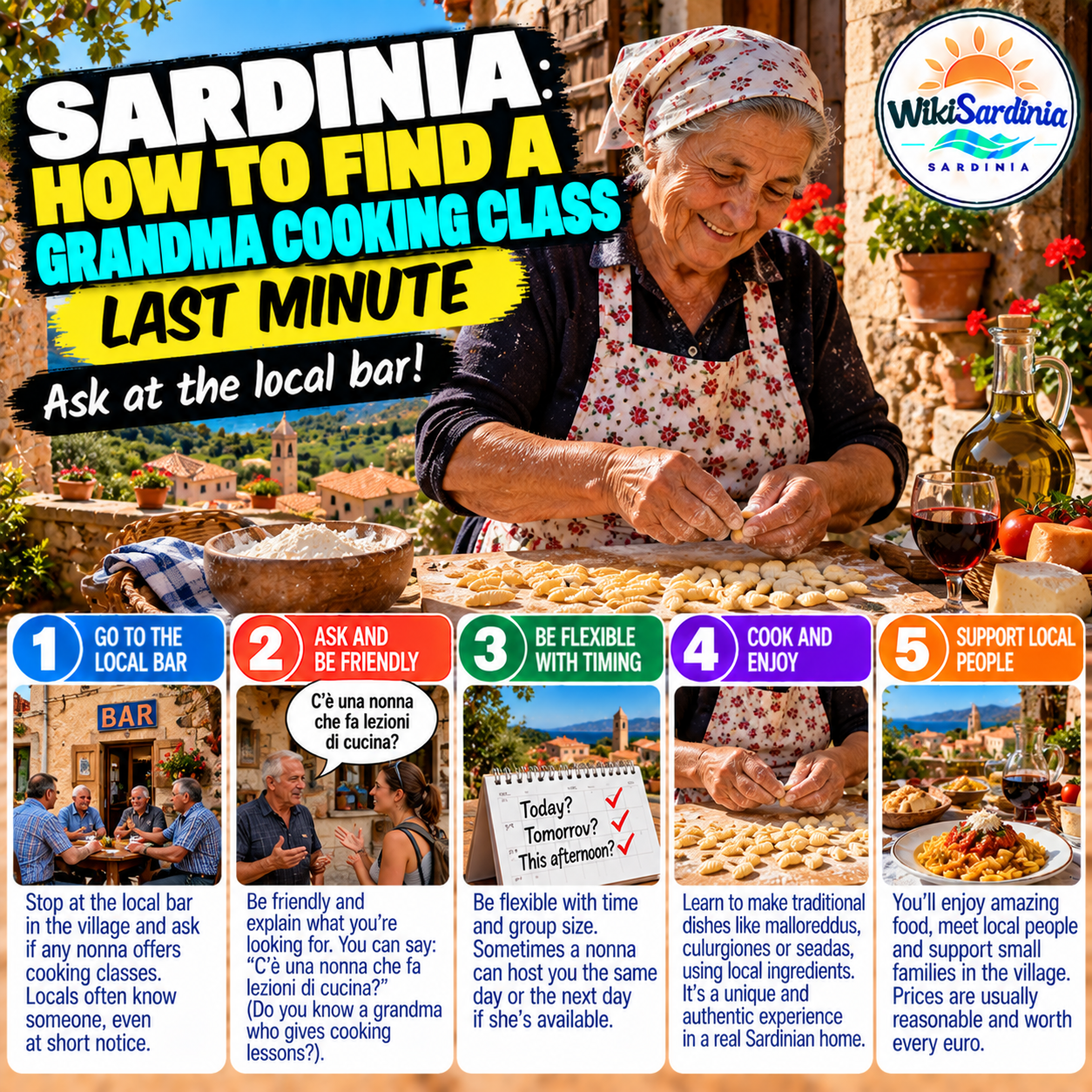
Want to learn how to make Sardinian pasta with a local grandmother, but only thought of it after arriving? You may still find an opportunity. In smaller Sardinian villages, the local bar can be a useful place to ask for recommendations: people often know local cooks, agriturismi and families who occasionally welcome visitors. It is a lead, not a guarantee, so be friendly, flexible and respectful of people’s time.
1. Start at the village bar
Choose a village near where you are staying and stop at a local café or bar when it is not especially busy. Ask the person behind the counter whether they know anyone who offers traditional cooking lessons or a home-cooking experience. If they cannot help, they may point you towards an agriturismo, farm shop, local association or small restaurant.
Do not assume every grandmother wants to host visitors or run a class. Treat introductions as recommendations, not as permission to turn up at someone’s home uninvited.
2. Use a simple Italian phrase
You can ask:
“Buongiorno, conoscete una signora che fa lezioni di cucina tradizionale sarda?”
This means, “Good morning, do you know a woman who gives traditional Sardinian cooking lessons?” For a more casual version, try:
“C’è una nonna che insegna a fare la pasta sarda?”
That means, “Is there a grandma who teaches people to make Sardinian pasta?” If your Italian is limited, show the sentence on your phone and explain that you are looking for a short lesson or a meal where you can help prepare the food.
3. Be flexible about the time
A host may be busy that day, especially during lunch preparation, family gatherings or local celebrations. Ask whether they might be available later in the afternoon, the next morning or another day. If you have only a few hours, say so clearly and ask whether a short demonstration is possible.
Keep your group small if you can. A spontaneous experience is easier to arrange for one or two people than for a large group, but availability will always depend on the host.
4. Ask what you will cook
Sardinian cuisine varies across the island, so ask which dish the host likes to teach. You might learn to shape malloreddus, prepare filled pasta such as culurgiones, make bread, or prepare a traditional dessert. Not every dish is suitable for a short session, and recipes differ from village to village.
Tell the host about any allergies or dietary requirements before agreeing. Ask whether ingredients are included and whether you will eat the food together afterwards.
5. Confirm the practical details before you agree
- Price: ask the total cost per person and what it includes.
- Duration: confirm the start time and how long the session will last.
- Location: ask for the exact meeting point and directions.
- Group size: check how many people can join.
- Food and allergies: explain any dietary needs in advance.
- Payment and cancellation: agree on these details clearly before travelling to the venue.
If the host is cooking at home, be sure the arrangement is genuinely welcome and clearly agreed. Do not arrive at a private address without an invitation.
6. If the bar has no leads, try these alternatives
Ask your accommodation host, a nearby agriturismo, a local food cooperative or the village tourist information office. You can also search for small-group cooking experiences online, then message the provider directly to ask about cancellations or same-day availability. Check recent reviews, what is included and the exact location before paying.
Markets and food shops can also be helpful places to ask about local workshops, particularly during harvest or festival periods. Keep expectations realistic: some experiences operate only on selected days or require advance booking.
7. Be a good guest
Arrive on time, follow the host’s instructions and ask before taking photos of people or their home. If the experience is informal, do not assume it is free; agree on a fair price or offer to pay for the lesson and ingredients. A thank-you and a respectful attitude go a long way.
A memorable taste of Sardinia
A last-minute cooking lesson with a Sardinian nonna can be a wonderful way to discover food traditions beyond a restaurant menu. The village bar is a good place to begin asking, but the secret is to be polite, flexible and clear about what you want. If no one is available that day, ask for a recommendation for another time—you may still find a local experience worth planning your trip around.