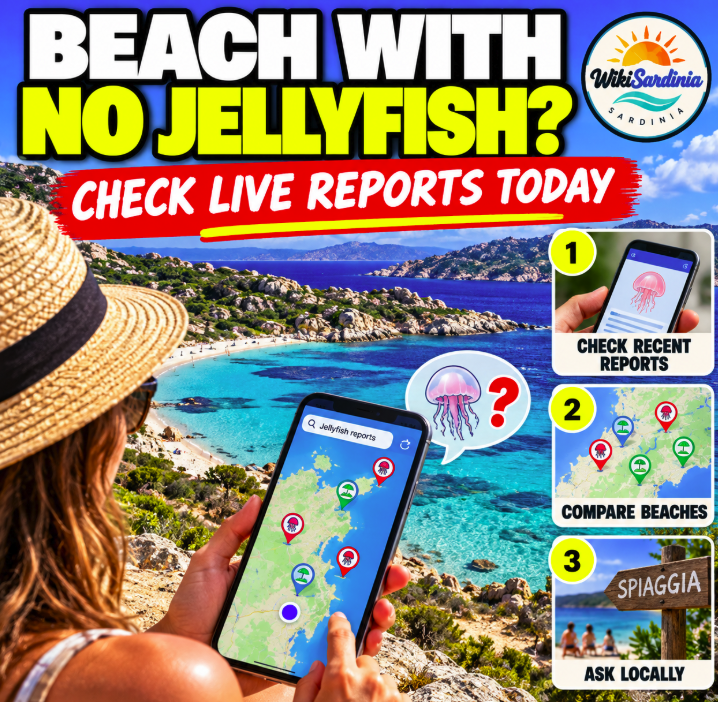
How can you find a Sardinian beach with no jellyfish today? Start by checking recent beach reports, not just a general weather forecast. Apps such as MedusApp and websites such as MeteoMeduse collect sightings from users, while some beach apps include live reports about jellyfish alongside wind, waves and water temperature. These tools can help you compare beaches, but no app can guarantee that a beach is jellyfish-free.
For a practical check before swimming, look at reports from the last few hours or days, confirm the exact beach, and ask a lifeguard or local beach operator when available. Jellyfish can move with currents and wind, so conditions can change after a report is posted.
Best tools to check jellyfish reports in Sardinia
1. MedusApp
MedusApp lets users report jellyfish sightings and offers a map of observations, including reports of beaches without jellyfish in recent days. Its app-store description says sightings can help researchers and includes first-aid information for stings. Reports are community observations, not a guarantee of current conditions.
Find it on the Apple App Store or search for MedusApp in your phone's app store.
2. MeteoMeduse
MeteoMeduse.it provides a map and database of submitted jellyfish sightings. You can review the date, location, species and reported density where that information is available. Check how recent the reports are: a report from weeks ago cannot establish whether a beach is clear today.
Open MeteoMeduse and inspect the map and report dates.
3. Spiaggiami Sardegna
Spiaggiami Sardegna provides a map and beach information for Sardinia, including user-submitted reports about jellyfish, seaweed, crowding and other conditions. It also lists wind, waves and sea temperature, which are useful for choosing a beach overall. These environmental readings do not predict jellyfish presence with certainty.
See the Spiaggiami Sardegna listing on Google Play for current features and availability.
How to check whether a beach is clear today
- Choose the exact beach. “Chia” or “Costa Smeralda” covers many different stretches of coast; check the specific cove or beach you plan to visit.
- Check the timestamp. Give more weight to a recent report than an old sighting or a general seasonal article.
- Look for both sightings and absence reports. A lack of reports does not mean there are no jellyfish; it may simply mean nobody has reported anything.
- Compare nearby beaches. Wind and currents can affect different coves differently, but nearby beaches are not guaranteed to share the same conditions.
- Check locally before entering the water. Ask lifeguards or beach staff and observe warning signs and any official instructions.
Can an app show “no jellyfish” in real time?
Usually, apps show submitted observations, recent reports or estimates—not a continuous scientific scan of every metre of shoreline. A green marker or an empty map area should be treated as helpful context, not proof of absence.
For example, MeteoMeduse displays dated user submissions and reports of absence. Its own historical notes explain that an absence report does not imply the beach will remain free of jellyfish the following day. Always check the date and time of the information you use.
Which Sardinian beaches have no jellyfish today?
There is no reliable island-wide list that can guarantee a jellyfish-free beach for today, 11 October 2026. Conditions can change quickly, and the reports available online may be sparse or out of date. Rather than inventing a “clear” beach, check the live reports for the area where you are staying and compare several nearby options.
If you tell us whether you are near Alghero, Stintino, Olbia, Pula or another area, you can narrow the check to beaches nearby—but even a fresh report cannot guarantee conditions when you arrive.
Does wind or sea temperature predict jellyfish?
Wind, currents, waves and water conditions can influence where jellyfish are observed, but there is no simple rule that reliably predicts a jellyfish-free beach. A calm sea is not necessarily free of jellyfish, and rough water does not mean they are absent.
Use weather and marine forecasts to assess swimming conditions, then use sightings and local advice for jellyfish information. These are different questions.
What should you do if you see a jellyfish?
Do not touch it, even if it appears dead or stranded. Keep children and pets away, and notify a lifeguard or beach staff if appropriate. Follow local warning signs and do not swim through a visible cluster.
If someone is stung, follow local first-aid guidance and seek assistance from a lifeguard. Treatment can depend on the species; avoid rubbing the area or using folk remedies. For severe symptoms such as breathing difficulty, collapse or a serious allergic reaction, call 112 in Italy.
Can you trust a photo or a social media post?
A photo can help identify a species, but it may be old, posted from a different beach or incorrectly located. Check the post date, location and whether the observation was confirmed. Do not make a long drive based on an undated image or a claim that a beach is “100% jellyfish-free.”
Quick checklist before swimming
- Check MedusApp, MeteoMeduse or a beach app with user reports.
- Confirm that the observation is recent and refers to the exact beach.
- Remember that no reports is not the same as no jellyfish.
- Ask a lifeguard or local beach staff where available.
- Follow warning flags and official instructions.
- Recheck when you arrive because conditions can change.
Frequently asked questions
What is the best app to find beaches without jellyfish in Sardinia?
Try MedusApp for community sightings, MeteoMeduse for a dated sighting map, and Spiaggiami Sardegna for broader beach conditions and user reports. None can guarantee a jellyfish-free swim.
Is MeteoMeduse live?
It displays submitted observations with dates and locations. Check the latest timestamp; it is not a guarantee of real-time monitoring at every beach.
Does MedusApp show beaches without jellyfish?
Its app-store description includes reports of beaches without sightings in recent days, alongside jellyfish observations. Treat these as community reports rather than proof of absence.
Are there definitely no jellyfish at Chia or La Pelosa today?
This guide cannot verify that either beach is free of jellyfish at this moment. Check recent location-specific reports and ask locally before swimming.
Does a green marker mean the beach is safe?
Not necessarily. It may represent a recent report or an app's summary, not a guarantee. Check what the marker means and when the information was submitted.
Can I swim if I see one jellyfish?
Do not swim through a visible cluster. Ask a lifeguard or local staff and follow any warnings; the safest choice depends on the number of animals and local conditions.
What if I am stung?
Leave the water, seek lifeguard assistance and follow appropriate first-aid guidance. Call 112 for severe or life-threatening symptoms.
The bottom line
To find a beach with fewer reported jellyfish in Sardinia today, check recent, location-specific reports in MedusApp, MeteoMeduse or Spiaggiami Sardegna, then verify locally. These tools help you make a more informed choice, but no app can promise that a beach is jellyfish-free. Reports can be delayed, and currents can change conditions quickly.
Sources and live tools
MedusApp — app listing and community sightings; MeteoMeduse — jellyfish report map; Spiaggiami Sardegna — beach conditions and reports; ARPAS — official marine bulletin for sea conditions, not jellyfish counts.