
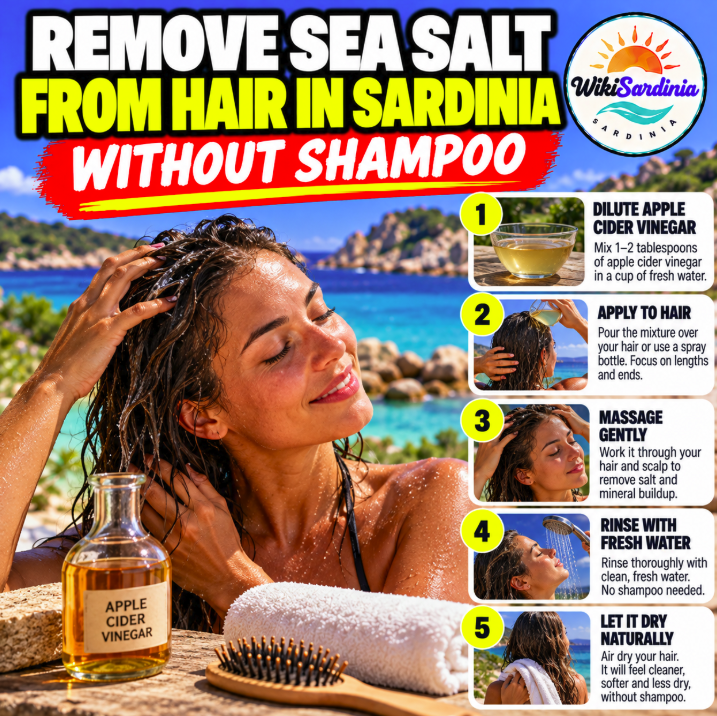
Just left the beach in Sardinia and your hair feels stiff with sea salt, but you don't want to use shampoo? The simplest option is usually to rinse your hair thoroughly with fresh, lukewarm water, gently massage your scalp with your fingertips and let the water carry away the salt. You often do not need apple cider vinegar—or any special product—to remove salt after a swim.
How to get sea salt out of your hair without shampoo
- Rinse with fresh water. Use a shower or clean tap water and rinse from the scalp to the ends for a few minutes.
- Massage gently. Use the pads of your fingers, not your nails, to loosen salt around the scalp and hairline.
- Separate thick or curly hair into sections. This helps water reach the roots and inner layers.
- Detangle carefully. Use your fingers or a wide-tooth comb, starting at the ends and working upwards. Avoid pulling on knots.
- Blot with a towel. Press gently instead of rubbing, which can cause tangles and friction.
- Let it dry naturally if practical. If you use a hair dryer, choose a moderate or cool setting and avoid excessive heat.
Does apple cider vinegar remove sea salt?
Apple cider vinegar is sometimes recommended as a hair rinse, but it is not necessary for removing sea salt. Fresh water is the gentler first choice. Vinegar is acidic and may irritate the scalp, eyes or sensitive skin, particularly if used undiluted or if you have scratches or sunburn. It can also dry or irritate some hair types.
If your scalp is sensitive, itchy, sunburned or irritated, skip vinegar and rinse with fresh water. Never apply it to the eyes, and stop using any rinse that causes burning or discomfort. Do not mix vinegar with other hair or cleaning products.
Will rinsing with water alone work?
For salt left by a swim, a thorough fresh-water rinse often removes most of it. If your hair still feels coated or greasy because of sunscreen, oils or styling products, water alone may not remove all the residue; use a gentle shampoo when you can. You do not need to scrub aggressively to make the hair feel clean.
What if you are at the beach without a shower?
- Use a bottle of clean fresh water to rinse the hairline and the lengths as best you can.
- Keep salt-heavy hair loosely tied rather than pulling it into a tight style.
- Avoid brushing forcefully while the hair is tangled.
- Rinse properly when you reach your accommodation.
Do not rely on another seawater rinse to remove salt: seawater can leave additional salt behind as it evaporates.
How to protect your hair after swimming in Sardinia
Salt water, sun, wind and repeated swimming can leave hair dry or tangled. Before swimming, you can wet your hair with fresh water so it absorbs less seawater, and use a hat or other suitable sun protection when you are out of the water. After swimming, rinse promptly and apply conditioner to the lengths if your hair needs extra moisture.
If your hair is bleached, colour-treated, curly or especially dry, be gentle with detangling and limit high heat. A leave-in conditioner can help with manageability, but it is optional.
Useful Italian phrases
- Posso usare la doccia per sciacquare i capelli? — Can I use the shower to rinse my hair?
- C'è una doccia con acqua dolce? — Is there a fresh-water shower?
- Vorrei sciacquare via il sale dai capelli. — I'd like to rinse the salt out of my hair.
Frequently asked questions
What is the quickest way to remove sea salt from hair without shampoo?
Rinse thoroughly with fresh, lukewarm water and gently massage the scalp with your fingertips. Detangle carefully afterward.
Is apple cider vinegar good for removing salt from hair?
It is not necessary. Fresh water is the gentler first option, while vinegar may irritate sensitive skin or the scalp, especially when undiluted.
Can sea salt damage your hair?
Repeated exposure combined with sun, wind and friction can leave hair feeling dry or tangled. Rinsing after swimming and conditioning when needed can help.
Can I just let salt water dry in my hair?
You can, but as the water evaporates, salt remains on the hair and may make it feel stiff or gritty. Rinsing with fresh water is a better option.
Should I brush my hair while it is wet?
Be gentle. Use your fingers or a wide-tooth comb, start at the ends and work upwards to reduce pulling and breakage.
The bottom line
To get sea salt out of your hair without shampoo, rinse thoroughly with fresh water, massage gently and detangle carefully. Apple cider vinegar is not needed and may irritate sensitive or sunburned skin. If sunscreen or other residue remains, use a gentle shampoo when available.


