
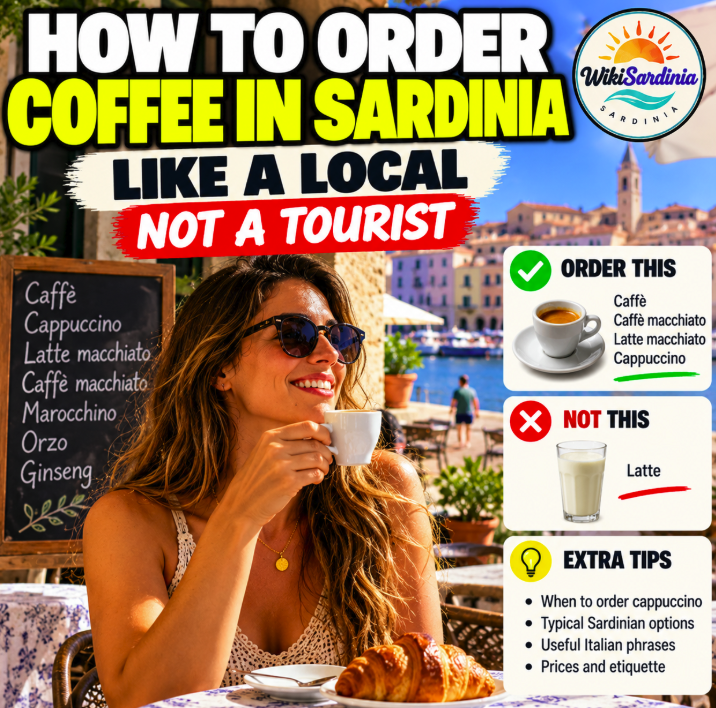
Want to order coffee in Sardinia without sounding like a confused tourist? Start with the word caffè. In an Italian bar, if you simply ask for un caffè, you will usually get an espresso. If you want milk, say what kind of coffee you mean: un cappuccino, un caffè macchiato or un latte macchiato.
One important tip: in Italian, latte means milk. If you ask for “a latte” in a bar, you may receive a glass of milk rather than the milky coffee you expected. Order the full drink name to make your request clear.
The quickest way to order coffee in Sardinia
- Un caffè, per favore. — An espresso, please.
- Un caffè macchiato, per favore. — An espresso with a little milk.
- Un latte macchiato, per favore. — Hot milk with a shot of espresso.
- Un cappuccino, per favore. — Espresso with steamed milk and foam.
- Un caffè decaffeinato. — A decaf coffee.
- Un caffè doppio. — A double espresso.
Add per favore (“please”) and grazie (“thank you”). A simple, friendly order is all you need.
Why you should not order just “latte”
Latte is the Italian word for milk, not the standard name for a latte-style coffee. To ask for a milky coffee, specify the drink: latte macchiato is milk “marked” with coffee, while caffè macchiato is coffee “marked” with a little milk.
These drinks are not identical. If you want mostly milk with some coffee, choose latte macchiato. If you want an espresso with just a splash of milk, choose caffè macchiato.
How to order like a local at the bar
Many Italians stop at the counter for a quick espresso. You can say “Buongiorno, un caffè, grazie” and then drink it at the counter. Routines vary by bar, and some places ask customers to pay at the till first, so follow the signs or watch what other customers do.
If you are unsure, ask: “Si paga alla cassa o al banco?” — “Do I pay at the till or at the counter?”
Espresso, cappuccino and macchiato: what is the difference?
- Caffè: usually a single espresso.
- Caffè macchiato: espresso with a small amount of milk or milk foam.
- Latte macchiato: a larger serving of milk with espresso added.
- Cappuccino: espresso with steamed milk and a layer of foam.
- Caffè lungo: espresso extracted with more water.
- Caffè ristretto: a shorter, more concentrated espresso.
- Caffè corretto: espresso with a small amount of liquor; ask what spirit is used.
Can you order a cappuccino after lunch?
Of course. The idea that Italians never drink cappuccino after breakfast is a cultural generalization, not a rule enforced by cafés. Many people prefer espresso after a meal, but bars will usually serve cappuccino later in the day too. Order what you enjoy.
How to order iced coffee in Sardinia
If you want a cold coffee, ask for un caffè freddo or ask the barista what cold coffee options are available. Crema al caffè is a chilled, creamy coffee dessert sold at some bars, particularly in warmer months, but it is not the same as an iced espresso.
Availability varies by café and season. If you want coffee over ice, you can ask: “Posso avere un caffè con ghiaccio?” — “Could I have a coffee with ice?”
What if you want coffee with plant-based milk?
Ask whether the bar has oat, soy or almond milk: “Avete latte d’avena?”, “Avete latte di soia?” or “Avete latte di mandorla?”. Availability varies, especially in smaller bars. If you have an allergy, state it clearly rather than relying only on the name of the drink.
Should you drink coffee standing at the counter or sit down?
Both are normal. A quick espresso at the counter is common, while sitting at a table may involve a different price or service charge. Check the menu or posted prices if the difference matters to you. Practices vary between cafés and tourist areas.
Useful coffee phrases in Italian
- Buongiorno! — Good morning / hello.
- Un caffè, per favore. — An espresso, please.
- Un latte macchiato, per favore. — A latte macchiato, please.
- Senza zucchero. — Without sugar.
- Con poco zucchero. — With a little sugar.
- Decaffeinato, per favore. — Decaf, please.
- Da portare via. — To take away.
- Posso pagare con carta? — Can I pay by card?
- Il conto, per favore. — The bill, please.
- Grazie, buona giornata! — Thanks, have a nice day!
A sample coffee order
Visitor: “Buongiorno, un latte macchiato e un caffè, per favore.”
Barista: “Certo.”
Visitor: “Grazie!”
That means: “Good morning, a latte macchiato and an espresso, please.” No elaborate phrasebook needed—clear words and a smile are enough.
Frequently asked questions
What should I order if I just want a coffee in Sardinia?
Say “un caffè, per favore”. In a typical Italian bar, that means an espresso.
Does “latte” mean coffee in Italy?
No. Latte means milk. Specify latte macchiato or another full drink name if you want coffee with milk.
What is the difference between caffè macchiato and latte macchiato?
Caffè macchiato is espresso with a little milk; latte macchiato is mostly milk with espresso added.
Can I order a cappuccino in the afternoon?
Yes. It may be less typical for some locals after a meal, but cafés generally serve it throughout the day.
How do I ask for decaf?
Say “un caffè decaffeinato, per favore”.
How do I ask for coffee with oat milk?
Say “Avete latte d’avena?” — “Do you have oat milk?”
Is coffee cheaper at the counter?
It can be, but pricing and service charges vary by café. Check the displayed menu.
How do I ask for iced coffee?
Ask for “un caffè freddo” or “un caffè con ghiaccio”.
The bottom line
In Sardinia, order “un caffè” for an espresso—and do not ask for just “latte” if you want a milky coffee. Choose caffè macchiato for espresso with a little milk or latte macchiato for mostly milk with coffee. Say per favore, thank the barista, and enjoy your coffee like you belong at the counter.


