
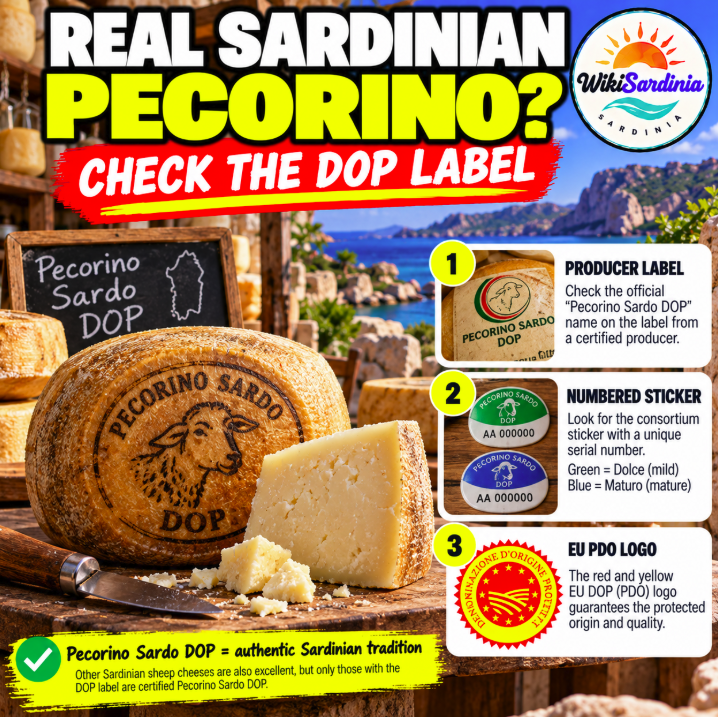
Buying pecorino in Sardinia and want to know whether it is genuinely Sardinian? Start by checking the exact name on the label. If the cheese is sold as Pecorino Sardo DOP (Protected Designation of Origin), look for the official DOP identification marks and traceability details—not just a picture of sheep, a Sardinian flag or the words “made in Sardinia.”
One important distinction: not every sheep's-milk cheese made in Sardinia is Pecorino Sardo DOP. The DOP name is protected and has specific production requirements. Other local sheep cheeses can be genuine Sardinian products without being entitled to use that particular designation.
1. Look for the Pecorino Sardo DOP label
The official Pecorino Sardo Consortium says the retail identification system includes three elements: the producer's label featuring the Pecorino Sardo DOP mark, a numbered sticker issued by the Consortium that identifies the individual cheese wheel, and the EU PDO/DOP logo. The numbered sticker is green for Dolce and blue for Maturo. Check the label carefully, especially when buying a whole wheel or a portion cut at the counter.
See the Consortium's official guide: Come riconoscerlo — Pecorino Sardo.
2. Check the identifying mark and traceability code
Compliant Pecorino Sardo DOP wheels are marked with an indelible food-ink stamp showing “PS DOP” and the producer's identification code. The stamp may be on the side or flat face of the wheel. Because processing and cutting can make the stamp no longer visible, the product label must provide traceability when that happens.
For packaged portions, check that the label and identification information are present. A loose wedge without its original outer label is not automatically fake, but you have less information to verify—ask the seller to show the original packaging or traceability details.
3. Know the difference between Pecorino Sardo Dolce and Maturo
- Pecorino Sardo Dolce: the milder variety, matured for 20–60 days; its Consortium identification sticker is green.
- Pecorino Sardo Maturo: the more mature variety, matured for at least two months; its Consortium identification sticker is blue.
Colour, rind and texture change with maturation, so appearance alone cannot prove authenticity. Use the official label and traceability system instead of trying to identify DOP status by taste or colour.
4. Don't rely on the word “pecorino” alone
Pecorino generally refers to sheep's-milk cheese. A product may be made in Sardinia and still not qualify as Pecorino Sardo DOP; likewise, “Sardinian-style” or a pastoral image does not itself certify origin. Read the full name, ingredients, producer details and any protected designation on the label.
If you specifically want the protected product, look for the exact designation Pecorino Sardo DOP and its identification marks. If you want any good local sheep cheese, ask the seller where it was produced and whether it is DOP or another Sardinian specialty.
5. What if you're buying from a market or cheese counter?
At a market, deli or cheese shop, ask to see the original label or packaging before a wheel is cut. If buying a portion, check the label on the wrapping and ask whether it is Pecorino Sardo DOP. A reputable seller should be able to explain the product and its origin without making vague claims.
Useful Italian phrase: “È Pecorino Sardo DOP? Posso vedere l'etichetta e il codice di tracciabilità?” — “Is this Pecorino Sardo DOP? May I see the label and traceability code?”
6. Can taste or price reveal a fake?
No single taste, smell, texture or price test can reliably establish whether a cheese is authentic DOP. Pecorino varies with age, production and storage. An unusually cheap price may be a reason to ask more questions, but it is not proof of fraud.
The strongest practical check is the official designation and traceability information. If the labelling seems inconsistent or the seller cannot clarify a claim, choose a clearly labelled product or contact the Consortium for guidance.
7. What to do if you suspect mislabelling
Keep the receipt, take clear photos of the label and packaging, and note the seller and purchase date. Ask the seller for clarification first. If you still suspect that a protected designation is being misused, contact the Consorzio per la Tutela del Formaggio Pecorino Sardo, whose official role includes protecting the designation against misuse and counterfeiting.
Useful Italian phrases
- È Pecorino Sardo DOP? — Is it Pecorino Sardo DOP?
- Posso vedere l'etichetta originale? — Can I see the original label?
- Ha il bollino numerato del Consorzio? — Does it have the Consortium's numbered sticker?
- È Dolce o Maturo? — Is it the mild or mature variety?
- Da quale caseificio proviene? — Which dairy does it come from?
Frequently asked questions
How can I tell if Pecorino Sardo is authentic?
Check for the exact Pecorino Sardo DOP designation, the producer's label, the Consortium's numbered identification sticker and the EU PDO logo. Traceability details matter more than appearance alone.
Is every pecorino made in Sardinia DOP?
No. Sardinia produces other sheep's-milk cheeses too. The protected name Pecorino Sardo DOP is reserved for cheese that meets the official production specification.
What do the green and blue stickers mean?
The Consortium identifies Pecorino Sardo Dolce with a green numbered sticker and Pecorino Sardo Maturo with a blue one.
What if the stamp is not visible on a cut piece?
The stamp may no longer be visible after processing. Check the retail label and traceability details, and ask the seller to show the original packaging if needed.
Can I identify fake pecorino by taste or price?
No. Taste and price are not reliable proof of DOP authenticity. Check the protected designation and traceability information.
The bottom line
To check whether a cheese is genuine Pecorino Sardo DOP, look for the official DOP label, the Consortium's numbered sticker and the EU PDO logo. Ask for traceability details if buying a cut portion. Remember that a different Sardinian pecorino can still be a genuine local cheese—it simply may not be the protected Pecorino Sardo DOP.
Official sources
Pecorino Sardo Consortium — How to recognise it; Consortium — Protection against misuse and counterfeiting; European Commission / EUR-Lex — Pecorino Sardo PDO specification.


