Driving through Sardinia’s Gennargentu mountains can mean steep climbs, tight bends and warm weather—all of which can put extra demand on a car’s engine. If the temperature gauge starts creeping up on an uphill stretch, a few sensible steps may help you reduce the load and decide when to stop. But remember: an overheating engine can signal a mechanical problem, and switching off the air conditioning is not a cure.
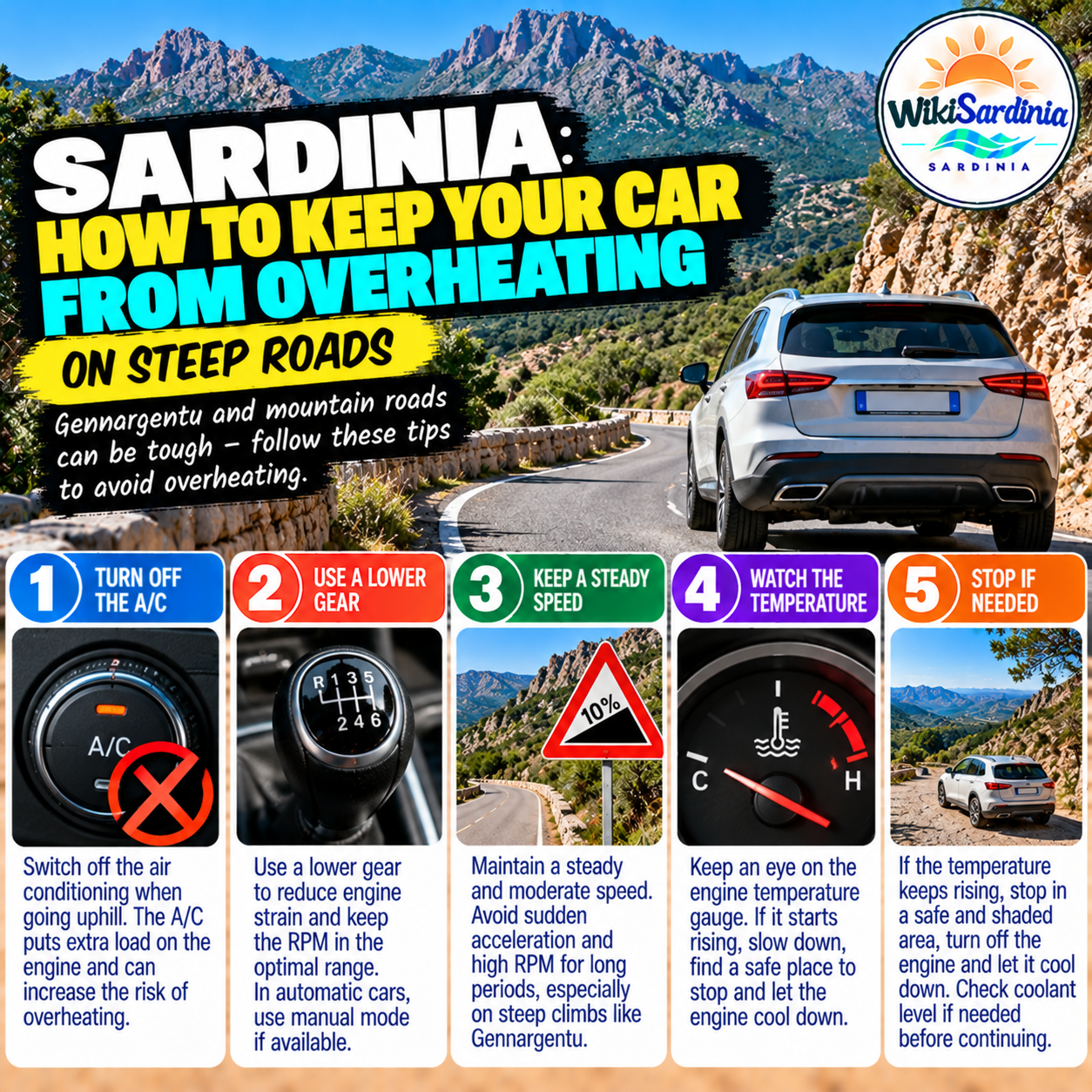
1. Switch off the air conditioning
If the engine is working hard on a long climb, turn off the A/C temporarily. The compressor adds load, so switching it off may help reduce the demand on the engine. It will not resolve a faulty cooling system, low coolant or another mechanical issue, so keep watching the temperature gauge.
2. Use the right gear
On steep roads, select a gear that lets the engine climb smoothly without labouring or revving excessively. In a manual car, change down when needed rather than pressing the accelerator hard in a gear that is too high. In an automatic, use the manufacturer’s recommended hill-driving mode or lower gear setting if available.
Do not coast downhill in neutral. Use an appropriate gear and follow the vehicle handbook for mountain driving.
3. Drive steadily and avoid unnecessary strain
Maintain a controlled, moderate pace suited to the road, visibility and traffic. Avoid repeated hard acceleration, and do not push the car to maintain speed if it is clearly struggling. Never drive faster than is safe just to get to the top of a climb.
4. Watch the temperature gauge and warning lights
Keep an eye on the engine temperature display, warning lights and any unusual steam, smells or loss of power. If the gauge rises above its normal range or a temperature warning appears, reduce engine load and look for a safe place to pull over as soon as possible. Do not continue climbing in the hope that the warning will disappear.
5. If the engine overheats, stop safely
Pull over somewhere safe and away from moving traffic, using hazard lights if appropriate. Follow the vehicle handbook’s instructions for an overheating warning. If there is steam, a red temperature warning or the gauge is in the danger zone, switch the engine off when safely stopped and let it cool. Keep people away from traffic and hot engine components.
Never remove the radiator cap or coolant reservoir cap while the engine is hot. Pressurised coolant can erupt and cause severe burns. Do not pour cold water over a hot engine. If the warning persists, coolant is leaking, or steam continues, call roadside assistance rather than risking further damage.
Can turning on the heater help?
In some vehicles, setting the cabin heater to hot can temporarily draw heat away from the engine. This can be uncomfortable, especially in Sardinian summer weather, and it is only a short-term measure to help you reach a safe stopping place—not a reason to continue a long climb. If the temperature is in the danger zone, stop safely instead.
Before driving into the Gennargentu
- Check coolant level only when the engine is completely cool, following the vehicle handbook.
- Check that the vehicle has been serviced and that the cooling system is in good condition.
- Carry drinking water for passengers, but do not use it to refill a hot cooling system.
- Plan breaks and avoid pushing a heavily loaded vehicle harder than necessary.
- If you are driving a rental car and see a warning, contact the rental company or roadside assistance.
The key rule for mountain driving in Sardinia
Switching off the A/C can reduce engine load during a climb, and using the correct gear helps the car work more comfortably. But if the temperature keeps rising, a warning light appears or steam is visible, stop at a safe place and get help. Protecting the engine—and your passengers—is more important than reaching the summit.