
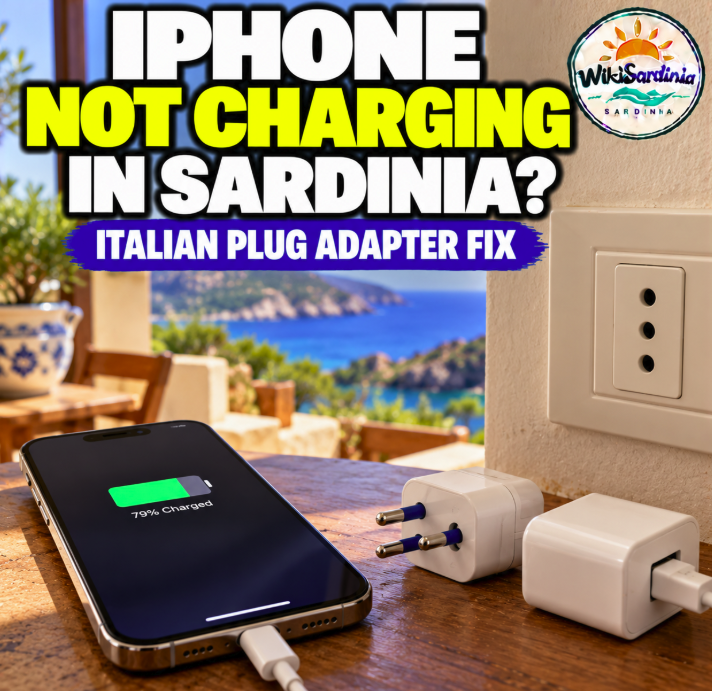
Your iPhone is not charging in Sardinia after you plug it into a travel adapter. What should you do? First, don't panic: Sardinia uses the same electricity system and plug standards as the rest of Italy. In most cases, the problem is the wall adapter, charger, cable, outlet or charging port—not a special “Sardinian voltage.”
For travelers arriving from the United States, Canada, the United Kingdom or Australia, the quickest solution is often to use a reliable USB-C wall charger with a plug designed for Italian outlets. Before buying anything, check the charger label and try a different known-working outlet.
Quick fix: iPhone not charging in Sardinia
- Unplug everything. Check for loose connections, damage, excessive heat or a burning smell. Stop using anything that looks damaged.
- Try a different wall outlet that you know works, preferably one without a hotel room switch or bedside control.
- Check the travel adapter. Does it fit firmly? Is it suitable for the exact socket? Some universal adapters make poor contact.
- Check the power brick. Look for “INPUT: 100–240V ~ 50/60Hz.” If your charger has this range, it is designed for Italian mains voltage.
- Try a different cable and USB charger if you have one. Use a reputable, safety-compliant product.
- Check the iPhone screen. A liquid-detection warning requires different steps from a completely unresponsive phone.
- Allow charging time. If the battery is fully drained, leave it connected to a known-working charger for a while before assuming it is broken.
Safety first: Never force an adapter into a socket, bypass an earth connection or use a damaged electrical product. Ask your accommodation host or a qualified professional to address a faulty wall outlet.
What plug type does Sardinia use?
Sardinia uses the Italian electrical system. The mains supply is nominally 230 volts, 50 hertz, and common socket arrangements include Type C, Type F and Type L.
Type C has two round pins. Type F, often called Schuko, has two round pins and side earthing contacts. Type L is the characteristic Italian three-round-pin plug in a straight line; different Type L sizes exist, so not every adapter fits every outlet.
Hotels, holiday apartments and older houses can have different combinations of sockets. That is why an adapter that worked in another European country may not fit properly into every Italian wall outlet.
For official country guidance, see Italia.it's practical travel information.
Do you need a voltage converter for an American iPhone?
Usually no. Apple's USB power adapters are designed for 100–240V AC at 50–60Hz, which covers both North American and Italian mains supplies. Many reputable third-party phone chargers are similarly universal, but always verify the printed input rating on the actual charger.
A plug adapter changes the physical connection between a foreign plug and an Italian outlet. It does not convert voltage. A voltage converter is a different device, and you should not use a 120V-only charger on 230V mains through a simple plug adapter.
Read the label before connecting an unfamiliar power supply. Apple explains the input range in its USB power adapter support guide.
Why does the adapter fit but the iPhone still won't charge?
A plug fitting into a socket does not guarantee electrical contact. Some inexpensive universal travel adapters have loose internal contacts, poorly aligned pins or unreliable USB ports.
Try removing the travel adapter from the setup by using a locally compatible, reputable USB-C wall charger directly in the socket. If the iPhone charges normally, the original adapter or its connection was likely the problem.
Do not repeatedly wiggle a loose plug while it is powered. Replace an adapter that sparks, overheats or fails to make secure contact.
Hotel room electricity: a common overlooked problem
Some hotels use a card-controlled power system. Removing the room card can switch off certain outlets, even if another outlet remains active. Bedside sockets may also be controlled by a switch.
Before deciding your iPhone or charger is broken, test the socket with another small device or ask reception whether that outlet is active. Never attempt to repair a hotel outlet yourself.
USB-C versus Lightning: check your cable
iPhone models use different charging connectors. Newer models use USB-C, while many earlier models use Lightning. Your wall charger may have a USB-C or USB-A port, so the cable must match both the charger and the phone.
If you borrowed a cable from another traveler, check that it is intended for charging and is undamaged. A cable that works for one device is not necessarily in good condition or compatible with every charging arrangement.
What if the iPhone says “Liquid Detected”?
This is especially relevant after a day at Chia, La Pelosa, Cala Brandinchi or another Sardinian beach. Sea spray, rain or moisture in the USB-C or Lightning connector can trigger a liquid-detection warning.
Disconnect the charging cable immediately. Apple advises gently tapping the iPhone against your hand with the connector facing down, then leaving it in a dry place with airflow. After at least 30 minutes, you may try again; full drying can take up to 24 hours.
Do not use a hairdryer, compressed air, rice, cotton swab or another object inside the port. Do not override the warning just to continue ordinary charging. If the phone and its back are dry and your model supports it, wireless charging may be an option. See Apple's liquid-detection instructions.
Could sand be blocking the charging port?
Fine sand, lint or debris can interfere with a charging connection. If the cable does not seat normally, do not force it and do not poke metal objects or sharp tools into the port.
Disconnect the charger and inspect the connector visually in good light. If debris appears lodged inside, ask an authorized service provider or qualified repair technician to assess it rather than risking damage to the charging pins.
Why does the battery percentage stay the same?
An iPhone can appear to be charging while the battery percentage rises very slowly, particularly if it is running navigation, mobile data, video or other power-hungry apps. High temperatures can also affect charging behavior.
Move the phone out of direct sunlight, stop demanding apps and let it cool naturally before trying again. Avoid leaving an iPhone on a hot car dashboard or in direct midday sun.
For faster charging, Apple recommends compatible USB-C Power Delivery equipment with wattage appropriate to your iPhone model. A 20W USB-C charger is a common practical choice for many models, although requirements and peak charging rates differ.
What if the phone shows no charging symbol?
Try a known-good cable, wall charger and outlet. If the battery is completely empty, allow some time for a response. If it still shows no signs of life, consult Apple's official charging troubleshooting guidance or an authorized service provider.
Do not conclude that the electrical system in Sardinia is incompatible with your iPhone. The fault is much more likely to involve the individual charger, cable, outlet, port or device.
Where can you buy a replacement charger in Sardinia?
Look for a reputable electronics shop, mobile-phone retailer or established supermarket with an electronics department. In larger towns such as Cagliari, Sassari, Olbia and Alghero, travelers may have more options than in remote beach villages.
Ask for “un caricabatterie USB-C con spina italiana”—a USB-C charger with an Italian plug—and confirm the output and cable you need. Do not buy an unknown charger solely because it is cheap.
Check opening hours before traveling, particularly on Sundays or during public holidays. A hotel receptionist or accommodation host may also be able to lend a suitable charger temporarily.
Which adapter should American travelers bring?
For a typical modern Apple charger labeled 100–240V, bring a good-quality travel plug adapter compatible with Italian sockets or buy a reputable European/Italian USB-C charger. If your equipment requires earthing, make sure the adapter preserves the necessary earth connection.
A simple two-pin adapter can be appropriate for some double-insulated phone chargers, but not for every appliance. Always follow the charger manufacturer's safety instructions.
Do you need a special Sardinia adapter?
No. An adapter sold for Italy is suitable for Sardinia, provided it matches the socket and your equipment. There is no separate Sardinian electrical plug standard.
The phrase “Sardinian plug adapter” is a travel-search term, not the name of a unique local plug type.
Can you charge an iPhone from a rental car?
Yes, if the rental car has a compatible USB charging port or a suitable, reputable 12V car charger. Some built-in USB ports deliver limited power and may charge slowly, especially while the phone runs navigation.
Use a secure cable and avoid handling the phone while driving. If a rental car USB port does not charge the phone, that does not prove the iPhone's battery is faulty.
Can you use a power bank?
A reputable power bank with a compatible cable can be useful while you troubleshoot a hotel adapter. It also provides backup power during long beach days or drives across Sardinia.
For flights, lithium power banks are generally subject to carry-on restrictions and airline capacity limits. Check your airline's current rules before flying.
How to ask for help in Italian
- Il mio iPhone non si carica. — My iPhone won't charge.
- Avete un caricabatterie USB-C? — Do you have a USB-C charger?
- Mi serve un adattatore per la presa italiana. — I need an adapter for an Italian outlet.
- Questa presa funziona? — Does this socket work?
- Posso provare un altro cavo? — Can I try another cable?
- C'è un negozio di elettronica qui vicino? — Is there an electronics store nearby?
Frequently asked questions
Why won't my American iPhone charge in Sardinia?
The most common possibilities include an incompatible or loose travel adapter, a faulty outlet, cable or charger, or an issue with the phone's charging port. Sardinia uses Italy's normal electrical system.
Does Sardinia use different plugs from Italy?
No. Sardinia uses Italian plug and socket standards, including Types C, F and L.
What voltage does Sardinia use?
Nominally 230V AC at 50Hz.
Will a US Apple charger work in Sardinia?
Apple USB power adapters support 100–240V, 50–60Hz. Check the label on your specific charger and use a suitable plug connection.
Do I need a voltage converter for an iPhone?
Usually not when using a universal-input charger rated 100–240V. A plug adapter does not change voltage.
Why does my adapter work for a lamp but not my iPhone?
The charger, cable or USB connection may be faulty. Different devices may also use different power paths. Test with known-working equipment.
What if my iPhone says liquid detected?
Disconnect the cable and follow Apple's drying instructions. Avoid heat, compressed air, rice and objects inserted into the port.
Can I buy a charger in Alghero or Cagliari?
Both cities have electronics and mobile-phone retailers, but verify individual stores and opening hours before going.
Is it safe to use a universal travel adapter?
Only if it is properly rated, undamaged, suitable for the outlet and used according to its instructions. Poor-quality or loose adapters can be unsafe.
Will a 20W USB-C charger work?
A reputable compatible 20W USB-C charger can charge many iPhone models, provided the correct cable is used. Check Apple's recommendations for your model.
The bottom line
If your iPhone won't charge in Sardinia, check the adapter and wall outlet before blaming the phone. Italian electricity is nominally 230V/50Hz, and Apple's USB chargers generally support that range. A reliable locally compatible charger, a good cable and a working outlet solve many travel charging problems. If you see a liquid warning after the beach, disconnect and let the device dry according to Apple's instructions.
Sources
Italia.it — Italy practical information and sockets; Apple Support — USB power adapters; Apple Support — Liquid detection on iPhone; Apple Support — Fast charging iPhone.


