
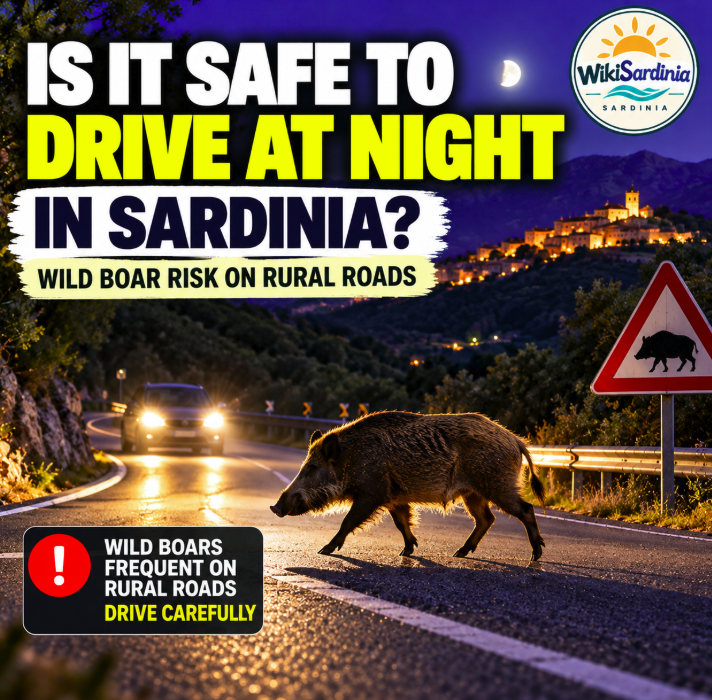
Yes, you can drive in Sardinia at night, but rural roads require extra care—especially where wild boars and other animals may cross unexpectedly. The island has modern main roads as well as winding inland routes with limited lighting, narrow shoulders and sharp bends. After sunset, visibility decreases and an animal can appear in the headlights with little warning.
If you are renting a car or planning to return from an inland village after dinner, the most useful advice is simple: reduce your speed to match what you can actually see, stay alert near wooded and agricultural areas, and avoid sudden steering movements if wildlife appears.
Are wild boars common in Sardinia?
Wild boars are part of Sardinia's wildlife and occur in a range of habitats, including wooded hills, scrubland and agricultural areas. Their presence does not mean every road is dangerous or that an encounter is inevitable, but drivers should expect the possibility of animals near rural routes.
Boars may move between feeding areas and cover, sometimes crossing roads without warning. They can be difficult to spot against dark vegetation, particularly on unlit stretches.
Why are wild boars a concern after dark?
Wild boars are often active during low-light periods and at night. Dusk and dawn are also times when drivers should be particularly watchful. A large animal entering the road can create a serious collision risk, especially if the vehicle is traveling too fast for the visible stopping distance.
Even when an animal is first seen near the roadside rather than on the road, it may move suddenly. If one boar crosses, others may be nearby, so do not accelerate immediately after the first animal passes.
Where should you be especially careful?
Take extra care on inland roads bordering woodland, dense scrub, fields and quiet countryside. Routes with repeated blind bends, roadside vegetation and little street lighting deserve particular attention.
Wildlife is not restricted to one province or one named road, and there is no reliable basis for promising that a specific inland route is boar-free. Pay attention to local animal-crossing signs and any current warnings from road authorities.
What makes Sardinian mountain roads different at night?
Many scenic inland roads have curves, changes in elevation and limited opportunities to stop safely. Outside built-up areas, lighting may be absent. After rain, the road surface can become slippery, while mist or low cloud can reduce visibility at higher elevations.
On narrow sections, an approaching vehicle may also require extra space and caution. Drive according to the conditions, not simply the posted maximum speed.
How to drive more safely when wildlife may be present
- Slow down before bends and wooded stretches. Choose a speed that lets you stop within the distance illuminated by your headlights.
- Watch both road edges. Scan for movement or reflected eyes without taking attention away from the lane ahead.
- Leave more following distance. Extra space gives you time to brake if the vehicle ahead reacts to an animal.
- Use headlights correctly. Follow Italian road rules and dip high beams when they could dazzle others.
- Brake firmly and progressively when safe. Avoid an uncontrolled swerve into oncoming traffic, a tree or a drop-off.
- Expect additional animals. Do not assume the road is clear after one boar crosses.
- Avoid distractions. Set navigation before departure and never handle a phone while driving.
- Rest if tired. Fatigue can make nighttime hazards harder to detect and respond to.
Should you swerve to avoid a wild boar?
Sudden evasive steering can cause a driver to lose control, enter the opposite lane or leave the road. The safest response depends on speed, traffic and available space, but controlled braking while maintaining vehicle stability is generally preferable to a reflexive, dangerous swerve.
No single maneuver guarantees safety in every situation. Keep both hands on the wheel, focus on maintaining control and do not deliberately place other road users at risk.
What if a wild boar is standing in the road?
Slow down and stop at a safe distance if conditions permit. Do not attempt to push past the animal or get out to approach it. Wild boars are powerful wild animals and can behave unpredictably, particularly if startled or accompanied by young.
Wait for the road to clear. If you cannot safely proceed, consider turning around only where it is lawful and safe to do so.
What should you do after hitting an animal?
First, prioritize people and traffic safety. If you can safely stop, move the vehicle out of danger where possible, activate hazard lights and follow applicable Italian roadside safety rules. Do not stand in an exposed traffic lane.
Call 112 if anyone is injured, the collision creates an immediate danger or emergency assistance is needed. Explain your location, the road and any injuries. For a non-emergency wildlife collision, contact the appropriate local police or road authority for guidance on reporting and handling the animal.
Do not approach or attempt to move an injured wild boar. A wounded animal can be dangerous. Document the incident only if it is safe, and notify your rental company or insurer as required by your agreement.
Can a rental car be damaged by a boar collision?
Yes. Wild boars can be large and heavy enough to cause substantial vehicle damage. Coverage depends on the rental contract, insurance terms, exclusions and reporting requirements. Do not assume that every collision with wildlife is automatically covered by a basic rental package.
Before leaving the rental desk, check how animal collisions are handled, which emergency numbers to use and what evidence the company requires after an incident.
Are other animals a problem on Sardinian roads?
Yes. Depending on the area, drivers may also encounter sheep, goats, cattle, horses, dogs or other wildlife. Farm animals can appear on rural roads, and their behavior may be unpredictable.
Where livestock or wildlife warning signs are posted, reduce speed and remain alert even if the road initially looks empty.
Is it better to avoid driving at night?
You do not need to avoid all nighttime driving, but it is sensible to plan unfamiliar mountain or countryside routes during daylight when possible. This is especially helpful if you are tired after a long flight, uncomfortable with narrow roads or unfamiliar with the vehicle.
For a rural dinner or an inland excursion, consider allowing extra travel time and checking the route before leaving. A longer main-road route may be easier than a short but twisting mountain shortcut.
What about the main roads between Sardinian cities?
Major routes generally offer a different driving experience from minor rural roads, but they are not immune to animals, poor weather or nighttime hazards. Follow road signs, adapt your speed and avoid assuming that a wider road eliminates wildlife risk.
Practical checklist before an evening drive
- Check your route, estimated travel time and fuel level.
- Make sure headlights, windscreen and wipers are working properly.
- Charge your phone and set up navigation before departure.
- Allow extra time for narrow, winding or unlit sections.
- Keep emergency contact details and rental paperwork accessible.
- Do not drive after drinking alcohol.
- Choose daylight travel if you are exhausted or uncomfortable with the conditions.
FAQ
Is driving in Sardinia at night dangerous?
Night driving is possible, but some rural and mountain roads require extra caution because of limited lighting, bends and animals that may cross.
Are wild boars active at night in Sardinia?
They can be, and drivers should also be attentive around dusk and dawn.
Which roads have the most wild boars?
There is no verified island-wide ranking provided here. Take particular care on roads near woodland, scrub and agricultural land, and follow local warnings.
What should I do if a boar crosses in front of my car?
Reduce speed, brake while maintaining control and avoid a sudden maneuver that could create a more serious crash.
Can wild boars travel in groups?
Yes. After seeing one animal, continue to watch for others.
Should I get out to photograph a wild boar?
No. Do not approach wild boars, especially near traffic or when young animals may be present.
What number should I call after a serious accident?
Call 112 for an emergency in Italy, including injuries or an immediate danger requiring assistance.
Does rental insurance cover wildlife collisions?
Coverage varies. Check your rental contract and report incidents as required.
The bottom line
Driving in Sardinia at night is generally manageable with careful planning, but wild boars and other animals are genuine hazards on some rural roads. Slow down where visibility is limited, watch the road edges, keep a safe stopping distance and prioritize vehicle control over abrupt evasive steering. A little extra caution lets you enjoy Sardinia's inland villages and landscapes without unnecessary risk.


