
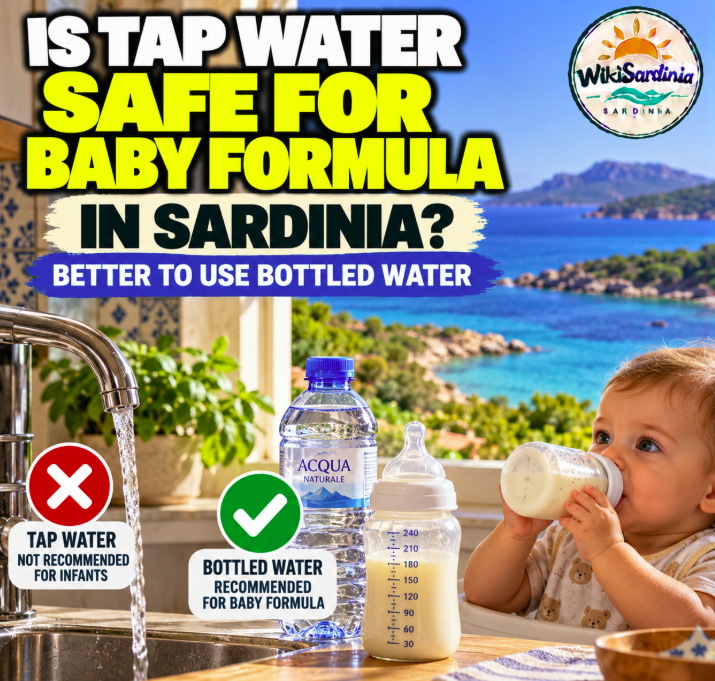
Is tap water in Sardinia safe for making baby formula? In many places, municipal tap water that is officially classified as potable can be used for infant formula when it is handled and prepared correctly. But parents should never assume that every tap, rural property, campsite or holiday rental has the same water supply. Check the local drinking-water status first, and follow safe formula-preparation instructions.
For families traveling with a newborn, bottled water may feel like the simpler option. It can be a practical choice when the tap-water status is uncertain, but bottled water is not sterile and does not remove the need to prepare powdered formula safely. This guide explains the difference and offers practical advice for a Sardinian holiday.
Is Sardinian tap water drinkable?
Sardinia has public drinking-water networks, and tap water supplied as potable water is subject to water-quality controls. However, the island is not one single water system. Different municipalities and neighborhoods can have different sources, maintenance conditions and temporary notices.
Water quality can also be affected by building plumbing, private tanks, cisterns or wells. In a holiday apartment, rural villa or campsite, ask the host whether the water comes from a monitored public drinking-water supply and whether any current non-potable water notice applies.
Do not use water subject to a non-potability order to prepare infant formula. Boiling does not necessarily make chemically contaminated water safe: it can kill many microbes, but it does not reliably remove substances such as nitrates, salts or certain metals.
Can you use potable tap water for powdered baby formula?
Often yes, provided the supply is safe and you follow the formula manufacturer's directions and relevant pediatric guidance. The crucial issue is not simply whether the water came from a tap or a bottle: powdered infant formula itself is not sterile.
Harmful bacteria, including Cronobacter, can occasionally be present in powdered formula. Babies younger than two months, premature infants and babies with weakened immune systems are at higher risk of serious illness. For these infants, ready-to-feed liquid formula is generally the safer choice when available and appropriate.
Why hot water matters when preparing powdered formula
The World Health Organization's guidance for reconstituting powdered infant formula recommends preparing feeds with water that is at least 70°C when it contacts the powder, to reduce the risk from bacteria that may be present in the powder. That means boiling safe water and allowing it to cool only briefly before mixing, rather than using water that has cooled completely.
Guidance differs between health authorities and formula products, especially for specialized formulas containing ingredients that may be affected by high temperatures. Follow advice from your baby's healthcare professional and the instructions for the specific product, particularly for medically prescribed formulas.
Never feed a baby formula at 70°C. The prepared bottle must be cooled to a safe feeding temperature before use.
How to prepare powdered formula safely on holiday
- Wash your hands and clean the preparation surface.
- Clean and sanitize bottles and feeding equipment as recommended for your baby's age and circumstances.
- Choose safe water from a confirmed potable supply or an appropriate bottled source; never use water with a current non-potability warning.
- Boil the water and, when following WHO's hot-water preparation method, let it cool briefly so it remains at least 70°C when mixed with the powder.
- Measure water first according to the formula label, then add the exact prescribed amount of powder. Never dilute or concentrate formula to stretch supplies.
- Mix carefully using the product's instructions, taking precautions against burns.
- Cool the sealed bottle rapidly under cool running water or in a container of cold water, keeping water away from the teat and inside of the bottle.
- Test the temperature before feeding. It should be comfortably warm or cool, never hot.
- Feed promptly and discard leftovers from a feeding.
For storage, follow the formula label and healthcare guidance. As a general CDC rule, use prepared formula within two hours of preparation and within one hour from the start of feeding; if not using it immediately, refrigerate promptly and use within 24 hours. Never leave prepared formula in a hot car or beach bag.
Is bottled water better for babies in Sardinia?
Not automatically. Commercial bottled water may be a convenient alternative if you are uncertain about a rental property's supply or are traveling through an area with a temporary water notice. But it is not sterile, and mineral composition varies widely between brands.
For infant formula, choose water appropriate for the baby's age and medical needs. If your pediatrician recommends low-mineral or low-sodium water, compare labels and follow that individualized advice. Do not assume that any bottle labeled acqua minerale naturale is automatically suitable for every infant.
Unless you are using a product specifically identified as sterile and intended for infant feeding, treat ordinary bottled water as nonsterile. The safety of powdered formula still depends on correct preparation.
What does “acqua oligominerale” mean?
In Italian shops, you may see labels such as acqua oligominerale, which refers to water with relatively low mineral content. Other useful label terms include naturale (still water) and frizzante (sparkling water).
Low mineral content is not the same as sterility. A label describing mineral composition does not replace the need for hygienic formula preparation or a pediatrician's advice where relevant.
Can you use water from a private well or tank?
Do not use water from a private well, storage tank or unknown source for infant formula unless it has been appropriately tested and confirmed suitable for drinking. Private supplies may not receive the same routine monitoring as public networks, and boiling does not remove all contaminants.
If your accommodation relies on a private source, ask for recent water-testing documentation. When that is unavailable, use a verified safe alternative and seek guidance from a healthcare professional if needed.
What if the tap water tastes unusual?
Chlorine taste or mineral flavor does not necessarily mean water is unsafe, just as clear and pleasant-tasting water is not proof of safety. Use official water-quality information rather than taste alone.
If water is discolored, smells strongly unusual, or there is a known supply interruption or local warning, avoid using it for formula until the water provider confirms its status.
Where can parents check Sardinian water alerts?
For a public supply, check the municipality's announcements and the relevant water provider, often Abbanoa in areas it serves. Local authorities may issue temporary ordinances or advisories after network problems or testing results.
Do not rely on a general statement that “Sardinian tap water is safe” if your exact street or accommodation is affected by a notice. Ask the property manager for the water supplier and current status.
Baby formula at the beach: what should you do?
Hot weather makes prepared formula storage especially important. Do not carry a mixed bottle around for hours in the sun. The safest practical option for many families is unopened ready-to-feed formula, when appropriate and available, because it avoids mixing powder in an environment with limited hygiene facilities.
If using powdered formula, plan access to clean equipment, safe water, accurate measurement and appropriate temperature control. Prepare feeds as close as possible to the time they are needed, and observe the product's storage limits.
What about hotels and holiday rentals?
Before arrival, ask whether the tap water is potable, whether the property uses a private tank or well, and whether there is a kettle or safe way to boil water. Ask how bottles can be cleaned and sanitized and whether a refrigerator is available.
If you are staying in a remote location, bring enough suitable formula and feeding supplies for the first day, rather than assuming that a nearby supermarket or pharmacy will stock your baby's usual brand.
Should you use a water filter?
A household filter is not a substitute for confirmed drinking-water safety. Different filters remove different substances, and poorly maintained filters can introduce contamination. Do not assume a jug filter, tap attachment or travel filter makes unknown water suitable for infant formula.
Use a verified potable source and follow the manufacturer's instructions for any equipment you use.
Are formula preparation machines safe?
Automated formula machines vary in how they heat, dispense and mix water. Some may not bring water into contact with powdered formula at the temperature recommended by WHO for reducing microbial risk.
Check the machine's instructions and your healthcare professional's advice. Do not assume that a machine's warm-water setting is equivalent to preparing powder with water at least 70°C.
Can you use cooled boiled water?
Cooled boiled water may be suitable for certain feeding situations, but mixing powdered formula with water that has cooled below 70°C does not provide the same reduction in potential bacteria within the powder as WHO's hot-water method.
For higher-risk infants, consult a pediatrician about using sterile ready-to-feed liquid formula. Always follow product-specific medical advice.
What if your baby becomes unwell?
Seek prompt medical advice if an infant develops fever, poor feeding, unusual lethargy, repeated vomiting or signs of dehydration. Very young babies with fever need urgent assessment. In an emergency in Italy, call 112.
This article provides general travel information and does not replace advice from your pediatrician or local health service.
Frequently asked questions
Is tap water in Sardinia safe for baby formula?
Potable public tap water can often be used when prepared correctly, but verify the exact local supply and any temporary restrictions. Never use water under a non-potability notice.
Should I buy bottled water for baby formula in Sardinia?
It can be practical if your accommodation's water status is uncertain, but bottled water is not sterile and must not be treated as a substitute for safe formula preparation.
Do I need to boil bottled water?
Ordinary bottled water is not sterile. Follow safe powdered-formula preparation guidance, including the recommended hot-water method where applicable.
Why does WHO recommend 70°C water?
Powdered formula is not sterile. Water at least 70°C when mixed with powder helps reduce the risk from harmful bacteria in the powder.
Can I use cold tap water directly?
Do not assume that mixing powdered formula with cold water provides the same microbial protection as hot-water preparation. Follow the baby's medical guidance and the product's instructions.
Is low-mineral water sterile?
No. “Oligominerale” describes mineral content, not sterility.
Can I use water from a Sardinian villa's tank?
Only if its quality has been appropriately verified. An unknown private supply should not be used for infant formula.
Is ready-to-feed formula safer for newborns?
Commercially sterile ready-to-feed liquid formula is generally the safer option for infants at higher risk, including very young, premature or immunocompromised babies.
Can I keep prepared formula in a beach cooler?
Only if it is kept at a reliably safe refrigeration temperature and used within recommended storage limits. A warm beach bag is not safe storage.
Where do I check water warnings?
Check the local municipality and the water supplier serving your accommodation, including Abbanoa where applicable.
The bottom line
You do not automatically need bottled water for baby formula in Sardinia. Confirm that your tap water is potable, avoid unknown private supplies, and follow careful formula-preparation procedures. Bottled water is a useful fallback in uncertain situations, but it is not sterile. For newborns and babies with particular medical needs, discuss the safest feeding method with your pediatrician before traveling.
Reliable guidance
World Health Organization — Safe preparation, storage and handling of powdered infant formula; CDC — Infant formula preparation and storage; Abbanoa — Sardinian water service and notices; Italian Ministry of Health. Consult current guidance and local drinking-water notices.


