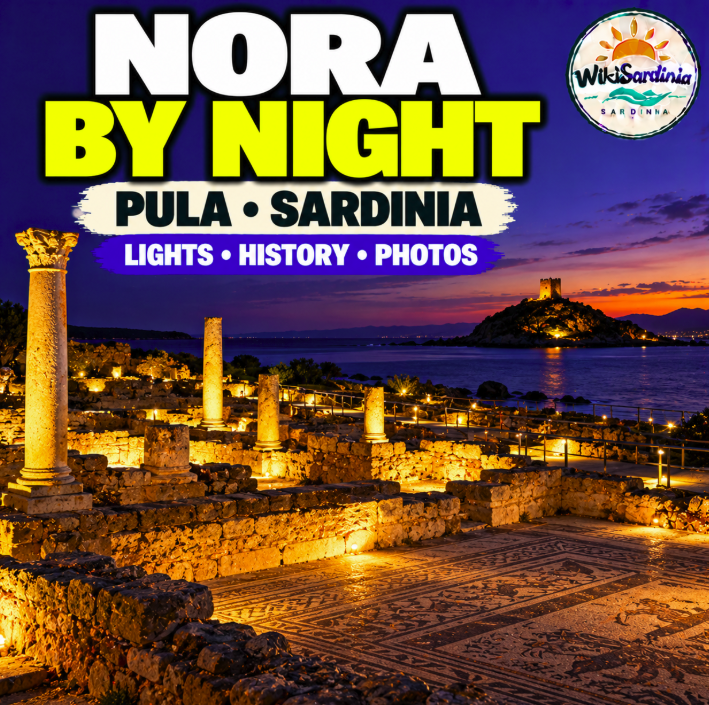
Can you see Nora's archaeological ruins illuminated at night? Nora, near Pula in southern Sardinia, is a spectacular place to photograph around sunset and the blue hour. Its ancient streets, Roman remains, mosaics and coastal setting create an unforgettable scene as the light changes. However, do not assume the archaeological site is illuminated every night or open for ordinary nighttime visits. Evening access and special lighting depend on official opening schedules, events and site management.
This guide explains how to plan an evening visit, what you can photograph, how to check for special openings and how to avoid confusing a dramatic promotional image with a guaranteed real-life lighting display.
Where is Nora?
The archaeological site of Nora lies on a small coastal peninsula near Pula, southwest of Cagliari. The ruins occupy a remarkable setting between the Mediterranean Sea and the landscape around the Torre del Coltellazzo. Nora is known for its Phoenician-Punic past and extensive Roman remains.
Its seaside position is part of what makes it so photogenic. Ancient stone structures stand close to the water, and changing light brings out different colors in the masonry, mosaics and surrounding landscape.
Is Nora illuminated at night?
Lighting and nighttime admission should be checked for the exact date. Archaeological sites sometimes organize evening tours, performances or special events with lighting, but these should not be mistaken for a permanent nightly program.
As of this guide's publication in October 2026, we have not independently confirmed a nightly illuminated visitor route or a special evening opening for tonight. If you see photographs of Nora glowing after dark, they may have been taken during a special event, at twilight, with selective lighting, or may be edited or illustrative.
Before traveling specifically for a night photograph, check official announcements and contact the site operator.
Why Nora is beautiful at sunset and blue hour
The moments around sunset often produce the most atmospheric photographs of Nora. Warm light can emphasize the textures of the ruins, while the sea takes on deeper blue tones. During blue hour, the sky retains color even as the land becomes darker.
If permitted artificial lighting is present, it may create striking contrast against the remaining blue in the sky. Even without illuminated ruins, the coastal landscape can be dramatic from authorized public viewpoints.
The key is to plan around actual access times. A site closing before sunset cannot be visited inside after hours merely because the light would be ideal.
What can you see at Nora?
Nora preserves traces of several periods of Mediterranean history. Visitors can explore remains associated with the ancient settlement, including:
- Roman theatre: one of the site's best-known architectural features.
- Ancient streets and buildings: evocative stone layouts that reveal the urban plan.
- Mosaics: delicate archaeological surfaces that require careful conservation.
- Baths and other Roman structures: evidence of daily life in the ancient city.
- Coastal views: the peninsula, sea and nearby tower make the setting especially distinctive.
Not every area is accessible on every visit. Respect barriers, conservation work and instructions from staff.
Can you visit Nora after dark?
Only when the site explicitly offers authorized evening admission. Ordinary daytime tickets do not automatically grant entry after closing. Special events may have different ticketing, guided-tour arrangements or visitor capacity limits.
Check the official opening hours for the month you are visiting. Autumn schedules can differ significantly from those in high summer, and sunset times become earlier through October.
Never enter through a closed gate, cross barriers or approach restricted archaeological areas to obtain a photograph.
Where can you take night photos of Nora?
There are two different photography situations:
Inside the archaeological park: photography depends on the site's opening hours, access permissions and any event-specific rules. Tripods, professional equipment or commercial filming may require additional authorization.
From permitted public areas outside: you may be able to photograph the surrounding coast, sky and landscape without entering the ruins, subject to local access restrictions and safety. Do not assume every nearby path or beach remains accessible at night.
Choose legal, safe viewpoints rather than attempting to recreate a dramatic image from an unverified location.
Best time for photography in October
For evening photographs, arrive while there is still daylight to understand the terrain and check permitted viewpoints. Sunset and the following blue hour can offer beautiful natural colors even when no special lighting is installed.
October's sunset becomes earlier as the month progresses. Italy's daylight saving time ends on 25 October 2026, so local clock times change near the end of the month. Use the precise sunset time for Pula on your visit date rather than relying on a summer itinerary.
Bring a warm layer, as the coastal breeze can make evenings cooler than expected.
How to photograph ancient ruins in low light
You do not need powerful artificial lights to create an atmospheric photograph. Try these approaches where photography is allowed:
- Use blue hour: photograph while there is still color in the sky rather than waiting for complete darkness.
- Keep the camera stable: brace it safely or use a permitted tripod.
- Protect highlights: if lights are present, avoid overexposing bright stone surfaces.
- Include the landscape: the sea and peninsula help tell Nora's story.
- Respect mosaics: never step onto protected surfaces to improve an angle.
- Avoid flash near other visitors: follow any site-specific photography restrictions.
Be careful when using phone night mode: long exposures can exaggerate artificial lighting or make a scene appear brighter than it was to the eye.
Are the viral night photographs accurate?
Not necessarily. A photo captioned “Nora by night” may show a special event, an edited exposure or a digital illustration. In particular, images depicting every ruin and mosaic brightly floodlit should not be treated as proof of a permanent installation.
If you are planning a visit because of a specific image, look for its photographer, capture date and event context. The cover illustration accompanying this article is a creative representation, not a verified photograph of Nora's actual lighting on 11 October 2026.
Does Nora host evening cultural events?
Archaeological venues can host cultural programming and special openings, sometimes including performances or guided experiences. Nora's Roman theatre and coastal atmosphere make it a memorable setting for cultural events, but specific dates, performances and lighting arrangements must be verified through official channels.
Do not assume an event is taking place because a previous year's program or an old social-media post appears in search results.
How to check official opening hours and tickets
Start with Nora's official visitor information and the Pula tourism channels. Look for:
- Opening and closing hours for your exact date
- Whether the last admission is earlier than closing time
- Guided tour requirements and languages
- Any special evening or nighttime openings
- Ticket price and reservation requirements
- Photography and tripod policies
- Temporary closures due to weather, events or conservation work
Check these details before making a long journey from Cagliari or another part of the island.
How to get to Nora from Pula and Cagliari
Nora is located near Pula, on the coast southwest of Cagliari. By car, visitors generally approach via the Pula area and follow local signs toward the archaeological site. Driving time varies with your starting point and traffic.
If you are relying on public transport, check both the outward and return services. Evening buses may be limited, and a special night opening does not guarantee a convenient late return.
Parking availability and access arrangements can change during events, so follow current official instructions rather than an old online map screenshot.
Can you combine Nora with a sunset at the beach?
Yes, when timing and access permit. The nearby coast offers attractive sea views, and a visit to Pula can combine archaeology, a walk and dinner. However, the archaeological site and the surrounding beach or coastal paths may have different access rules.
Plan your schedule around the site's confirmed admission hours first, then choose a permitted viewpoint for sunset.
Is Nora suitable for families in the evening?
An officially organized evening visit may be enjoyable for families, but uneven ancient surfaces, low light and coastal terrain require attention. Ask the operator about route length, lighting, steps and stroller accessibility.
Keep children close, stay on designated paths and bring suitable footwear. Avoid wandering into unlit or restricted areas after closing.
Is nighttime photography safe?
Ancient sites and rocky coasts are not ordinary paved city streets. After dark, steps, uneven stones and edges become harder to judge. Sea spray and wind may also affect nearby paths.
Use a small flashlight where allowed, wear shoes with good grip and never climb ruins or barriers. A striking photograph is not worth damaging archaeological heritage or risking a fall.
Why the site deserves respect
Nora is not simply a scenic backdrop. Its ruins are a fragile archaeological record of centuries of settlement and Mediterranean exchange. Mosaics and stonework can be damaged by foot traffic, touching or equipment placed on them.
Stay on marked visitor routes, respect staff instructions and avoid using lights or equipment in ways that disturb other visitors or conservation work.
What if there is no nighttime opening?
You can still enjoy Nora by visiting during official daytime hours, when details of the ancient city are easier to appreciate. Late-afternoon visits, where permitted by the seasonal schedule, can offer soft light and fewer harsh shadows.
For a true night photograph, wait for a verified authorized event rather than assuming access will be available. Alternatively, explore Pula's town center in the evening and save the archaeological visit for daylight.
Frequently asked questions
Is Nora illuminated every night?
We have not verified permanent nightly illumination or routine after-dark admission. Check official schedules and special events.
Can you visit the Nora archaeological site at night?
Only during authorized evening openings or events, subject to the site's current rules.
Where is Nora in Sardinia?
On a coastal peninsula near Pula, southwest of Cagliari.
What is Nora famous for?
Its Phoenician-Punic history, Roman ruins, theatre, mosaics and seaside location.
Can I photograph the mosaics after dark?
Only if you are lawfully admitted during an authorized opening and photography is permitted. Never enter a closed site.
Is October a good month for Nora photos?
It can be, thanks to softer seasonal light and earlier sunsets, but check the site's autumn opening hours.
Are tripods allowed?
Policies can vary by visit and equipment type. Ask the site operator before bringing a tripod, especially for professional work.
Are online photos of illuminated Nora real?
Some may document events, while others may be edited or illustrative. Check the source and date.
Can I see Nora from outside after closing?
Some surrounding views may be possible from permitted public areas, but access and visibility vary. Respect barriers and local rules.
Do I need to book tickets in advance?
It depends on the visit type, date and any special event. Confirm with the official operator.
The bottom line
Nora near Pula is one of Sardinia's most atmospheric archaeological landscapes for sunset and evening photography—but an illuminated nighttime visit is not something to assume. Check official opening hours and special events, use authorized viewpoints and distinguish real event photographs from creative illustrations. Whether seen in warm afternoon light or during a genuine evening opening, Nora's combination of ancient history and Mediterranean scenery is remarkable.
Useful official resources
Fondazione Pula Cultura / Nora visitor information (verify current official operator and announcements); SardegnaTurismo — Official Sardinia tourism information; Map search — Area Archeologica di Nora, Pula. Always verify opening hours and event details directly before visiting.