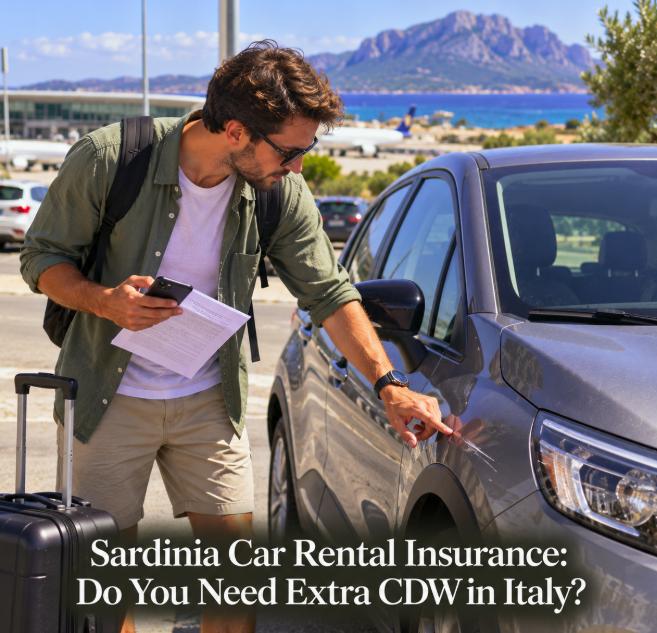
For Americans renting a car in Sardinia, the confusing question at the counter is rarely whether the vehicle has any protection at all. The real question is how much financial responsibility remains after the basic rental protections and whether paying for an additional excess-reduction product is worth it. In Italy, many rental rates already include Collision Damage Waiver (CDW) and Theft Protection, but that does not necessarily mean zero liability if the car is damaged or stolen.
The safest approach is to read the exact rate conditions before arriving at Cagliari, Olbia or Alghero airport. Do not buy an upgrade simply because someone says you are “not insured,” but do not decline it simply because your US credit card advertises rental-car coverage either. Both statements can hide important details.
CDW is not the same as zero-excess coverage
Collision Damage Waiver generally limits what the rental company can charge you for damage to its vehicle, subject to the rental agreement. Theft Protection performs a similar role for theft. Major rental companies operating in Italy state that these protections are included in many rates, although the precise conditions depend on the booking.
The catch is the excess, sometimes described to American travelers as a deductible. A rental can include CDW and still leave you responsible for a specified amount if the vehicle is damaged. Optional products sold under names such as Super Cover, Super CDW or excess waiver may reduce or eliminate that remaining amount for covered incidents.
This is why comparing two Sardinia rentals only by the headline daily price can be misleading. One quote may include a relatively low excess while another leaves a much larger amount at risk.
Do Americans need to buy the extra CDW?
Not automatically. First determine what is already included. If your booking already contains CDW and Theft Protection, the counter product may actually be an upgrade designed to reduce the excess rather than the basic collision protection itself.
Whether that upgrade makes sense depends on your tolerance for financial risk, the excess shown in the contract and any independent coverage you already have. Some travelers prefer to pay more for the rental company’s strongest waiver because a covered claim can then be handled directly with the company. Others accept the excess because they have verified credit-card or third-party reimbursement coverage.
There is no universal answer because credit-card benefits and rental contracts differ. The important step is to compare the actual numbers and exclusions before pickup.
Your US credit card may help — but verify Italy specifically
Some American credit cards provide rental-vehicle damage or theft coverage when the card is used to pay for the rental and the renter declines certain optional protections. Major rental companies themselves advise customers to verify the card issuer’s terms before relying on this benefit.
Ask your card issuer whether Italy is covered, whether the protection is primary or secondary, the maximum rental duration, excluded vehicle classes and whether theft, tires, glass, towing, loss-of-use charges and administrative fees are included. Also ask exactly which rental-company waiver must be declined for the card benefit to activate.
Do not assume a benefit from a US domestic rental works identically overseas. And remember that collision coverage for the rental car is different from liability for injuries or damage you cause to other people or property.
If you intend to rely on a card benefit, keep written proof or the current benefit guide accessible on your phone. A verbal assurance from a call-center agent is less useful during a later claim than the actual policy terms.
What the extra protection may still exclude
Even the strongest rental-company waiver is not permission to use the car without restrictions. Coverage can be invalidated by breaches of the rental agreement, prohibited driving, unauthorized drivers or gross negligence.
Specific components can also receive different treatment. Europcar’s current general and Italy-specific terms, for example, show why renters need to read beyond the letters “CDW”: theft protection is a separate concept, and some types of damage or circumstances can fall outside the waiver. Hertz likewise states in its rental terms that waivers operate subject to contractual conditions and that additional excess-reduction products may be available.
Check tires, wheels, windshield and glass, roof, underbody, keys, incorrect fueling and roadside assistance. These are common areas where travelers incorrectly assume that “full coverage” means literally every possible cost.
How to reduce the risk of a rental-car dispute
Insurance is only half the strategy. Before driving away, walk around the car slowly and record a continuous video showing every side, the wheels, windshield, roof where visible and the interior. Take close photographs of scratches and dents, and make sure significant existing damage appears on the checkout record.
Do the same when returning the vehicle. If possible, return during staffed opening hours and obtain confirmation that the car has been checked. Keep fuel receipts, the rental agreement, the final invoice and return documentation.
If the company places a security authorization on your credit card, distinguish that hold from an actual charge. The amount and release process depend on the rental company, vehicle and protection level. A large temporary authorization is not by itself evidence of a scam.
Beware of vague language at the counter
A legitimate rental agent can explain the optional protection and its consequences. The useful questions are concrete: “What is my current excess for collision damage?”, “What is my theft excess?”, “How much does this option reduce each one?” and “Which types of damage remain excluded?”
If the answer is simply that you have “no insurance,” ask the agent to show you the relevant section of the rental agreement. Your booking voucher should also identify the protections already included.
Likewise, do not describe every counter upsell as a scam. Excess-reduction products are real services and can be valuable to travelers who want to limit risk. The problem arises when a customer buys without understanding what the original rate already covered or what the upgrade actually changes.
Third-party excess insurance works differently
Travel-insurance companies and specialist providers sometimes sell policies that reimburse a rental-car excess. These can cost less than the rental desk’s premium waiver, but the claims process is different.
With reimbursement insurance, the rental company may still charge you after damage and require you to pursue repayment from the insurer. You may need the damage report, repair invoice, rental agreement, police report where applicable and proof of payment. A rental-company zero-excess product can be simpler because there may be less money to recover afterward, although exclusions still apply.
For travelers who dislike paperwork or do not want a potentially large charge sitting on their card during a dispute, that difference can matter as much as the daily premium.
A practical checklist before collecting the car
- Read the booking voucher and identify CDW, Theft Protection and the exact excess.
- Check the security deposit or credit-card authorization required at pickup.
- Verify your US credit card’s current Italy rental coverage directly with the issuer.
- Confirm excluded vehicle types and maximum rental duration.
- Check treatment of tires, wheels, glass, roof, underbody, keys and towing.
- Make sure every driver is listed on the rental agreement.
- Photograph and video the car before leaving and again at return.
- Keep all paperwork until the deposit has been released and the final bill is settled.
The bottom line for Sardinia
You do not need to accept every insurance product offered at a Sardinian rental desk simply because you are an American visitor. But you do need to understand the difference between basic CDW, the remaining excess and an optional product that reduces that excess.
For many travelers, paying for low- or zero-excess protection is primarily a convenience and risk-management decision. For others, a carefully verified credit-card benefit provides enough protection. The mistake is deciding at the airport while tired, with a line behind you and without knowing what your original booking contains.
Check the contract before the trip, document the vehicle thoroughly and ask the counter agent for exact euro amounts rather than vague descriptions. That preparation is far more effective at avoiding unpleasant surprises than assuming either that every insurance upgrade is necessary or that every rental company is trying to trick you.