
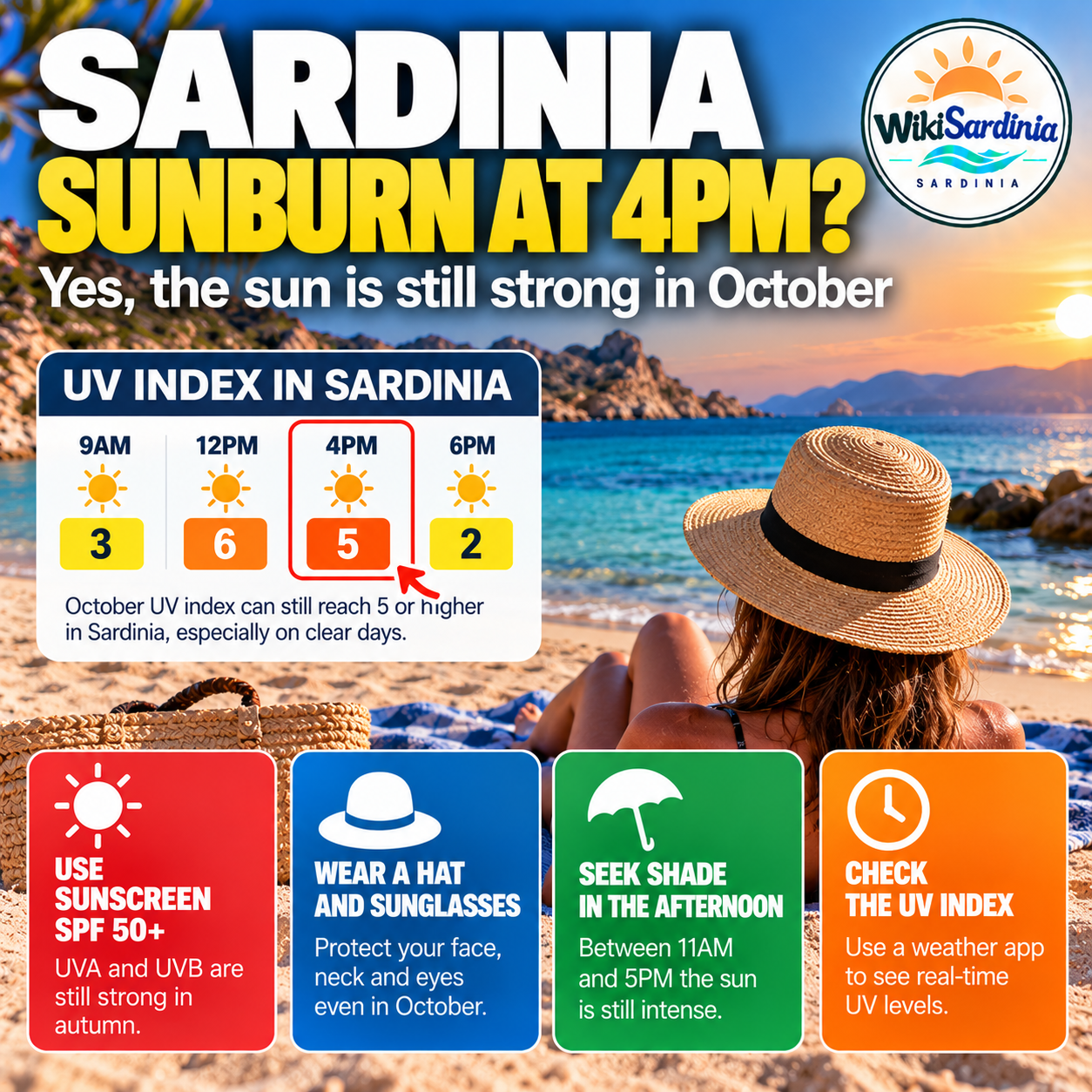
Yes, you can still get sunburned at 4 p.m. in Sardinia in October. The sun is lower than in midsummer, but ultraviolet (UV) radiation can remain strong enough to damage unprotected skin, especially on clear days. The actual UV index changes with the date, cloud cover and location, so check the forecast for the day rather than assuming autumn sun is harmless.
If you are spending the afternoon at the beach, protect your skin even when the air feels cooler. A hat, sunglasses, shade and broad-spectrum sunscreen can all help reduce exposure.
Can the UV index still reach 5 in October?
It can, under suitable conditions, but UV levels are not the same every day or at every place in Sardinia. A UV index of 5 is considered moderate, and sunburn risk depends on how long you stay outside, your skin type, the time of day and how much protection you use.
Do not treat “4 p.m. in October” as a fixed safe or unsafe time. Check a reliable weather service or UV forecast for your exact location and date. Brightness and temperature are not reliable ways to judge UV exposure.
How to avoid sunburn at 4 p.m.
1. Use broad-spectrum sunscreen
Choose broad-spectrum sunscreen with at least SPF 30; SPF 50+ is a practical option for a long beach day. Apply it generously to exposed skin before going outside and reapply at least every two hours, and after swimming, sweating or towel-drying, following the product instructions. Sunscreen is only one layer of protection—not a reason to stay in the sun longer.
2. Wear a hat and sunglasses
A wide-brimmed hat helps protect the face, ears and neck. Sunglasses that provide UV protection help protect your eyes. Clothing that covers your shoulders and arms adds another layer, especially if you burn easily.
3. Find shade, even in the late afternoon
Use a beach umbrella or move to a shaded area when the sun feels strong. Shade reduces direct exposure, but UV can still reach you through reflection from sand and water and from scattered light. Combine shade with clothing and sunscreen rather than relying on the umbrella alone.
4. Check the UV forecast for your location
Look up the UV index for the specific Sardinian town or beach you are visiting. Conditions can differ between locations and change during the day. If the index is moderate or higher, take protective measures; if it is high, reduce direct exposure and seek shade more consistently.
Why October beach weather can be misleading
Air temperature and UV radiation are different things. A mild or breezy afternoon can feel comfortable while UV rays are still reaching your skin. The same applies when thin cloud makes the sun seem less intense. Do not use warmth, wind or the season alone to decide whether you need protection.
Quick checklist before your beach walk
- Check the local UV index rather than relying on the clock.
- Apply broad-spectrum SPF 30 or higher; consider SPF 50+ for extended outdoor time.
- Wear a hat, UV-protective sunglasses and covering clothing.
- Take breaks in shade and remember that sand and water reflect UV.
- Reapply sunscreen as directed, especially after swimming or towel-drying.
The bottom line
Do not assume the Sardinian sun is harmless at 4 p.m. just because it is October. UV levels can still be high enough to cause sunburn on some days, but the exact index varies. Check the local forecast and use sunscreen, clothing, sunglasses and shade to enjoy the coast more safely.


