
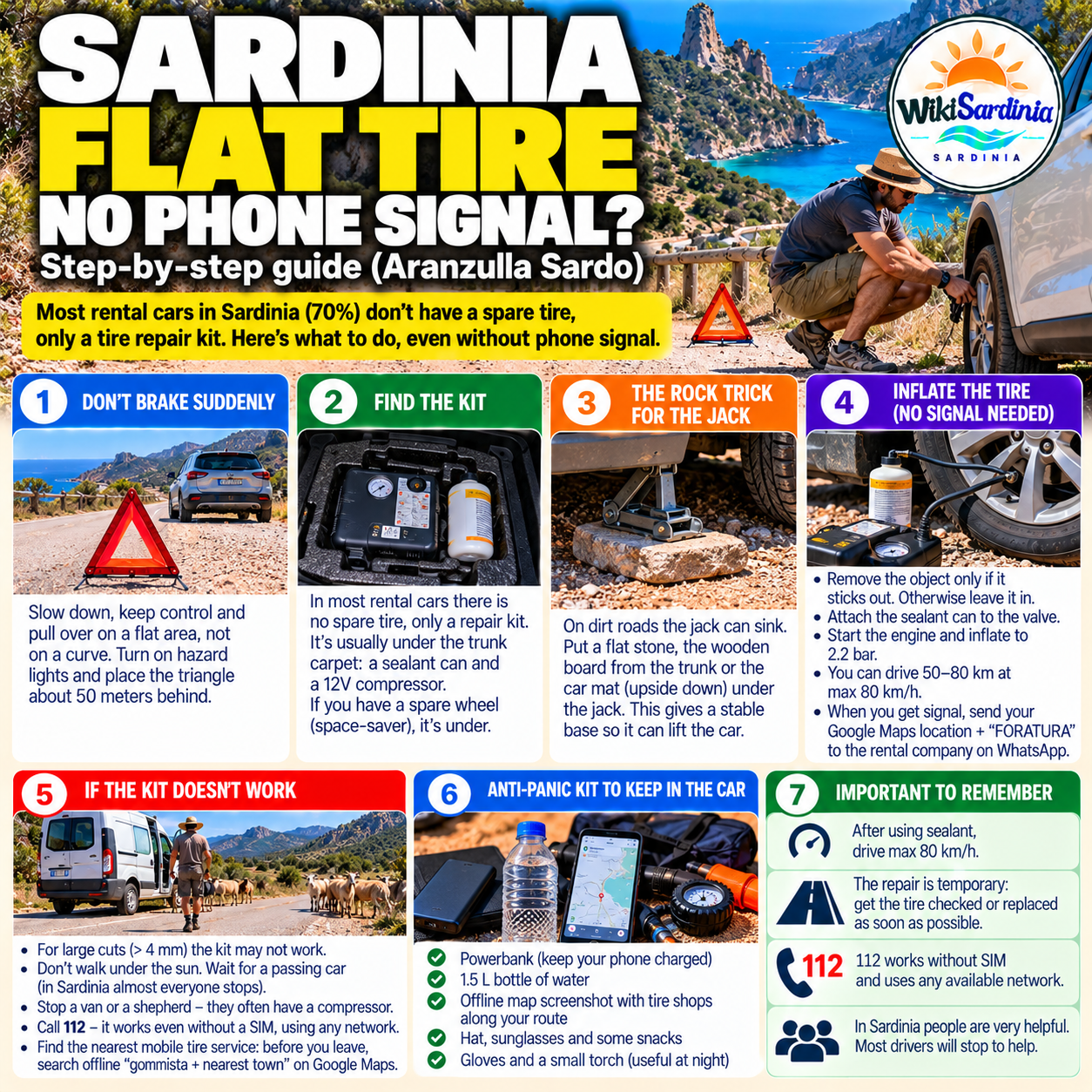
A flat tyre on a remote Sardinian road with no phone signal is stressful, but the safest first step is to get yourself and your passengers away from traffic—not to start repairing the car immediately. Roads around the Supramonte, Dorgali and Baunei can be isolated, and mobile coverage varies. Rental cars differ too: some have a spare wheel, while others carry only a tyre repair kit. Check what your specific vehicle has before you set off.
1. Slow down carefully and stop somewhere safe
If you feel a tyre losing pressure, keep a firm grip on the steering wheel, ease off the accelerator and avoid sudden braking or sharp steering. Stop at the nearest safe, level place away from moving traffic. Do not stop on a blind bend, narrow lane or loose slope if you can safely reach a better location.
Switch on the hazard lights. Follow the vehicle handbook and local road-safety rules for warning triangles and high-visibility clothing. Never place a warning triangle if doing so would put you in danger. If you are on a narrow mountain road, a blind bend or another unsafe location, stay out of the carriageway and prioritise getting help.
2. Find out whether the car has a spare or a repair kit
When it is safe to check, look in the boot and consult the rental-car handbook. Depending on the model, you may find a spare wheel or space-saver, a sealant bottle and a 12-volt compressor, or a different system. The kit is often stored beneath the boot floor, but its location varies.
Before your trip, ask the rental company where the equipment is stored and how roadside assistance works in areas with poor coverage. Save the rental company’s assistance number and the vehicle registration details offline.
3. Use a tyre repair kit only if the instructions say it is suitable
Sealant-and-compressor kits are temporary emergency equipment, not a universal fix. They may not work for a large cut, sidewall damage, a tyre that has come off the rim or damage to the wheel. Never use a kit if the tyre or wheel looks unsafe, or if the vehicle handbook says not to.
Follow the instructions supplied with that exact kit and vehicle. Do not assume every product uses the same pressure, method or driving limit: the required pressure and maximum permitted speed and distance depend on the manufacturer’s instructions. After using sealant, arrange for a tyre professional to inspect or replace the tyre as soon as possible, and tell them sealant has been used.
Do not pull an embedded object out of the tyre unless the kit or a tyre professional instructs you to. Removing it can make the air loss worse. Do not keep driving on a flat tyre just to reach a town.
4. Do not improvise with an unstable jack
On gravel, sand or uneven ground, a jack can sink, slip or tip. A flat stone, loose board or car mat is not a guaranteed safe base. Never crawl under a vehicle supported only by a jack, and never try to lift the car on a slope or soft shoulder.
If the vehicle handbook does not provide a safe procedure for the ground you are on, or you cannot position the jack on firm, level ground at the designated lifting point, do not attempt a wheel change. Call the rental company’s assistance service when you can get a signal, or seek help from a safe location.
5. What if there is no mobile signal?
- Stay in a safe place: keep clear of traffic and do not walk along a dangerous road searching for reception.
- Try again from a safer nearby location: if you can reach one on foot without risk, a more open or elevated spot may have coverage. Do not leave passengers in an unsafe situation.
- Use emergency calling only when needed: in Italy, 112 is the emergency number. An emergency call may work through another available mobile network, but service is not guaranteed where there is no coverage at all; do not rely on a call working without a SIM or in every dead zone.
- Ask for help prudently: if another vehicle stops, explain the problem from a safe position. Do not accept a lift from someone you do not trust, and do not stand in the road to flag vehicles down.
- Contact the rental company as soon as you have signal: send your location pin or coordinates, vehicle registration and a short message such as “FLAT TYRE / FORATURA”. A screenshot or offline map can help you describe where you are.
6. Prepare before driving into remote areas
Download an offline map of your route and nearby towns, and save the location of tyre repair shops before leaving. Offline maps may show businesses that have since closed, so check opening hours and phone numbers in advance when possible. Save the rental company’s roadside-assistance details on paper or in your phone as well.
A small emergency kit is useful: a charged phone, power bank, drinking water, hat, sun protection, a reflective vest and a torch. Keep the car’s handbook and tyre-kit instructions accessible. Do not assume a passing driver will stop or have a compressor.
7. When to stop and wait for professional help
Call roadside assistance rather than attempting a repair if the tyre has a large cut, the sidewall is damaged, the wheel is bent, the car is unstable, the repair kit is missing or expired, or you cannot work safely away from traffic. If the car is in a dangerous position, there is an immediate risk to people, or someone is injured, contact emergency services as soon as a call is possible.
Quick checklist for a Sardinia road trip
- Check whether your rental car has a spare wheel or a sealant-and-compressor kit.
- Save roadside-assistance contacts and vehicle details offline.
- Download offline maps and mark nearby towns and tyre shops.
- If a tyre fails, slow down gently and stop in the safest available place.
- Use the repair kit only according to the exact instructions; don’t improvise with a jack on soft or uneven ground.
- If you cannot repair the tyre safely, wait for professional assistance.
The bottom line
With a flat tyre and no phone signal in Sardinia, prioritise safety, check the car’s own repair equipment and follow its instructions exactly. Tyre sealant is temporary and not suitable for every puncture, while a jack on gravel can be dangerous. Prepare offline maps and rental-assistance details before travelling through remote areas—and never assume that 112 or another network will be reachable where there is no signal.


