
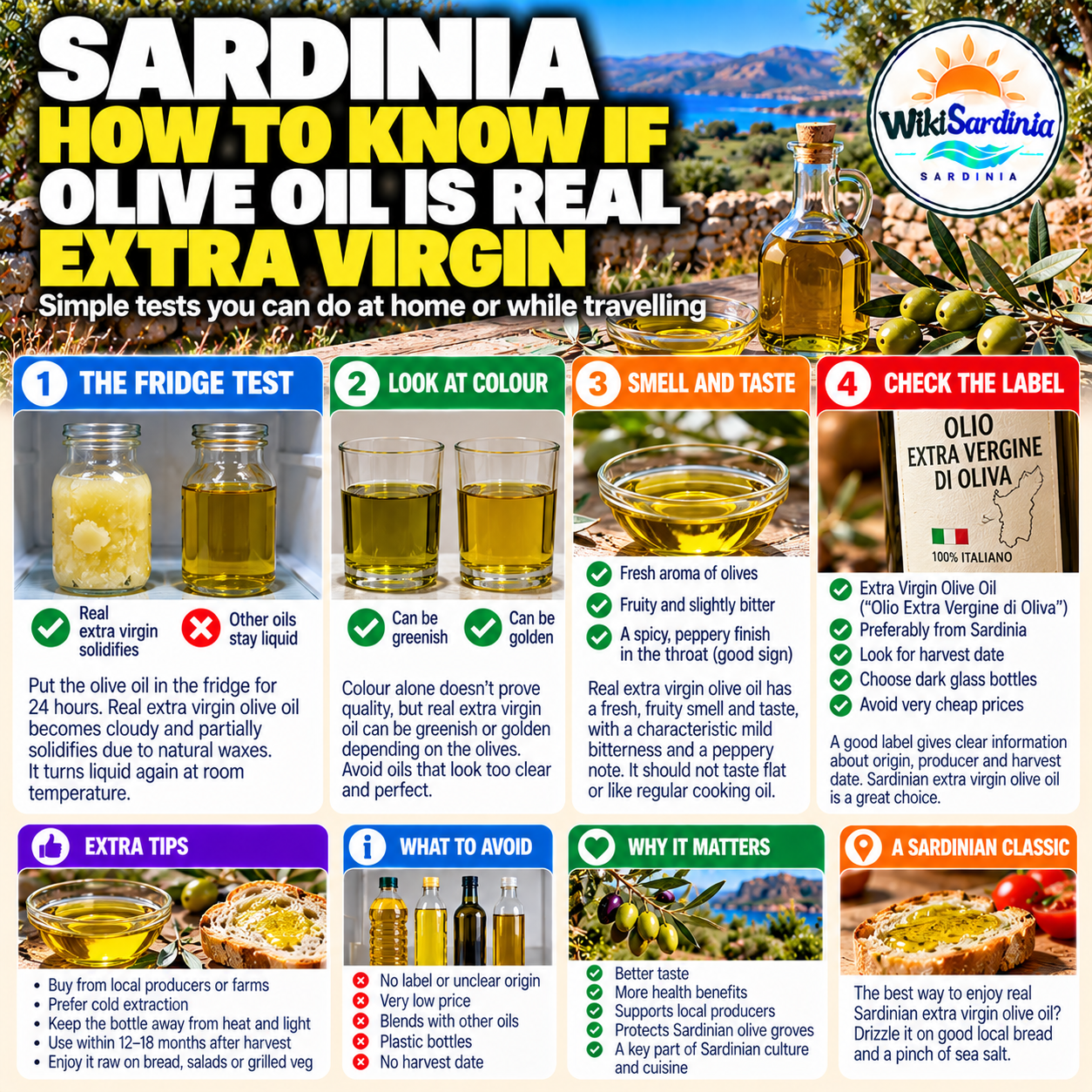
Buying extra virgin olive oil in Sardinia and wondering whether it is genuine? Start with the label, producer and taste—not the fridge test. You may have heard that real extra virgin olive oil solidifies when chilled. In reality, olive oil can become cloudy or partly solid at low temperatures, but this varies with its natural composition. The fridge test cannot reliably prove that an oil is extra virgin or detect adulteration.
Sardinia has olive-growing areas and local producers, so buying directly from a mill, farm shop or trusted retailer can be a good way to learn where an oil comes from. Still, a Sardinian label by itself is not proof of quality: check the details and ask questions.
1. Don’t rely on the fridge test
Putting a bottle in the refrigerator may make olive oil cloudy or cause some of it to solidify. That change is influenced by the oil’s fatty-acid composition and temperature, not simply by whether it is extra virgin. Some genuine oils remain more liquid, while other oils can solidify.
So, a bottle that solidifies is not automatically genuine, and one that stays liquid is not automatically fake. Use the label, traceability and sensory quality as better starting points. Definitive authentication may require laboratory testing.
2. Read the label carefully
Look for the exact designation “extra virgin olive oil” (in Italian, olio extra vergine di oliva). Check the origin statement, producer or bottler details, lot information and best-before date. If the label claims a specific Sardinian origin, look for clear details about where the olives were grown and processed.
“Packed in Italy” does not necessarily mean all the olives were grown in Italy. If local origin matters to you, ask the producer or retailer for a more specific explanation.
3. Look for freshness and sensible storage
Olive oil is best protected from heat, light and air. Dark glass or another suitable light-protective container can help preserve quality, although packaging alone does not prove authenticity. Check for a harvest date when available, and prefer a product with clear traceability and a reasonable turnover rather than relying only on a distant best-before date.
Once opened, keep the bottle tightly closed in a cool, dark cupboard, away from the oven and direct sunlight. You generally do not need to refrigerate olive oil for everyday storage.
4. Smell and taste it, if you can
Fresh extra virgin olive oil often has fruity aromas that may suggest green leaves, fresh grass, herbs, tomato or ripe fruit, depending on the olive variety and harvest. A bitter taste and a peppery sensation in the throat can be normal characteristics of high-quality oil. Their intensity varies, so there is no single flavour profile that every genuine oil must have.
Musty, rancid, winey-vinegary or otherwise unpleasant odours can indicate defects or poor storage. However, taste alone is not a definitive test for authenticity, and consumers may find it difficult to identify every defect.
5. Buy from a producer or trusted shop
If you are visiting an olive farm or local producer, ask which olives are used, where they were grown, when they were harvested and whether the oil is from a single estate or a blend. A trustworthy seller should be willing to explain the product clearly. Very low prices can be a reason to ask more questions, but price alone does not prove that oil is fake.
For extra assurance, look for recognised certification or protected-origin labels when applicable, and check that the claim matches the official product information. No single badge, bottle colour or marketing phrase is a guarantee on its own.
Quick checklist for buying extra virgin olive oil in Sardinia
- Look for the words “extra virgin olive oil” on the label.
- Check the origin statement, producer, lot and date information.
- Ask specific questions if you want oil made from Sardinian-grown olives.
- Choose oil stored away from heat and light.
- Use aroma and taste as clues, not as conclusive proof.
- Ignore the fridge test as a way to authenticate extra virgin olive oil.
The bottom line
The fridge test does not tell you reliably whether olive oil is real extra virgin. Oil can cloud or solidify when cold for natural reasons, and the result varies. In Sardinia, your best approach is to buy from a trusted producer or retailer, read the origin and traceability details, store the bottle properly and appreciate its aroma and flavour.
Further reading
For standards and consumer information, consult the International Olive Council and the European Commission’s information on olive oil.


