
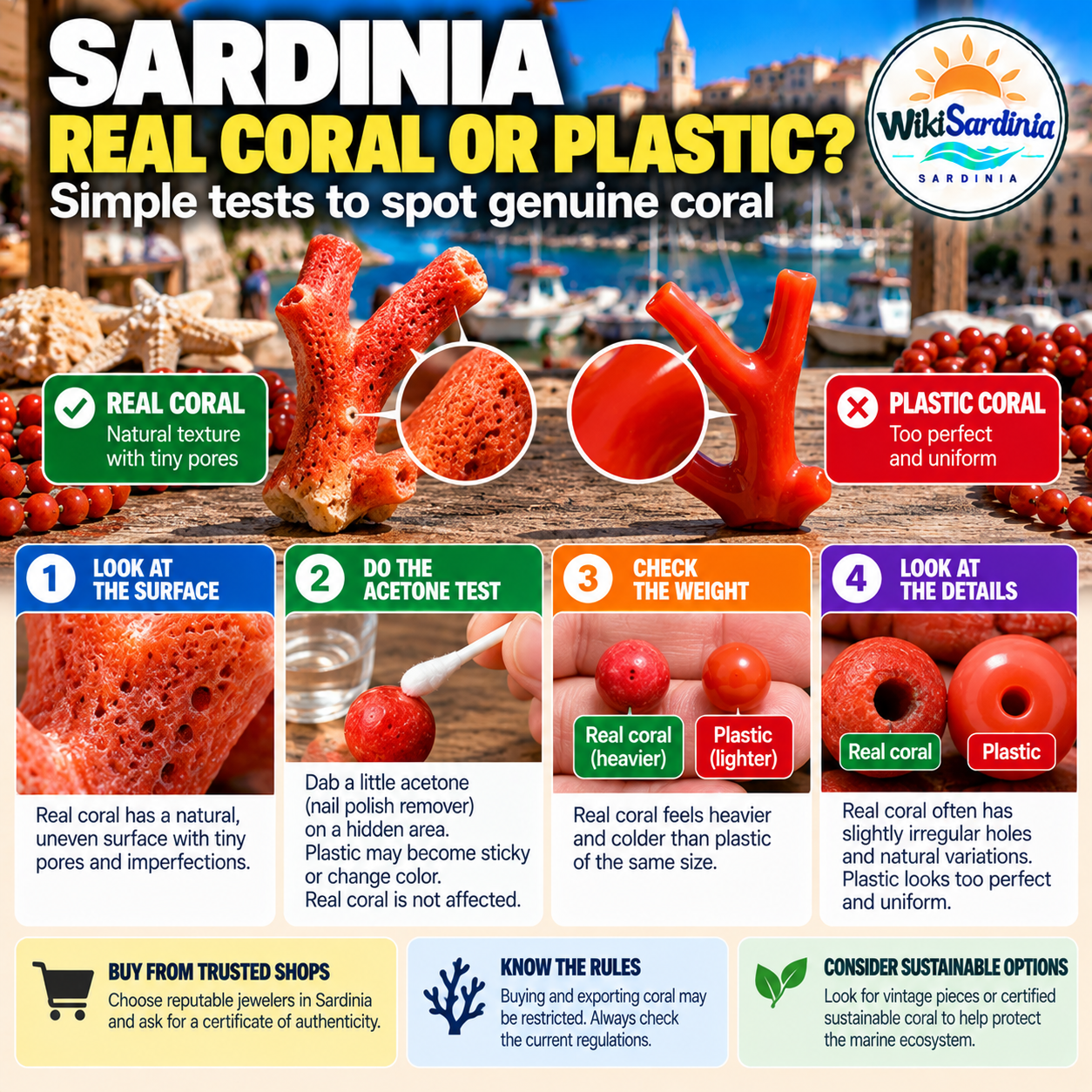
Shopping for real Sardinian coral jewellery? Don’t rely on colour alone—and avoid using an acetone test on a piece you might buy. Red coral jewellery is sold in Sardinia, but plastic, glass, dyed materials and other imitations can look convincing in photographs or shop displays. The safest approach is to buy from an established jeweller, ask clearly about the material and origin, and request written documentation when available.
Real Mediterranean red coral is associated with the jewellery trade around Sardinia, including Alghero. But a red colour or a “Sardinian coral” label alone does not prove that a piece is genuine, locally sourced or legally traded.
1. Look closely at the surface—but treat it only as a clue
Natural coral may show small pores, irregularities and variation in colour or shape. Plastic imitations can look very smooth and uniform. However, polishing, carving, dyes and different imitation materials can make visual inspection unreliable. Use surface texture as a clue, not a final verdict.
2. Be careful with the acetone test
You may see advice online recommending nail-polish remover or acetone to distinguish plastic from coral. Do not apply acetone to jewellery in a shop or to a piece you own unless a qualified specialist confirms it is safe. Acetone can damage some coatings, dyes, adhesives, settings and other components, and a simple spot test cannot reliably authenticate every material. A negative reaction does not prove that a piece is genuine coral.
If you suspect an item is plastic, ask the jeweller to explain the material and show any documentation. For a valuable purchase, use an independent gemmologist or qualified jeweller rather than relying on a home test.
3. Compare weight and temperature only cautiously
Some people compare how heavy or cool a bead feels, but these are weak clues: size, shape, mounting and the type of imitation all affect the result. Do not buy—or reject—a piece based on weight or touch alone.
4. Ask the seller specific questions
- What is the material? Ask whether the item is natural coral, a different natural material, glass or plastic.
- What is its origin? Ask whether the seller can document where the coral came from. “Sold in Sardinia” does not necessarily mean “harvested in Sardinia.”
- Can you provide a receipt and description? Keep a written record of the material and any claims about origin.
- Is there supporting documentation? For an expensive piece, ask for an appropriate certificate or independent assessment.
- Can I return it if the description is incorrect? Understand the shop’s return policy before paying.
5. Buy from an established jeweller
Choose a reputable jeweller who can answer questions clearly and provide a proper receipt. Be cautious of pressure to buy quickly, vague descriptions and prices that seem unusually low for the item being advertised as genuine coral. A professional shop is not an automatic guarantee, but it gives you a clearer route to documentation and follow-up if a problem arises.
6. Check the rules before buying or taking coral home
Trade in certain coral species and international movement of coral products can be subject to wildlife-trade rules, including CITES requirements. The rules depend on the species, product, origin and destination. If you plan to take coral outside Italy or the EU, check the current official requirements before purchasing, and ask the seller for the documents needed for your journey. Never collect living coral or coral fragments from the sea or beach.
Quick checklist: real coral or imitation?
- Inspect the surface for natural variation, but do not treat appearance as proof.
- Do not use acetone as a casual home test on a piece you may buy.
- Ask for the exact material, origin and written documentation.
- Use an independent specialist for an expensive or disputed item.
- Check current wildlife-trade rules before taking coral across borders.
The bottom line
The best way to avoid fake coral in Sardinia is to buy from a reputable jeweller and verify the material with documentation—not to rely on an acetone test. Texture, weight and temperature may offer clues, but none is conclusive. For valuable jewellery or questions about legal origin, seek qualified advice before buying.


