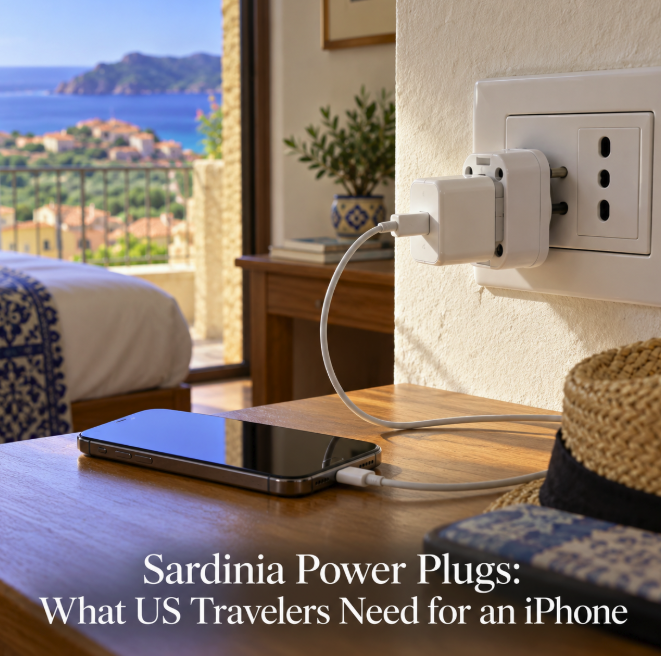
American travelers bringing an iPhone to Sardinia need to think about the shape of the plug, but usually not about converting the voltage. Sardinia uses the Italian electrical system, so a standard US two-flat-pin plug will not fit directly into many wall sockets. For a holiday, the practical solution is a US-to-Italy or compatible European travel plug adapter, with Type C and Type L being the two names travelers are most likely to encounter.
The key point for iPhone users is reassuring: Apple states that its USB power adapters are designed for power sources rated from 100 to 240 volts AC at 50 to 60 Hz. That range covers both the United States and Italy. With a compatible Apple charger, therefore, you normally need a plug adapter to make the physical connection rather than a separate voltage converter.
Type C or Type L: which adapter should you bring?
Italy is associated particularly with Type L sockets, recognizable by three round contacts arranged in a straight line. Travelers will also encounter sockets that accept the common two-round-pin Type C plug. In practice, accommodation in Sardinia can contain different socket designs depending on the building and when its electrical fittings were installed or renovated.
For that reason, a travel adapter explicitly sold as compatible with Italy is a safer choice than assuming that any generic “European” adapter will work everywhere. Many compact adapters for Italy are designed to fit the relevant Italian sockets while accepting the two flat pins of a US charger.
If an adapter is labeled only Type C, it may be useful with compatible two-pin European sockets, but travelers who want broader compatibility in Italy should look for an adapter that specifically states support for Italian Type L outlets. Universal travel adapters can also be convenient, especially when a trip includes several European countries.
Do you need a voltage converter for an iPhone?
With genuine modern Apple USB power adapters, generally no. Apple’s current support information says its USB power adapters are designed for 100–240 V AC and 50–60 Hz power sources. Apple also lists its 20 W USB-C iPhone power adapter with a 100–240 V line-voltage specification.
That distinction matters because a plug adapter and a voltage converter do different jobs. A plug adapter simply changes the physical connection so an American plug can fit an Italian socket. A voltage converter changes the electrical voltage supplied to a device. An Apple charger designed for 100–240 V already handles the voltage range itself.
Travelers using a third-party charger should check the tiny specifications printed on the charger before connecting it. Look for an input range that includes 230 V, typically written as something similar to “100–240V, 50/60Hz.” Apple advises using third-party power adapters that comply with applicable safety standards.
What about the iPhone cable?
The cable connection depends on the iPhone and charger you bring, not on Sardinia. Recent iPhones use USB-C, while older models may use Lightning on the phone side. If you already charge your phone successfully in the United States, you can normally keep using the same compatible charging cable and power brick; the travel adapter goes between the US plug and the Italian wall socket.
An alternative is to buy or use a European USB-C wall charger with the appropriate Italian-compatible plug. In that case there is no need to attach a US plug adapter to the charger. Hotels and newer accommodation may also provide USB-A or USB-C charging ports, but travelers should not depend on finding them in every room, particularly in older properties, agriturismi or holiday apartments.
A simple packing choice for Sardinia
For most US visitors carrying only an iPhone, a small Italy-compatible travel plug adapter plus the charger and cable they already use is enough. If two people are traveling with phones, watches, tablets and other electronics, a reputable multi-port USB-C charger designed for 100–240 V can reduce the number of adapters required.
Be more cautious with appliances that produce heat or use powerful motors, such as some hair dryers and styling tools. Unlike iPhone chargers, they are not automatically universal-voltage devices. Check the voltage label on each appliance rather than assuming that what works for the phone will work for everything in the suitcase.
The short version for an American arriving in Alghero, Cagliari, Olbia or anywhere else in Sardinia is straightforward: bring an adapter compatible with Italian sockets, preferably one that explicitly supports Type L as well as the common European two-pin connection. For a compatible Apple iPhone charger rated 100–240 V, you do not normally need a voltage converter.