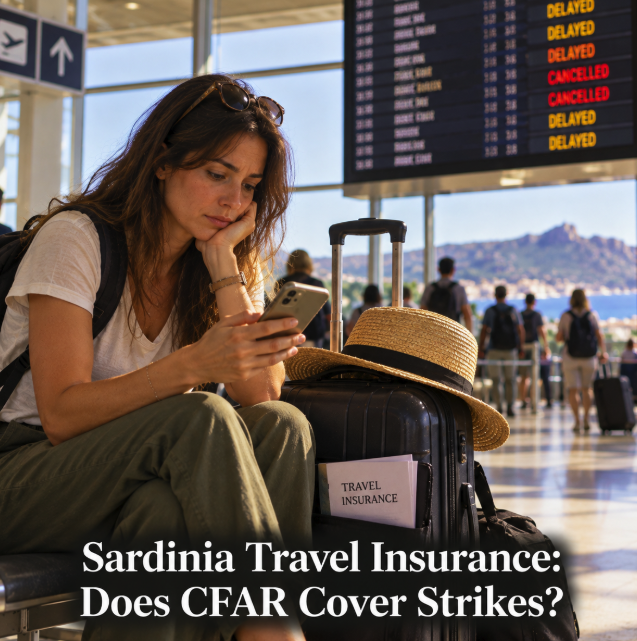
Transport strikes are a realistic concern when planning a trip to Sardinia, especially when the itinerary depends on connecting flights, trains or ferries in mainland Italy. Travel insurance can help in some strike-related situations, but there is an important distinction between a strike that unexpectedly disrupts your trip and deciding that you no longer want to travel because you are worried about a strike. The second situation is where Cancel For Any Reason, usually shortened to CFAR, can become relevant.
CFAR is not a magic policy that returns every dollar whenever plans change. It is normally an optional upgrade to a comprehensive travel insurance plan, it must usually be purchased soon after the first trip payment, and it typically reimburses only part of the prepaid non-refundable cost.
Can standard travel insurance cover a strike?
Sometimes. Current travel-insurance guidance shows that some policies include transportation strikes among their covered reasons for trip cancellation, delay or interruption. This can include strikes affecting airlines, air traffic control, trains or other common carriers, depending on the policy wording.
The crucial word is unforeseen. If you purchased insurance before a strike became a known or foreseeable event, a policy with the appropriate strike benefit may respond when that strike actually disrupts your insured trip.
If the strike had already been publicly announced when you bought the policy, standard coverage may not apply to losses caused by that event. Insurance is generally designed for unforeseen problems, not an event that was already known when coverage was purchased.
What if you are simply worried about a future strike?
Fear that a strike might disrupt your vacation is normally different from an actual covered cancellation.
Suppose you have booked flights from the United States to Rome, a connection to Cagliari and two weeks of hotels in Sardinia. News reports then discuss possible industrial action around your travel dates, but your flights are still scheduled to operate.
If you decide to cancel because you do not want to risk the disruption, ordinary trip-cancellation insurance generally does not reimburse you merely because you are concerned. A policy normally requires one of its specifically listed covered reasons to occur.
CFAR is designed for precisely this type of flexibility. If your policy includes a valid CFAR upgrade and you satisfy all of its conditions, you can generally cancel without proving that a standard covered event forced the decision.
How much does CFAR reimburse?
Current 2026 insurance-market guidance shows that CFAR commonly reimburses around 50% to 75% of eligible prepaid, non-refundable trip expenses.
That means a traveler with $6,000 of insured non-refundable trip costs should not assume CFAR will return the full $6,000. Depending on the plan, the maximum eligible reimbursement could be $3,000, $4,500 or another amount specified in the policy.
Refundable expenses are generally not the point of CFAR. If an airline or hotel returns your money directly, there is no equivalent non-refundable loss for the insurer to reimburse.
You usually have to buy CFAR early
This is one of the biggest traps for travelers who start worrying only after strike headlines appear.
CFAR usually has a time-sensitive purchase requirement. Current 2026 guidance from major U.S. travel-insurance marketplaces describes typical windows of roughly 14 to 21 days after the initial trip deposit, although individual policies vary and some use different deadlines.
Travelers are also commonly required to insure 100% of their prepaid, non-refundable trip costs and to update the insured amount as additional trip expenses are added.
You generally cannot wait until a strike is announced, become nervous and then buy CFAR as a last-minute escape route. Eligibility depends on the actual contract and purchase timing.
CFAR also has a cancellation deadline
CFAR is designed for cancellation before the trip, not for deciding at the airport that you would rather go home.
Many current policies require the entire trip to be canceled at least 48 hours before scheduled departure; some use a two- or three-day requirement. The precise deadline is policy-specific.
If you wait until the final hours before departure, CFAR may no longer be available even though you bought the upgrade correctly months earlier.
What if the strike was already announced?
This is where CFAR can differ most sharply from ordinary trip cancellation.
A standard policy may exclude losses connected with a strike that was already a known event when the insurance was purchased. Current Italy travel-insurance guidance specifically warns that publicly announced airline or transport strikes may fall outside new standard coverage.
CFAR may still provide a route to partial reimbursement if you purchased and qualified for the CFAR benefit within its required time window and later decide to cancel for a reason that is not otherwise covered. But the actual policy language controls the claim, and travelers should never assume an upgrade overrides every exclusion or eligibility condition.
What if you are already in Sardinia?
CFAR is principally a pre-departure cancellation benefit. Once the trip has started, travelers need to look at other sections of the policy.
Trip Delay can reimburse eligible extra expenses such as meals or accommodation when a covered transport disruption exceeds the policy's minimum delay period. Trip Interruption may cover certain unused prepaid costs or additional transportation when a listed covered event forces the trip to end early.
A less common optional benefit called Interrupt For Any Reason, or IFAR, is available on some policies. Current 2026 guidance describes it as an upgrade that can reimburse part of unused prepaid non-refundable costs when a traveler voluntarily ends a trip for a reason not covered by standard interruption benefits. Its eligibility rules and waiting periods vary significantly.
Do not assume that buying CFAR automatically gives you IFAR.
Why strikes matter particularly for Sardinia
Sardinia is an island, so most international travelers depend on air or sea transport to arrive. A traveler from the United States may also pass through Rome, Milan, Paris, Frankfurt or another European hub before reaching Cagliari, Olbia or Alghero.
A disruption on the mainland can therefore affect the Sardinian holiday even when nothing is happening on the island itself. Train strikes can matter to travelers combining Rome with Sardinia; airline or air-traffic-control action can affect connections; ferry disruptions can affect travelers bringing a rental or personal vehicle from the mainland.
Current 2026 Italy travel-insurance guidance continues to identify transport strikes as a significant disruption risk and emphasizes the importance of purchasing insurance before an announced strike becomes a known event.
What should you compare before buying?
Do not shop only by the words “Cancel For Any Reason.” Read the benefit conditions and ask concrete questions.
- How many days after the first trip payment do I have to add CFAR?
- What percentage of eligible non-refundable costs does CFAR reimburse?
- Must I insure 100% of all prepaid non-refundable trip expenses?
- How long before departure must I cancel?
- Does the standard policy cover airline, train, ferry or air-traffic-control strikes?
- What minimum delay is required before Trip Delay benefits begin?
- What happens if a strike was announced before I bought the policy?
- Does the plan include or offer IFAR after the trip begins?
Ask the insurer to point to the relevant language in the policy certificate rather than relying on a verbal summary or marketing page.
Is CFAR more expensive?
Yes. Current 2026 market data indicates that adding CFAR can increase the cost of a comprehensive travel insurance plan substantially. Squaremouth estimates that the upgrade commonly increases premiums by around 40% to 50%, while the final price depends on trip cost, traveler details, policy and state of residence.
Interest in the benefit has also increased sharply in 2026. Squaremouth reported that CFAR became its most-searched insurance benefit during the first quarter of the year, reflecting travelers' concern about disruptions and uncertainty.
That popularity does not mean every Sardinia traveler needs it. A trip made mostly with refundable hotel reservations and flexible tickets has less money at risk than an expensive itinerary with non-refundable villas, tours and business-class flights.
A practical Sardinia example
Imagine a couple has paid non-refundable deposits for flights, a villa near Alghero and a rental car. They bought comprehensive travel insurance with qualifying CFAR shortly after making the first deposit and insured all required trip costs.
Several weeks before departure, a strike is announced. Their flights have not yet been canceled, but they decide the uncertainty is unacceptable. Standard cancellation coverage might not pay simply because they choose not to travel. CFAR could potentially provide partial reimbursement if all policy requirements are satisfied and they cancel before the CFAR deadline.
Now change the scenario: the couple buys travel insurance only after the strike has been announced. The known-event issue can prevent standard strike coverage, and they may already be outside the eligibility window to purchase CFAR. Buying insurance after the problem becomes visible is often too late.
The key rule after strike headlines
If you already have insurance and a strike is announced, do not immediately cancel bookings. First check what the airline, ferry company or other carrier is offering, then read the insurance policy and contact the insurer if necessary. Voluntarily canceling too early can sometimes turn a potentially covered disruption into a choice that falls outside standard benefits.
For a future Sardinia trip, the most useful insurance decision is made near the beginning of the booking process, not after a strike appears in the news. Standard insurance can protect against specified unforeseen disruptions; CFAR buys additional flexibility when you want the right to walk away for reasons that standard cancellation does not recognize. The price of that flexibility is a higher premium and only partial reimbursement.