
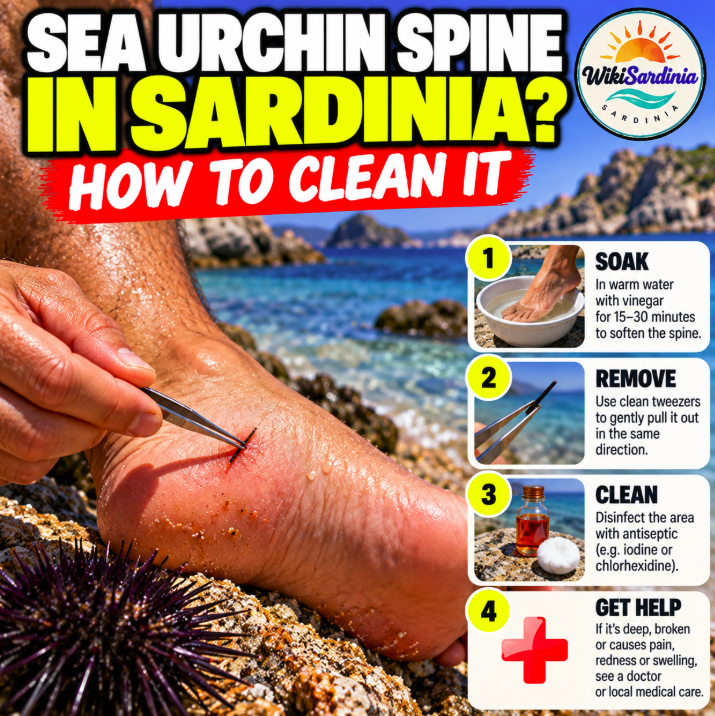
Stepped on a sea urchin in Sardinia? Sea urchin spines can break under the skin and cause pain, swelling and irritation. If a spine is stuck in your foot, don't panic—but don't dig into the skin with a needle or blade, either. The safest next step depends on whether the spine is superficial or deeply embedded.
Important: vinegar and tweezers are often suggested online, but they are not a guaranteed fix. Tweezers may be suitable only for a spine that is clearly visible, close to the surface and easy to grasp. Vinegar is not a substitute for medical assessment, and you should not delay care if the spine is deep, pain is severe or walking is difficult.
What to do immediately
- Get out of the water carefully and sit somewhere safe. Avoid putting more pressure on the injured foot.
- Rinse the area with clean water and gently wash around it with soap and water. Do not rub or squeeze the puncture.
- For pain, soak the foot in hot—but not scalding—water if you can do so safely. Sea urchin injuries are often treated with hot-water immersion for pain relief; test the temperature carefully and avoid burns, especially if sensation or circulation is reduced.
- Do not dig for broken fragments. If a spine is deep, broken off, near a joint or under a toenail, seek medical care.
- Check your tetanus vaccination status and ask a healthcare professional whether a booster is needed.
Can you remove a sea urchin spine with tweezers?
If a small spine is completely visible, superficial and can be lifted out easily, clean tweezers may help. Pull gently without squeezing or crushing it. Stop if it breaks, resists removal or causes significant pain.
Sea urchin spines are brittle. Trying to remove deeply embedded fragments at home can push them farther in or break them. A clinician may need to assess the wound and decide whether imaging or a procedure is appropriate.
Does vinegar dissolve sea urchin spines?
Vinegar is a traditional home remedy sometimes recommended for certain superficial sea urchin spines, but its effectiveness is uncertain and it will not reliably remove every fragment. Do not pour vinegar into a deep wound or use it instead of medical care. If a spine is embedded, pain persists or the area is worsening, get medical advice.
Do not use urine, alcohol, bleach, harsh disinfectants or improvised chemicals on the puncture. Avoid cutting the skin or using a needle to dig out a fragment.
When should you see a doctor?
Seek prompt medical assessment if:
- a spine is deeply embedded, broken off or difficult to remove;
- the injury is near a joint, tendon, nail or the sole where you bear weight;
- you have severe or persistent pain, significant swelling or trouble walking;
- redness spreads, the area becomes increasingly warm, pus appears or you develop a fever;
- you have numbness, reduced movement or a feeling that a fragment remains inside;
- you have diabetes, poor circulation or a weakened immune system.
Get emergency help for severe symptoms or a serious allergic reaction. In Italy, call 112 for an emergency.
Can sea urchin spines cause infection?
Yes. A puncture can introduce bacteria, and retained fragments may cause persistent inflammation or a foreign-body reaction. Do not assume that a dark spot in the skin is harmless, especially if pain, swelling or redness continues or worsens.
Keep the wound clean and follow medical advice about dressing, follow-up and infection symptoms. Do not take leftover antibiotics or apply prescription medication without professional guidance.
Can you walk after stepping on a sea urchin?
Try to avoid pressure on the injured foot until you know how serious the puncture is. If walking is painful, the spine is in the sole or heel, or you suspect a fragment remains, seek medical advice rather than forcing yourself to walk along the beach.
How to avoid sea urchin injuries in Sardinia
- Wear suitable water shoes in rocky areas, while remembering that they may not protect against every spine.
- Look carefully before stepping on submerged rocks or entering shallow water.
- Do not stand on or handle sea urchins.
- Follow local beach warnings and ask lifeguards about rocky entry points.
Useful Italian phrases
- Ho una spina di riccio di mare nel piede. — I have a sea urchin spine in my foot.
- La spina è ancora sotto la pelle. — The spine is still under the skin.
- Mi fa male quando cammino. — It hurts when I walk.
- Dove si trova la guardia medica? — Where is the medical service?
- Devo controllare il richiamo antitetanico? — Do I need to check my tetanus booster?
Frequently asked questions
Should I use vinegar on a sea urchin spine?
Vinegar is sometimes suggested for superficial spines, but it is not a guaranteed treatment and should not delay medical care for embedded fragments or worsening symptoms.
Can I pull the spine out with tweezers?
Only if it is clearly superficial, fully visible and comes out easily. Do not dig, squeeze or persist if it breaks or resists removal.
Should I soak my foot in hot water?
Hot-water immersion may help pain. Use hot, not scalding, water and take care to prevent burns. Seek medical assessment when the injury is deep or symptoms are significant.
Will a sea urchin spine dissolve by itself?
Some tiny fragments may gradually work their way out, but retained spines can cause ongoing inflammation. Do not rely on this if pain persists or the fragment is deep.
When is the injury urgent?
Seek prompt care for deep or multiple spines, severe pain, trouble walking, infection signs, numbness or a wound near a joint. Call 112 for a medical emergency.
The bottom line
If a sea urchin spine is stuck in your foot in Sardinia, wash the area, avoid pressure and don't dig into the skin. Tweezers may be appropriate only for a clearly superficial spine that comes out easily. Vinegar is not a guaranteed solution. For deep fragments, severe pain, difficulty walking or signs of infection, seek medical care and check your tetanus status.
Medical sources
MSD Manual — Sea Urchin Stings; Healthdirect Australia — Sea urchin stings; CDC — Tetanus information. General information only; not a diagnosis or a substitute for professional medical care.


