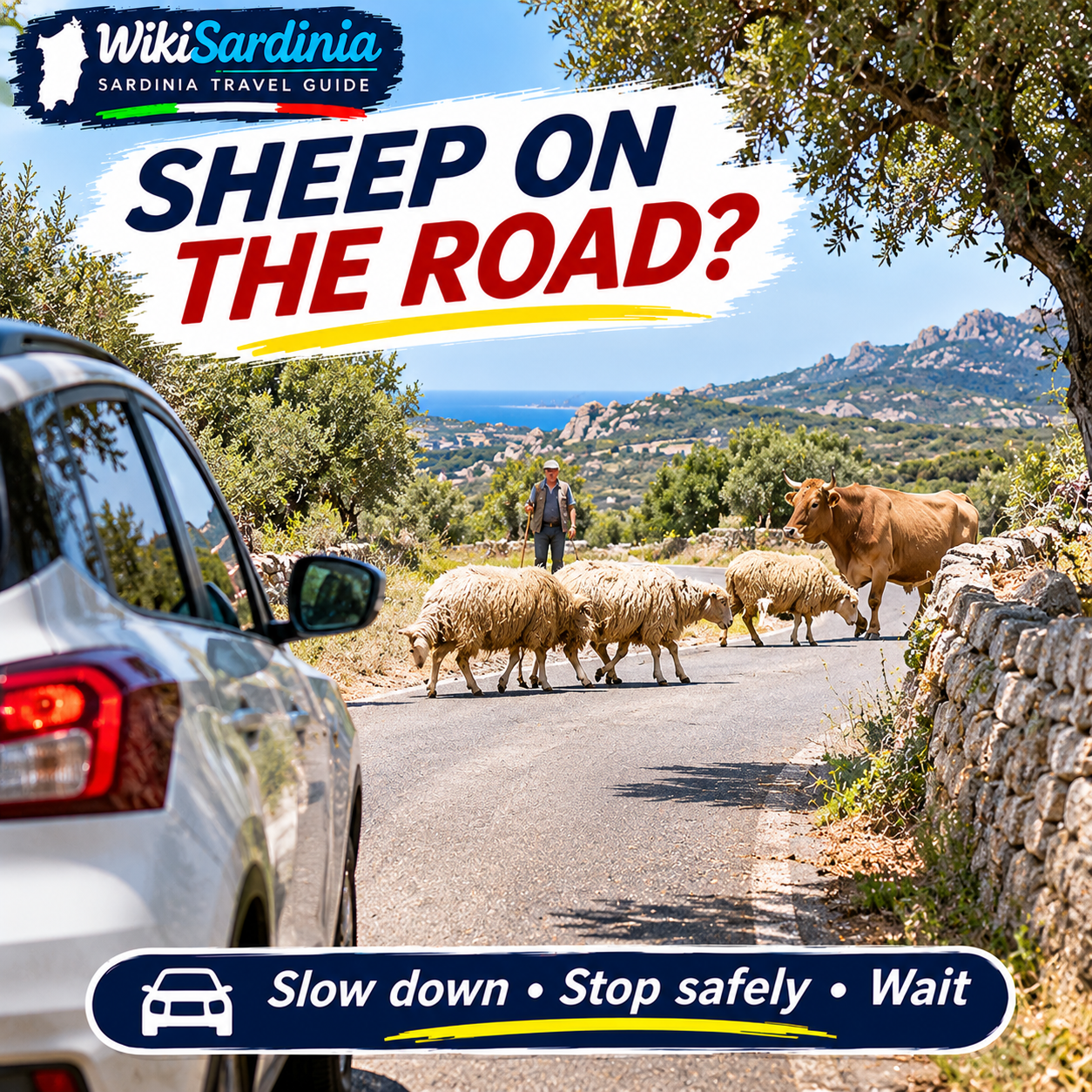
You are driving through rural Sardinia, following a narrow road between dry-stone walls and rolling hills, when a flock of sheep appears around the next bend. Or perhaps a cow is standing right in the middle of the lane, apparently in no hurry to move. What should you do?
Slow down smoothly, stop at a safe distance and wait for the animals to clear the road. Do not drive into the herd, repeatedly sound your horn, attempt a risky pass or get out to push the animals aside. On country roads, a little patience is safer for you, your passengers and the livestock.
Is it common to find sheep or cows on Sardinian roads?
Yes, encounters with farm animals can happen on rural routes, particularly in inland and agricultural areas. Sheep, goats, cattle and occasionally pigs may cross or occupy narrow roads. The official regional tourism website, SardegnaTurismo, warns drivers to pay attention to animals crossing inland roads. Local travel guides also describe sheep and cows on country roads.
That does not mean every road is regularly blocked by livestock. The important point is that drivers should be prepared for an unexpected animal around a bend, especially where visibility is limited.
What should I do immediately if a sheep or cow blocks my lane?
- Reduce speed gently. Brake progressively rather than making a sudden steering manoeuvre, provided you can stop safely.
- Stop with room to spare. Keep a comfortable distance so the animals do not feel trapped against the car.
- Stay inside the vehicle. Keep doors closed and do not reach out to touch or feed livestock.
- Wait quietly. Let the animals cross or move away naturally, and watch for more animals following behind.
- Follow the shepherd's directions. If a herder is present, allow them to manage the animals and indicate when it is safe to proceed.
- Move off only when the road is genuinely clear. Check both sides, drive slowly and leave plenty of space.
Should I honk the horn to make the animals move?
Avoid using the horn to hurry or frighten the animals. Sudden noise may startle a sheep or cow and cause unpredictable movement. Sardinia-focused driving advice specifically recommends waiting calmly instead of sounding the horn at a flock.
A horn can be a legitimate safety warning in other driving situations, but using it repeatedly to force livestock aside is not a sensible strategy.
Can I drive slowly through a flock of sheep?
Do not force a path through a group of animals. Sheep may move unpredictably, including back toward your vehicle, and lambs may follow adults across the road. Wait for the group to clear, even if it takes a few minutes.
If an authorised shepherd directs traffic and clearly indicates a safe opportunity to pass, follow their guidance cautiously. Never assume a small gap means the entire flock has finished crossing.
What if a cow refuses to move?
A cow is a large animal capable of causing serious injury or vehicle damage. Stay in the car, keep a safe distance and allow it space. Do not walk toward it, shout, wave your arms or try to push it. Be especially careful around calves, because a protective adult may react unpredictably.
If the animal remains in place and there is no safe way through, wait or consider turning around only if you can do so without creating another hazard. If the road remains dangerously obstructed, contact the appropriate local authorities; call 112 when there is an immediate danger or a serious incident.
Should I get out to take a photograph?
Photographing livestock from a safe position inside a stopped vehicle may be possible if it does not distract you or obstruct traffic. Do not step into the road or approach animals for a selfie. A sheepdog may be working nearby, and a cow or bull may react defensively if approached.
Do not block the road longer than necessary just to take photographs, and never leave your vehicle where it creates danger for other road users.
What if there is a shepherd or sheepdog nearby?
Shepherds and their dogs may be moving animals between grazing areas. Stay back and let them work. Sheepdogs are not pets waiting for attention: avoid calling them over, feeding them or trying to separate them from the flock.
If the shepherd signals you to wait, wait. If they indicate that the road is clear, proceed cautiously and watch for stragglers.
Do animals have the right of way in Sardinia?
There is no need to rely on a slogan such as “sheep always have right of way” to know what to do. Italian road-safety law requires drivers to adjust their speed and, where necessary, stop when animals on the road show signs of fright. Article 141 of the Italian Highway Code addresses appropriate speed and caution; Article 184 governs the movement and control of livestock on roads.
Under Article 184, published by ACI, herds and flocks on roads are subject to rules about supervision and safe movement. Those rules do not justify driving into animals because you believe a shepherd should have kept them off the road.
Are sheep and cows more dangerous at night?
They can be much harder to see after dark, particularly on unlit country roads. Drive at a speed that lets you stop within the visible distance, pay attention to warning signs and avoid assuming that a quiet road is empty.
At dusk and dawn, visibility can change quickly. Animals may emerge from vegetation or around blind bends. Keep headlights correctly adjusted and avoid sudden evasive manoeuvres that could send the car into a wall or ditch.
What if the road is too narrow to pass safely?
Wait for the animals to move completely out of your path. Do not mount a steep verge, drive into a drainage ditch or scrape past a stone wall just to save time. Narrow rural roads may also carry oncoming traffic even when no centre line is painted.
If you must reverse or turn around, do so only when visibility, road width and traffic conditions make the manoeuvre safe. A longer alternative route is preferable to damaging a rental car or injuring an animal.
What should I do if an animal runs toward the car?
Remain inside, stop and give it room. Keep the windows closed if the animal is very close, and do not try to scare it away with sudden movements. If the animal touches the vehicle, avoid accelerating or turning sharply while it is alongside the car.
What if I accidentally hit a sheep or cow?
Stop as safely as possible and protect yourself and other road users. If anyone is injured or the situation presents immediate danger, call 112. Do not approach an injured or frightened animal, which may kick, charge or bite. Contact the authorities for guidance and notify your rental company or insurer promptly.
Document the location and circumstances when it is safe to do so, and follow the instructions of police or other responders. Responsibility for an incident depends on the facts and applicable law; it is not automatically assigned to the driver or the animal's owner in every case.
What if the road is blocked for a long time?
Give the animals and their handler time to clear the road. If the obstruction continues and creates a serious hazard, report the precise location to the relevant local authority or emergency service as appropriate. Describe the road name or number, nearest junction and approximate number of animals. Use 112 for immediate danger, not merely because you are impatient.
Should I feed or pet animals beside the road?
No. Feeding livestock may encourage them to approach vehicles, and unfamiliar animals can react unpredictably. Respect fences, gates and private property. Do not open a gate to move a herd or let animals out of a field.
Where in Sardinia might I encounter livestock?
Rural encounters are possible across the island, including agricultural and mountain areas of the interior. Travellers driving through Barbagia, the hills around Nuoro, parts of Gallura or other pastoral landscapes should be attentive. The risk depends on the specific road, time and local activity—not simply the name of the region.
Popular scenic routes and roads to agriturismi can be narrow or winding. Ask your host about access conditions, particularly if your accommodation is reached by an unpaved farm road.
Can Google Maps send me onto roads used by livestock?
Navigation apps may recommend short rural routes that are narrow, steep or unpaved. Review the route before setting off, especially when heading to isolated beaches, farms or country accommodation. If a road looks unsuitable for your rental car, use a safer alternative instead of following the app blindly.
How should I drive on narrow Sardinian country roads?
Keep your speed appropriate to the available visibility and road width. Expect sharp bends, dry-stone walls, agricultural vehicles, cyclists and occasional animals. Do not copy the speed of a local driver who knows the road. Where safe, allow faster vehicles to pass rather than feeling pressured to accelerate.
The official SardegnaTurismo driving guide recommends extra attention on inland roads because animals may cross.
Useful Italian phrases
- Pecora: sheep
- Gregge: flock of sheep
- Mucca / vacca: cow
- Mandria: herd
- Pastore: shepherd
- Cane da pastore: sheepdog
- Animali sulla strada: animals on the road
- Strada stretta: narrow road
- Attenzione, animali: caution, animals
- La strada è bloccata: the road is blocked
- Possiamo passare?: may we pass?
- Serve aiuto?: do you need help?
Frequently asked questions
What should I do if sheep block a road in Sardinia?
Slow down, stop at a safe distance and wait quietly for the flock to clear. Follow the shepherd's instructions if one is present.
Can I honk to make a cow move?
Avoid honking to frighten or hurry livestock. It can provoke unpredictable movement.
Should I get out of the car?
Usually no. Staying inside is safer than approaching a cow, sheepdog or large flock.
Can I drive slowly between sheep?
Do not force a passage through the flock. Wait until the road is clear or a shepherd safely directs traffic.
Are cows dangerous to tourists?
Large livestock can injure people if startled or approached, particularly near calves. Keep your distance.
Are there sheep on roads near Alghero?
Animals may be encountered on rural roads in the wider countryside, but no particular road is guaranteed to have livestock on it.
Is it safe to drive in rural Sardinia after dark?
Use extra caution because animals, bends and narrow roads can be difficult to see. Adjust your speed to visibility.
What if an animal blocks the road for 20 minutes?
Wait if it is safe to do so, or take a safe alternative route. Report a prolonged dangerous obstruction to the appropriate authorities.
Who is responsible if I hit a farm animal?
Liability depends on the circumstances and applicable law. Notify the authorities and your rental company or insurer, and preserve relevant details.
What emergency number should I call after a serious collision?
Call 112 if someone is injured or there is an immediate danger.
The bottom line
If a sheep or cow blocks a narrow road in Sardinia, the best approach is slow down, stop safely, stay calm and wait. Do not frighten, touch or try to drive through the animals. Give the shepherd room to work, watch for stragglers and continue only when the road is clear. A brief delay is part of travelling responsibly through Sardinia's rural landscapes.