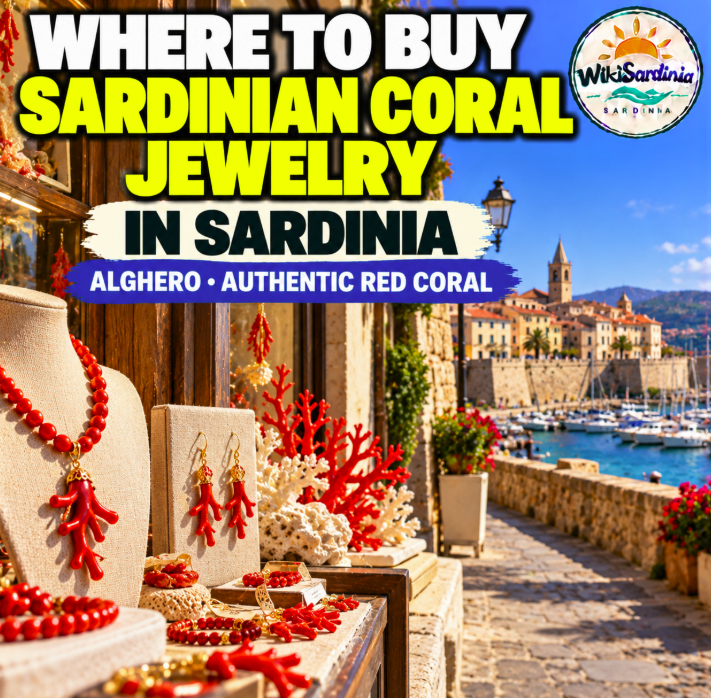
Where is the best place to buy authentic Sardinian coral jewelry? Alghero, on Sardinia's northwestern coast, is the natural starting point. The city is closely associated with Mediterranean red coral, so much so that its coastline is known as the Riviera del Corallo, or Coral Riviera. Visitors can explore jewelry boutiques and artisan-oriented shops in the historic center while discovering a craft with deep local roots.
However, a red necklace sold in Alghero is not automatically made of genuine Mediterranean coral, and a piece made of real coral is not necessarily sourced from Sardinian waters or crafted locally. The key is to ask questions, examine documentation and choose a seller who is transparent about the material and its origin.
Why Alghero is famous for red coral
Alghero's identity has long been linked to the Mediterranean red coral species Corallium rubrum. Coral has influenced the city's jewelry traditions, commercial history and imagery, while the surrounding coastline carries the evocative name Coral Riviera.
In workshops and boutiques, coral may appear as beads, pendants, earrings, rings and decorative details. The best shopping experience is not just about finding a beautiful red object; it is about understanding what the object is, where it came from and how it was made.
What is genuine Sardinian red coral?
The material most closely associated with traditional Alghero coral jewelry is Corallium rubrum, a marine animal species that forms branching colonies and a hard red or pinkish skeleton used in ornamental work. It is not a stone or a plant.
Natural red coral can vary in shade, from lighter pinkish tones to deeper reds. Color alone does not prove species, origin or quality. The term “Sardinian coral” may be used loosely in tourist retail, so ask for the exact species and a credible explanation of provenance.
Where should you shop in Alghero?
Start in and around Alghero's historic center, where visitors can compare jewelry shops and ask about artisan production. Look for businesses that clearly describe the materials they use, can explain the difference between natural coral and imitation, and provide receipts and written product details.
Do not assume that every store advertising corallo sells coral harvested in Sardinia. Some pieces may be imported, assembled locally from sourced materials or manufactured elsewhere. That does not automatically make them inferior, but the origin should be represented accurately.
Opening hours and stock change throughout the year. Check the specific retailer before making a special journey, especially outside the summer season.
How can you tell if coral jewelry is authentic?
The most reliable approach is documentation from a reputable seller and, for valuable pieces, an independent qualified gemological assessment. Visual appearance alone cannot reliably identify every coral material or treatment.
Ask the retailer to identify the material by species, disclose any dyeing, coating, filling or other treatment, and explain whether the beads are natural coral, reconstructed material or an imitation. A clear invoice should describe what you purchased.
Beware of online “tests” involving scratching, acids, hot needles or chemicals. These can damage jewelry, are not definitive and should not be used on a purchased piece.
Real coral versus imitation coral
Jewelry sold in coral-like colors may be made from dyed stone, resin, glass, ceramic or other materials. Some products are deliberately styled to resemble coral, which is perfectly legitimate if labeled honestly.
Problems arise when imitation material is sold as natural Corallium rubrum or when a piece is advertised as Sardinian without evidence of that provenance. Ask for the material name in writing rather than relying on terms such as “coral-style,” “Mediterranean red” or “artisan red.”
What should a coral certificate tell you?
A useful seller's document should clearly identify the piece and provide meaningful information, such as the declared species, whether it is natural or reconstructed, known treatments, and the seller's identity. If a seller claims a specific geographical origin, ask what evidence supports it.
Not every attractive certificate is an independent laboratory report. A shop-issued certificate may simply record the seller's declaration. For an expensive purchase, ask whether independent verification is available and understand exactly what the document guarantees.
Does dark red coral mean higher quality?
Not necessarily. Color is only one factor. Craftsmanship, condition, size, matching, surface quality, design and authenticity all matter. Market preferences can favor certain shades, but there is no universal rule that the darkest piece is always the best or most valuable.
Inspect beads and settings carefully, especially if a piece is presented as handmade. Ask whether the metal is sterling silver, gold or another alloy, and request the appropriate markings and description.
Is Sardinian coral jewelry handmade?
Some pieces may be cut, polished, assembled or set by skilled local artisans, while others may be manufactured or assembled elsewhere. A shop's location in Alghero does not prove where each stage of production occurred.
If local craftsmanship matters to you, ask who designed the piece, who worked the coral and who assembled the finished jewelry. A transparent artisan should be able to describe their role without inventing a romantic story about the product.
Is harvesting red coral environmentally sensitive?
Yes. Mediterranean red coral is a living marine organism, and its collection is subject to management measures and legal restrictions. Collection rules can differ by jurisdiction and may change over time.
Buyers should avoid assuming that any red coral offered for sale is sustainably or legally harvested simply because it appears in a reputable-looking tourist shop. Ask about lawful sourcing, traceability and relevant documentation. When evidence is unclear, consider jewelry made from other materials instead.
Never attempt to collect coral while swimming or diving. Protected-area and collection rules apply, and damaging living colonies harms the marine environment.
Can you take coral jewelry home on a flight?
Finished jewelry is generally easy to pack, but wildlife-trade, customs and import rules may apply depending on the species, origin, destination and nature of the item. Do not assume that a receipt automatically satisfies every border requirement.
Before international travel, check the current rules with the relevant customs and wildlife authorities, especially if traveling outside the European Union. The exact scientific species name is important for determining whether any special documents are required. Regulations and exemptions are complex and can change.
How much does authentic red coral jewelry cost?
Prices vary widely with the material, size, workmanship, precious-metal setting, provenance and retailer. A simple pair of earrings and a substantial necklace are not directly comparable.
There is no trustworthy single “Alghero coral price” without examining specific current items. Be cautious of claims that unusually cheap, uniformly colored jewelry must be genuine Sardinian coral. Compare multiple sellers and ask for written specifications before purchasing.
What to ask before buying coral in Alghero
- È corallo rosso naturale? — Is this natural red coral?
- È Corallium rubrum? — Is it Corallium rubrum?
- Da dove proviene? — Where does it come from?
- È stato tinto o trattato? — Has it been dyed or treated?
- È lavorato ad Alghero? — Was it crafted in Alghero?
- Avete documentazione sulla provenienza? — Do you have provenance documentation?
- Potete indicare il materiale sulla ricevuta? — Can you specify the material on the receipt?
- Ci sono documenti necessari per esportarlo? — Are any export documents required?
What type of coral jewelry makes a good souvenir?
For travelers who want something wearable and understated, small pendants or earrings can be appealing. Necklaces, rings and more elaborate settings may suit special occasions or gifts.
Choose a design you genuinely enjoy, not just a color or a claim of rarity. If you are buying for someone else, ask about metal allergies, sizing and return policies.
How to care for red coral jewelry
Coral is an organic gem material and can be sensitive to chemicals, abrasion and heat. Keep it away from perfumes, harsh cleaning products and prolonged direct sunlight. Wipe gently with a soft cloth and store separately from harder jewelry that could scratch it.
Ask the seller for care instructions specific to the piece, especially if it includes delicate settings or treated material. Avoid ultrasonic cleaning unless a qualified professional confirms it is suitable.
When is the best time to shop in Alghero?
Alghero is lively in summer, when many visitor-oriented shops operate extended schedules. Spring and autumn can offer a more relaxed shopping experience, though some businesses reduce their hours outside peak season.
If you want to speak with an artisan about a particular piece or a custom order, contact the shop in advance rather than assuming the maker will be present throughout the day.
What else can you discover in the Coral Riviera?
A jewelry-shopping visit can be combined with a walk through Alghero's historic streets and seafront. The name Riviera del Corallo reflects the area's relationship with the sea, but the coast is also valued for its landscapes, marine life and protected environments.
Learning about the ecology of red coral can make a jewelry purchase more thoughtful. The living organism is part of the Mediterranean ecosystem, not merely a decorative raw material.
Frequently asked questions
Where is the best place in Sardinia to buy red coral jewelry?
Alghero is a natural starting point because of its longstanding connection with Mediterranean red coral and its concentration of jewelry shops.
Is all coral sold in Alghero genuine?
No. Materials and origins vary. Ask for the species, treatment disclosures and written product details.
What is authentic Sardinian coral called?
The traditional Mediterranean red coral species is Corallium rubrum. A species identification alone does not prove that the material was collected in Sardinia.
Can fake coral look real?
Yes. Dyed stone, resin, glass and other materials can resemble coral. Visual tests are unreliable for definitive identification.
Does a certificate guarantee Sardinian origin?
Not automatically. Check who issued it, what it actually states and whether the provenance claim is supported.
Is red coral protected?
Collection and trade can be regulated. Requirements vary by location and destination, so check current rules.
Can I bring coral jewelry back to the United States?
Import requirements depend on the exact species and item. Check current U.S. customs and wildlife rules before traveling and retain documentation.
Is coral jewelry expensive?
Prices range widely by size, quality, design and workmanship. Compare verified items rather than relying on a fixed tourist price.
Can I buy handmade coral jewelry in Alghero?
Yes, locally crafted pieces may be available, but verify who made the jewelry and which production stages occurred in Alghero.
What if I prefer not to buy animal-derived coral?
Choose jewelry made from glass, ceramics, metal, stone or other clearly labeled alternatives inspired by Sardinian colors and designs.
The bottom line
Alghero is one of Sardinia's most meaningful places to look for traditional red coral jewelry. Its identity as the Coral Riviera gives the shopping experience cultural context, but authenticity should never be taken for granted. Ask for the scientific species, clear provenance, treatment information and honest details about local craftsmanship. A thoughtful purchase respects both the artisan's work and the marine environment that made the tradition possible.
Useful resources
SardegnaTurismo — Official Sardinia tourism information; Map search — Coral jewelry shops in Alghero; CITES — International wildlife trade information; Italian Customs and Monopolies Agency. Verify retailer credentials and destination-specific rules before purchase or travel.