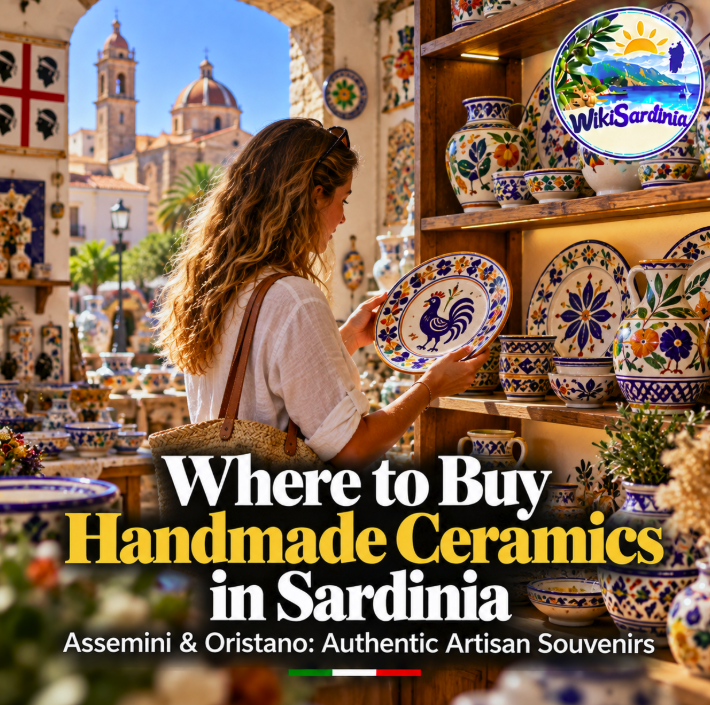
If you want to bring home one genuinely Sardinian object rather than another mass-produced souvenir, make it a piece of handmade ceramic.
And if pottery is the reason for the trip, start with Assemini. The town just outside Cagliari has such a strong relationship with clay and pottery that its municipal planning documents describe ceramics as part of the community's cultural identity, with a tradition stretching back through Punic and Roman production to workshops that remain active today.
Oristano is the other strong stop, especially if your route is already taking you through central-western Sardinia.
Why Assemini is our first choice
Assemini is not simply a town where somebody happens to sell pottery. Ceramics are woven into its local identity.
Municipal historical documentation records ancient pottery activity around the Santa Gilla area and describes the continuing skill of Assemini's ceramic artisans. The town developed a dedicated ceramics centre and has continued supporting workshops, exhibitions and public ceramic projects.
Assemini has also participated in Buongiorno Ceramica, the nationwide event connecting Italy's recognised ceramics towns, since the initiative began in 2015.
That makes it an excellent destination for travellers who want to buy from a working ceramic tradition rather than simply find a souvenir shop.
What should you buy?
Do not limit yourself to decorative plates.
Depending on the workshop, Sardinian ceramics can include bowls, pitchers, cups, serving dishes, tiles, sculptural pieces and contemporary interpretations of traditional forms.
For an American traveller, a small bowl or serving plate is often the ideal compromise: distinctly Sardinian, useful at home and easier to pack safely than a large vase.
Look for the maker, not just the motif
A Sardinian-looking design does not automatically mean an object was made in Sardinia.
If authenticity matters, ask the simplest possible question: “È fatto qui?” — “Is it made here?”
Better still, buy directly from a workshop where you can identify the artisan who produced the piece.
Small variations in glaze, shape and decoration are not defects. In genuinely handmade pottery, they are often part of the appeal.
Why Oristano belongs on the ceramics route
Oristano has its own important ceramic culture and a formal connection with Assemini.
Assemini's municipal planning documents record a cooperation agreement with the Municipality of Oristano aimed at supporting the growth of artistic ceramics, addressing challenges such as generational renewal and access to markets.
The agreement also involves Oristano's artistic education tradition, including the ceramics programme associated with the Carlo Contini art institute.
For visitors, that means Oristano is not merely a convenient shopping alternative: it belongs to the same broader effort to preserve and develop Sardinian ceramic craftsmanship.
Traditional does not have to mean old-fashioned
One of the most interesting things about buying ceramics in Sardinia today is seeing how artisans reinterpret local visual language.
You may find pieces inspired by birds, fish, plants, geometric decoration or forms associated with older Sardinian pottery, alongside extremely clean contemporary designs.
If your home does not suit rustic folk decoration, do not assume Sardinian ceramics are not for you. Look for a studio combining traditional techniques with modern forms.
How much should handmade ceramics cost?
There is no meaningful single price because size, technique, firing, decoration and the reputation of the artisan all matter.
A small handmade object can still be affordable, while a large hand-decorated centrepiece may cost considerably more.
Instead of searching only for the lowest price, compare the object with mass-produced souvenir ceramics. You are paying for small-scale production and the maker's work, not just clay.
Ask how to pack it
If the piece is travelling back to the United States, tell the shop.
Experienced ceramic sellers are accustomed to visitors and may be able to package the object far better than you could with clothes and a supermarket bag.
For hand luggage, smaller pieces are easier. If you buy several items, ask whether the workshop offers shipping before assuming you need to carry everything home yourself.
What about the famous Sardinian symbols?
You will see ceramics using imagery associated with Sardinia, but do not buy purely because a piece contains an obvious island symbol.
The more interesting souvenir is often something whose connection with Sardinia comes from the maker, clay tradition and technique rather than a stereotypical graphic added for tourists.
Ask the artisan about the design. The story behind a piece can be more memorable than the decoration itself.
Make Assemini a stop from Cagliari
Assemini is particularly practical because it is close to Cagliari.
You do not need to dedicate an entire day to souvenir shopping. It can be combined with another southern Sardinia itinerary, while still giving you access to a town where ceramics are an actual local craft.
If ceramics are a major interest, however, slow down and visit more than one workshop. Different makers can have dramatically different styles.
Oristano works perfectly on a west-coast trip
Oristano makes more sense if you are travelling between Cagliari and the central or north-western coast, or exploring the Sinis Peninsula.
Combine ceramics shopping with the area's archaeology, food and nearby wetlands rather than making the city a standalone shopping mission.
That turns the souvenir into part of the journey rather than something bought hurriedly at the airport.
WikiSardinia verdict
For “Sardinia best place to buy handmade ceramics,” our first recommendation is Assemini.
It has a documented, living ceramic tradition, active artisan culture and a public commitment to preserving and promoting the craft.
Oristano is the excellent second stop, particularly for travellers already exploring western Sardinia.
Skip the anonymous souvenir shelf. Find a workshop, ask who made the piece and take home something whose connection to Sardinia continues after your holiday ends.