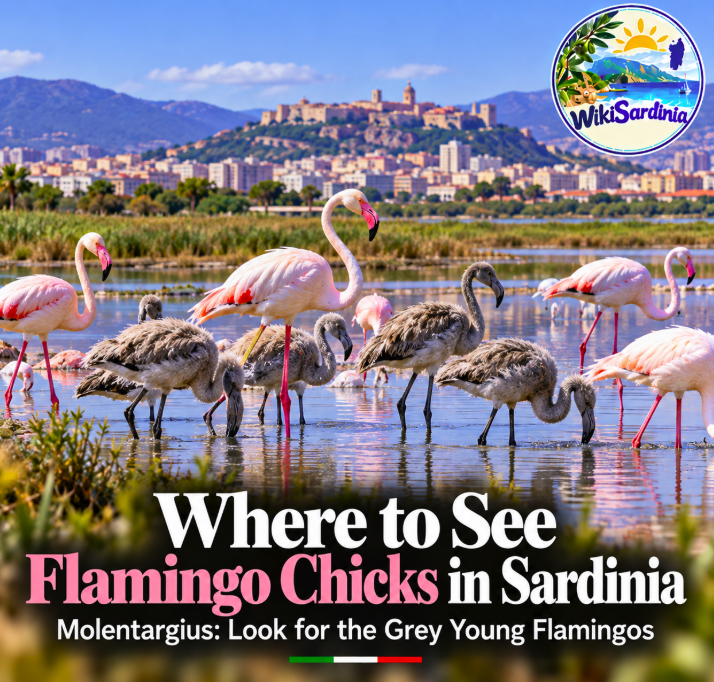
If you are in southern Sardinia right now and wondering why some of the flamingos are grey instead of pink, you may be looking at this year's young birds.
Molentargius, between Cagliari and Quartu Sant'Elena, is the place to go. The latest official figures, released on October 1, 2026, confirm an exceptional breeding season: 3,710 young flamingos reached the stage close to fledging from 6,562 breeding pairs.
That represents a reproductive success rate of 57% — the best result recorded at Molentargius in the last ten years.
Can you see flamingo chicks at Molentargius now?
Yes, with one important distinction. In October you are no longer looking for tiny newly hatched fluffy chicks sitting around the nests.
The 2026 hatching season began around April 20 and was completed by approximately June 8. The first young birds began flying from the second week of August.
So what you can look for now are juvenile flamingos from the 2026 breeding season: larger young birds that are already mobile or flying but still have predominantly grey-brown plumage.
The official October update says the young flamingos have begun dispersing from Molentargius into the Mediterranean, so numbers will change as autumn progresses.
Why are baby flamingos grey?
Flamingos are not born pink.
Young greater flamingos start life covered in greyish down and later develop grey-brown juvenile feathers. Their famous pink coloration develops progressively as pigments called carotenoids from their diet accumulate in their plumage.
That is why a mixed group at Molentargius can contain brilliant pale-pink adults alongside unmistakably darker grey youngsters.
For visitors, October can actually make identification fun: instead of searching for tiny chicks hidden around a nesting colony, look for the obviously grey juveniles among the adults.
Where should you look?
The most important breeding area is around Bellarosa Maggiore. According to the official 2026 breeding report, nesting occurred on the lagoon's embankments, including the Quartu embankment and areas near the pylons.
SardegnaTurismo specifically recommends the park's guided birdwatching routes, including a hide facing Bellarosa Maggiore, where flamingos nest.
The birds are wild and move around the wetland, so there is no single point where a juvenile is guaranteed to be standing when you arrive.
Bring binoculars
This is one of those Sardinian experiences where binoculars genuinely improve the visit.
The birds should not be approached closely, particularly around sensitive wetland and breeding areas. SardegnaTurismo explicitly recommends bringing binoculars so visitors can observe the avifauna without disturbing it.
A camera with optical zoom is also much more useful than trying to get physically closer for a phone photo.
Why 2026 is a special year
The latest numbers are remarkable because the colony had fewer breeding pairs than in 2025 but produced more young birds reaching the pre-fledging stage.
In 2025, Molentargius recorded 7,730 breeding pairs and 3,599 young near fledging, giving a reproductive success rate of 47%.
In 2026, there were only 6,562 pairs, but 3,710 young reached that stage, pushing reproductive success to 57%.
The park says this is the highest rate of the last decade.
Why nesting success changes so much
Flamingos generally lay a single egg, so survival during the first weeks is crucial.
The official report identifies predation by yellow-legged gulls as one important pressure on chicks. The shape and width of nesting embankments can affect how exposed the young birds are to predators.
Water levels also played an important role in 2026. Heavy rainfall kept the lagoon unusually high early in the season, initially reducing the amount of exposed embankment available for nesting.
Management of the water allowed additional areas to emerge progressively, and the colony established itself in stages.
When is the best time to visit?
For seeing tiny chicks, late spring and early summer are better. For seeing grey juveniles alongside pink adults, late summer and early autumn can be excellent.
In October 2026, the opportunity is particularly interesting because thousands of young birds successfully reached the stage close to fledging this season.
Go earlier rather than waiting until winter: the official October update notes that dispersal has already begun.
How to visit Molentargius
The park sits immediately beside Cagliari and Quartu Sant'Elena, making it one of Europe's most accessible major wetlands.
Official access points include Via La Palma and the Poetto side in Cagliari, with additional entrances from Quartu Sant'Elena.
You can explore parts of the park independently on foot or bicycle, while guided visits offer access to birdwatching viewpoints and interpretation of the lagoon ecosystem.
Do not leave marked routes or attempt to approach the colony.
Combine flamingos with Poetto
One reason Molentargius is so easy to recommend is its location.
You can spend the morning watching flamingos and then continue directly to Poetto beach. The wetland and coastline sit beside each other, creating one of the most unusual urban landscapes in Sardinia.
For American visitors staying in Cagliari without a car, this is also considerably easier than planning a long wildlife excursion into the island's interior.
WikiSardinia verdict
For “Sardinia where to see pink flamingo chicks” right now, choose Molentargius.
But look for grey juveniles, not tiny pink babies. The youngest 2026 birds hatched months ago and many are now capable of flight.
With 3,710 young reaching the stage close to fledging, 2026 has been Molentargius' most successful flamingo breeding season of the last decade.
Bring binoculars, keep your distance and look for grey among the pink.