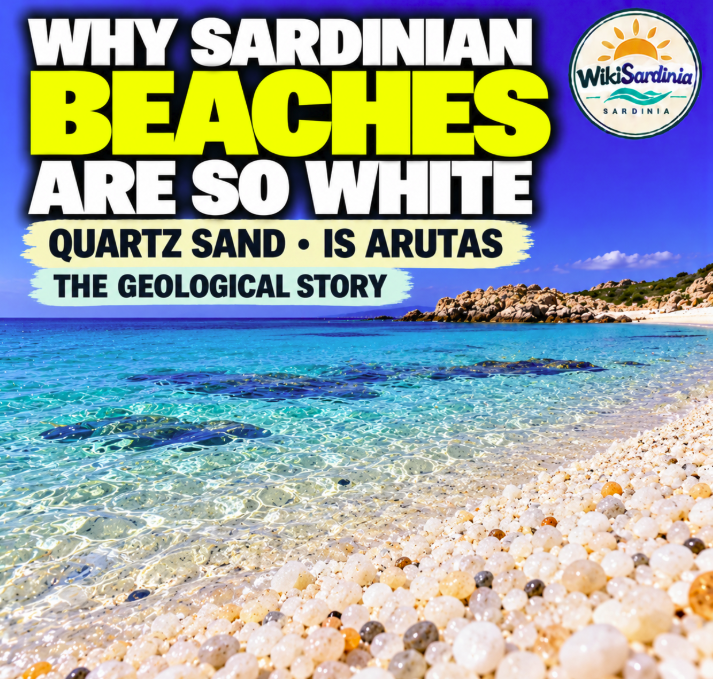
Why are so many beaches in Sardinia dazzlingly white? The answer is geology—but there is more than one geological recipe for a pale beach. Some of Sardinia’s famous shores contain abundant light-colored mineral grains, while others get their color from a mixture of quartz, shell fragments and other carbonate material. Is Arutas, on the Sinis Peninsula in western Sardinia, is especially famous for its rounded quartz grains.
Those grains are sometimes compared to tiny grains of rice because they are larger and more distinct than the fine sand found on many other Mediterranean beaches. They can appear white, translucent, pale pink, greenish or amber, giving the beach its remarkable mosaic-like texture.
What makes Is Arutas different from ordinary sandy beaches?
At Is Arutas, the most memorable feature is the texture: instead of a uniform blanket of fine powder, visitors see individual rounded mineral grains. Quartz is particularly prominent, and the grains can sparkle in sunlight.
Quartz is a durable mineral made of silicon dioxide, with the chemical formula SiO₂. It is common in many rocks, including granites and other crystalline formations. As rock breaks down through weathering and erosion, quartz grains can survive repeated transport and abrasion better than many less-resistant minerals.
That durability helps explain why quartz can become concentrated in some beach sediments over long periods.
How did the quartz reach the beach?
Beach sand begins with the breakdown of rock and other material. Rain, temperature changes, flowing water and waves gradually weather and erode rock, releasing mineral fragments. Those fragments can be moved by streams, coastal currents and waves before settling in places where the energy of the water allows them to accumulate.
In the Sinis region, geological history and coastal processes have helped create beaches rich in quartz grains. The exact pathways and ages of individual grains are more complex than the simple story that all the sand came from one nearby granite boulder. Over geological time, sediments may be transported, deposited, reworked and rounded more than once.
Wave action contributes to the smooth appearance of many grains: repeated collisions and abrasion can wear away sharp edges. The result is the distinctive rounded texture seen at Is Arutas and other quartz-rich beaches of the Sinis coastline.
Why are the grains white?
Pure quartz can be transparent or colorless, but tiny inclusions, fractures, surface textures and mixtures with other minerals affect how light passes through or scatters from a grain. Many quartz-rich sediments therefore look milky white or translucent. Other grains may carry subtle colors due to mineral inclusions or staining.
Under strong Sardinian sunlight, pale grains reflect and scatter considerable light, making the beach look exceptionally bright. The contrast with turquoise water amplifies the effect.
Are all white beaches in Sardinia made of quartz?
No. This is the most important misconception to avoid. The island has varied geology and coastal habitats. Some beaches contain abundant quartz and other silicate minerals, while others include significant amounts of biogenic carbonate material such as broken shells and fragments from marine organisms.
That means two beaches can look similarly white in photographs but have quite different grain sizes, mineral compositions and origins. The term “white sand” describes an appearance, not a single rock type.
What is the difference between quartz sand and shell sand?
Quartz sand consists mainly of grains of silicon dioxide, a mineral derived from rock. Shell-rich sand contains fragments of shells and other calcium-carbonate structures produced by marine organisms. Many natural beaches are mixtures of several components rather than pure examples of either category.
Under a hand lens, quartz grains may look glassy or translucent, whereas shell fragments can show curved, layered or porous structures. Color alone cannot reliably identify the composition.
Why does the water look turquoise at Is Arutas?
The spectacular blue-green color is not caused by quartz alone. Clear water, sunlight, depth, the color of the seabed and the way light is absorbed and scattered all contribute. Pale underwater sediment reflects light upward, helping shallow water appear bright turquoise.
Sea conditions also matter. Wind and waves can stir up sediment, making the water look less transparent. The same beach can change appearance dramatically from one day to the next.
Where exactly is Is Arutas?
Is Arutas is on the Sinis Peninsula, within the territory of Cabras in the province of Oristano, on Sardinia’s western coast. It is one of the area's best-known beaches, alongside other remarkable stretches of the Sinis shoreline.
The beach faces the open western sea, so conditions can be rough when winds and swell arrive from exposed directions. Visitors should check marine conditions before swimming and avoid assuming that clear-looking water is always safe.
Other quartz-rich beaches near Is Arutas
Mari Ermi
Mari Ermi, also on the Sinis coast, is known for pale, quartz-rich sand. Its grains and surrounding coastal landscape make it an appealing alternative for visitors exploring the area. Like Is Arutas, it deserves careful protection.
Maimoni
Maimoni is another notable beach in the Sinis area, with light-colored sand that includes quartz and other material. The exact composition and texture vary along the shoreline, so do not assume every nearby beach has identical sediment.
Why do the grains look like rice?
“Rice beach” is a popular visual comparison, not a scientific classification. The nickname refers to the unusually distinct, rounded grains that can resemble tiny rice kernels. The grains are mineral particles, not biological seeds or manufactured pebbles.
The size and roundness reflect the history of weathering, sediment transport and abrasion. Not every grain has the same shape, and the beach is not made of perfectly uniform pieces.
Can you take quartz sand home from Is Arutas?
No. Do not remove sand, pebbles, stones or shells from Sardinian beaches. Sardinia’s regional law protects beach material, and unauthorized removal can lead to significant administrative penalties. Regional Law No. 16 of 2017, Article 40, provides for fines from €500 to €3,000 for taking, possessing or marketing sand, pebbles, stones or shells from the shoreline without authorization.
Even a small souvenir jar contributes to damage when multiplied by many visitors. The best way to preserve the beach is to leave every grain where it belongs.
Why is removing a handful of sand harmful?
A beach is not an unlimited pile of replaceable material. Its sediment supply depends on geological processes that can be slow or interrupted. Beaches also respond to waves, storms, seasonal changes and human activity.
When thousands of visitors each take a small quantity, the total loss can become meaningful. Removing grains also damages the natural heritage and visitor experience of a distinctive place.
Is Is Arutas sand naturally replenished?
Beaches can receive and redistribute sediment through natural coastal processes, but that does not mean the distinctive quartz grains are replaced quickly or at the same rate at which people might remove them. Sediment budgets vary, and some sources are effectively limited on human timescales.
Protecting the existing sand is therefore much more sensible than assuming nature will immediately replace what is taken.
Does quartz sand get hot in the sun?
Any beach surface can become uncomfortably hot under strong sunlight. The temperature depends on grain color, moisture, wind, sun exposure and other factors. Do not assume white quartz is always cool enough to walk on barefoot. Test the surface and wear sandals when needed.
Is Is Arutas suitable for children?
The distinctive grains can be fascinating for families, but the beach is exposed to open-sea conditions. Depth, shore break, wind and currents can change. Closely supervise children, check warnings and avoid swimming when waves are strong. The larger grains may also feel different underfoot from fine sand.
When is the best time to visit Is Arutas?
Late spring, early summer and early autumn can offer pleasant conditions and fewer crowds than the busiest summer weeks, but weather is never guaranteed. In October, mild days are possible, yet stronger winds and swell can make swimming unsuitable.
For photography, softer morning or late-afternoon light can reveal the grains' subtle colors and textures. Bring a camera with a close-focus mode and take photos instead of souvenirs.
How to photograph the quartz without disturbing it
- Use a macro or close-up setting to capture the rounded grains.
- Photograph where wet and dry sediment meet to show the difference in color.
- Use side lighting to reveal texture.
- Do not collect or rearrange grains for a photo.
- Stay on designated paths and respect dune vegetation.
- Keep a safe distance from breaking waves when shooting near the water.
FAQ
Why is Is Arutas beach so white?
It contains abundant pale, rounded quartz grains that reflect and scatter sunlight, giving the beach its distinctive bright appearance.
Is Is Arutas made of rice?
No. The “rice grains” are naturally rounded mineral particles, especially quartz.
Is the sand at Is Arutas pure quartz?
Quartz is prominent, but natural beach sediments can include other mineral and biological components. Avoid assuming a perfectly pure composition.
Why are some grains pink or green?
Color differences can arise from mineral inclusions, coatings and variations in composition.
Are all Sardinian white beaches quartz beaches?
No. Some contain substantial shell and other carbonate fragments, while others have different mineral mixtures.
Can tourists take a small bottle of Is Arutas sand?
No. Unauthorized removal of beach material is prohibited and can lead to fines.
Where is Is Arutas located?
On the Sinis Peninsula near Cabras, on Sardinia’s western coast.
What other beaches near Is Arutas have quartz-rich sand?
Mari Ermi and Maimoni are two well-known nearby beaches with distinctive pale sediments.
Is Is Arutas good for swimming in October?
Sometimes, when the sea is calm, but the exposed coast can experience wind and swell. Check conditions on the day.
The bottom line
Sardinia's white beaches are the result of natural geology and coastal processes, not one universal type of sand. At Is Arutas, the star is quartz: durable mineral grains that have been weathered, transported and rounded over time. Their pale colors and distinctive texture make the beach unforgettable. Admire them, photograph them and leave them exactly where they belong.
Sources and further reading
SardegnaTurismo — Is Arutas; Sardinia Regional Law No. 16/2017; USGS — Sediment and transport basics. Geological composition and grain proportions can vary across beaches and even within one shoreline.