Imagine a summer evening at a Sardinian agriturismo: stone walls glowing in the sunset, olive trees outside your window and a long dinner of local food under the stars. Then a mosquito arrives. Should you expect insects to ruin a countryside stay in Sardinia?
Usually, no—but mosquitoes can be a genuine nuisance in summer, and the experience varies enormously by location, season, weather and property management. An agriturismo near irrigated gardens, ponds or standing water may have a different insect situation from a breezy farmhouse on a dry hillside. The right accommodation features and a small amount of preparation can make a big difference.
Are mosquitoes common in the Sardinian countryside?
Mosquitoes are part of Sardinia's natural environment, as they are across much of Mediterranean Europe. Warm weather and suitable breeding sites can increase their numbers. They are not confined to farms: mosquitoes can also occur in towns, coastal resorts, gardens and holiday apartments.
Conditions differ from one agriturismo to another. A rural property surrounded by greenery is not automatically mosquito-infested, and a hotel near the beach is not automatically mosquito-free. The presence of standing water, local vegetation, wind and prevention measures often matters more than the label on the accommodation.
When are mosquitoes most active?
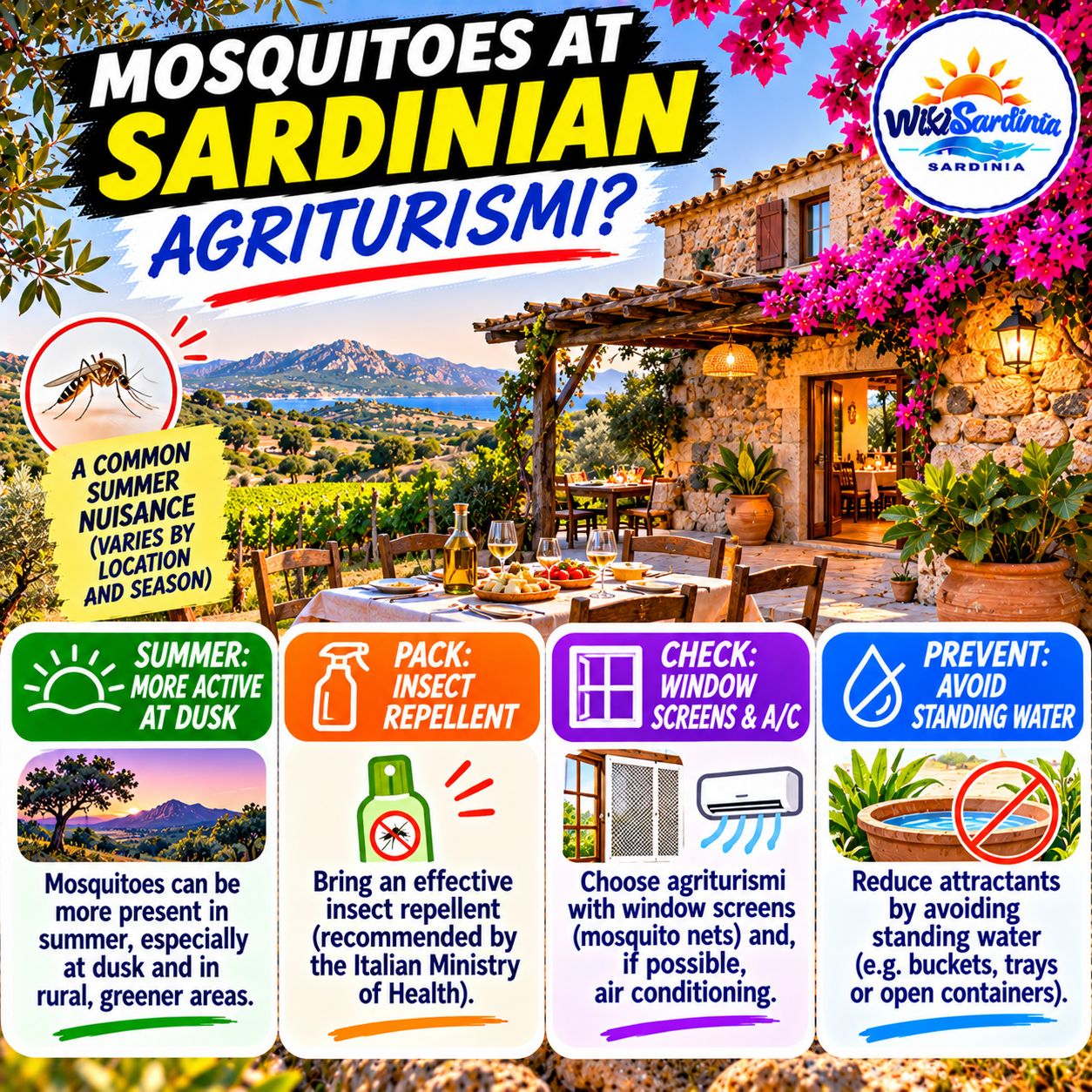
Many common mosquitoes are especially active around dusk, overnight and at dawn. The Asian tiger mosquito, however, may also bite during daylight hours, so it is worth using protection whenever insects are active rather than relying on one specific time of day.
Summer is a particularly relevant period, but mosquito activity can extend into milder parts of spring and autumn depending on local temperatures and rainfall. There is no single guaranteed 'mosquito-free month' for the entire island.
Which locations are more likely to have mosquitoes?
Areas with standing water, irrigation channels, ponds, wetlands, rainwater containers or poorly drained outdoor spaces can provide favourable breeding conditions. Even small amounts of water left in flowerpot saucers or buckets can support mosquito larvae. This is why Italian public-health authorities repeatedly recommend eliminating standing water around homes and accommodation.
Properties on exposed, breezy hillsides may feel more comfortable than sheltered, humid gardens, but wind is not a reliable substitute for protection. Ask about the specific property rather than assuming all inland or coastal locations behave alike.
What other insects might you see at an agriturismo?
Rural accommodation naturally brings you closer to insects and other small animals. Depending on the season and setting, you may encounter flies near outdoor dining areas, ants, moths attracted by lights, bees or wasps around flowers and food, and occasional spiders. These encounters do not automatically indicate poor hygiene.
If you walk through long grass or scrub, ticks are another reason to take sensible precautions: wear suitable clothing, stay on established paths where possible and check your skin and clothing after outdoor activities. Do not disturb nests or attempt to handle unfamiliar wildlife.
Do Sardinian mosquitoes carry diseases?
Most mosquito bites cause temporary itching and irritation, but mosquitoes can transmit infections. In May 2026, the Autonomous Region of Sardinia renewed its public-information campaign on mosquito-borne illnesses, including West Nile disease and other arboviruses. Italy's Ministry of Health also published summer 2026 advice about preventing West Nile infection.
That does not mean that a typical agriturismo guest is likely to become seriously ill, or that every mosquito carries a virus. It means that avoiding bites is sensible rather than merely cosmetic. Risk varies over time and place, and travellers should consult official health updates when planning their trip.
The Ministry of Health notes that most West Nile infections are asymptomatic and severe disease is uncommon, but some people—particularly older adults and those with certain vulnerabilities—are at greater risk of complications. If you develop concerning symptoms after mosquito exposure, seek medical advice.
What should you pack to prevent mosquito bites?
Bring an effective skin repellent appropriate for your age and circumstances, and follow the product label carefully. The Italian National Institute of Health identifies products containing ingredients such as DEET or icaridin among useful options. Do not apply repellent to irritated skin or use it in ways the label does not permit.
Lightweight long trousers and long-sleeved shirts are useful for evenings outdoors, particularly if you are sensitive to bites. A small anti-itch product may help with minor irritation, but ask a pharmacist or clinician which product is suitable for you. Families travelling with young children should check age-specific instructions for repellents rather than assuming every adult product is suitable.
What should you ask before booking an agriturismo?
The most useful questions are practical. Do bedroom windows have intact mosquito screens? Is air conditioning available, or can rooms be ventilated while windows remain screened? Are outdoor dining areas protected or managed to reduce insects? Have recent guests reported a persistent mosquito problem?
If you are especially sensitive to bites, ask the host directly about conditions during your travel month. A thoughtful, specific answer is more useful than a generic promise that there are 'no insects in the countryside.'
Are mosquito nets and air conditioning worth prioritising?
Yes. The Sardinian regional health campaign recommends choosing accommodation with window screens and, where possible, air conditioning. Screens help keep insects outside while allowing ventilation; air conditioning can make it easier to keep windows closed when necessary.
Inspect screens when you arrive and avoid leaving doors open at night with bright indoor lights attracting insects. If a screen is damaged, tell the host so it can be repaired.
How can you enjoy dinner outdoors without being eaten alive?
Apply repellent according to the label before sitting outside, especially if mosquitoes are active. Consider long, lightweight clothing, choose a breezier table when available and keep food covered where flies or wasps are present. Ask the host whether the dining area has fans or other sensible insect-management measures.
Be cautious about relying solely on scented candles, decorative gadgets or folk remedies. Their effectiveness varies, and they should not replace proven personal protection.
Are agriturismi less comfortable than hotels?
Not necessarily. Some agriturismi provide excellent modern rooms, well-maintained grounds, air conditioning and screened windows. Others are simpler, and a remote rural setting may mean more insects around outdoor spaces. The same differences can exist among hotels and holiday rentals.
An agriturismo offers the chance to experience Sardinian landscapes, local food and rural hospitality. A few insects outdoors are part of being in nature, but persistent insects inside bedrooms, damaged screens or standing water near rooms are reasonable issues to raise with the host.
What if you get bitten?
For an ordinary itchy bite, gently clean the area, avoid scratching and consider a cool compress. Seek medical help for signs of a severe allergic reaction, rapidly worsening swelling, fever or other concerning symptoms. If someone has difficulty breathing, swelling of the throat or collapses, call emergency services on 112.
Do not assume that fever after a bite is automatically caused by a mosquito-borne illness, but do tell a clinician about recent travel and insect exposure.
Frequently asked questions
Are mosquitoes worse at agriturismi than at beach hotels?
Not always. Conditions depend on water, vegetation, weather and insect-control measures. A coastal property near wetlands may have more mosquitoes than a breezy inland farmhouse.
Are mosquitoes bad in Sardinia in August?
They can be active in summer, but severity varies from one location and week to another. Pack repellent and ask your accommodation about screens.
Will I need a mosquito net over the bed?
Not necessarily if windows are properly screened and the room can be kept insect-free. A bed net may be helpful in accommodation without adequate screens.
Do mosquitoes bite during the day?
Some species do, including the tiger mosquito. Protect yourself whenever mosquitoes are active, not only after sunset.
Are there ticks in Sardinian countryside?
Ticks can occur in grassy or scrubby rural environments. Use suitable clothing and check for ticks after countryside walks.
Should I avoid booking an agriturismo because of insects?
Generally, no. Ask about mosquito screens, air conditioning and outdoor conditions, and bring repellent. Many travellers enjoy rural stays comfortably with basic precautions.
The verdict: don't skip the countryside—just come prepared
Mosquitoes are a real part of summer life in Sardinia, but they do not define the agriturismo experience. A well-maintained property, effective repellent, screened windows and sensible evening clothing can make a rural holiday far more comfortable. Choose your accommodation thoughtfully, enjoy the food and landscape, and let the countryside be the reason you came—not a reason to stay away.