One of the first questions visitors ask after arriving in Sardinia is surprisingly simple: can you fill your water bottle from the kitchen tap, or should you buy bottled water at the supermarket? The answer is reassuring, but it comes with an important qualification.
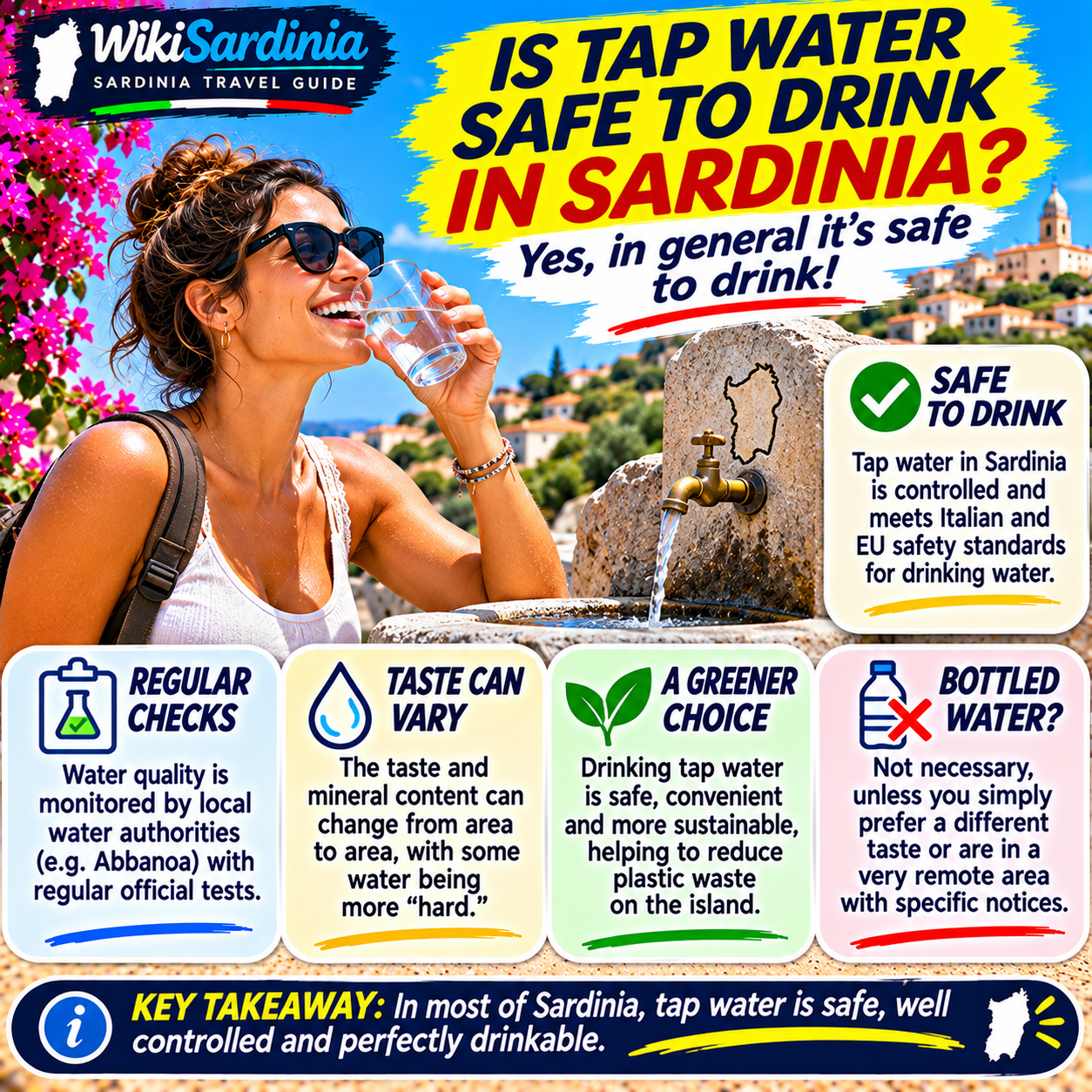
Tap water supplied by a compliant public drinking-water network in Sardinia is generally intended to be safe to drink. However, you should never assume that every tap, private well, campsite supply or public fountain is drinkable at every moment. Temporary local non-potability orders, maintenance works, private plumbing and other circumstances can change the situation. The best travel advice is to check the source and any current notices rather than follow a blanket rule that Sardinian tap water is either always safe or always unsafe.
Is Sardinian tap water generally safe to drink?
Yes, when the water comes from a public supply that meets drinking-water standards and there is no active restriction affecting your address. Sardinia is part of Italy and follows the national legal framework implementing European Union requirements for water intended for human consumption.
Italy's Legislative Decree No. 18/2023, as amended, sets requirements for drinking-water safety, monitoring and risk management. Water that is legally described as potable must meet applicable microbiological and chemical standards. This framework applies in Sardinia as it does elsewhere in Italy.
But compliance is assessed for specific water supplies and conditions. A statement that a town normally has potable water is not a guarantee that a particular building's tap is safe during a temporary incident.
Who checks drinking-water quality in Sardinia?
Abbanoa manages the integrated water service across much of Sardinia, although arrangements can vary in some locations. The company operates treatment and distribution infrastructure and conducts water-quality monitoring. Public health authorities also carry out their own controls and assess whether water is suitable for human consumption.
In a 2025 statement, Abbanoa reported that its accredited laboratory collected approximately 8,000 drinking-water samples annually for chemical, physical and microbiological monitoring. This is evidence of an ongoing testing programme, not proof that every tap is safe at every instant.
If tests reveal a problem, health authorities and municipalities may issue restrictions while the cause is investigated and corrected. Visitors should take these notices seriously.
Can a town temporarily have non-potable water?
Yes. Temporary non-potability orders are a real possibility in Sardinia, just as in other regions. They can follow abnormal laboratory results, treatment difficulties or other water-quality incidents. The exact restriction depends on the contamination or parameter involved.
For example, in July 2025, water-use restrictions affected Sarroch, Villa San Pietro, Pula and Domus De Maria after problems involving the south-western aqueduct. Abbanoa subsequently reported that laboratory results had returned to acceptable levels and that the health authority had given a positive assessment supporting the revocation of restrictions.
In another documented case, Alghero's municipality issued a restriction affecting Maristella in May 2024 and revoked it after the local health authority confirmed compliance. These are historical examples of how the warning-and-clearance process works, not claims that those locations are currently under restriction.
What does “acqua non potabile” mean?
The Italian phrase acqua non potabile means “non-drinking water.” If a tap or fountain has this sign, do not drink from it. If an official municipal order says that water cannot be used for drinking or food preparation, follow the exact instructions until the authority formally lifts the restriction.
Other useful terms include divieto di utilizzo per uso alimentare (prohibition on use for food purposes), ordinanza di non potabilità (non-potability order), and revoca dell'ordinanza (revocation of the order).
Restrictions can differ. Some notices may prohibit drinking and cooking while permitting other uses; others may impose broader limitations. Do not guess that boiling, filtering or leaving the water to stand will solve the problem. Those methods do not remove every possible chemical contaminant, and boiling may not make restricted water safe.
How can tourists check whether their tap water is drinkable?
Start by asking your hotel, host, agriturismo or campsite manager whether the property is connected to a public drinking-water network and whether any current water-use restrictions apply. For independent verification, check the municipality's official notices and the relevant water provider's updates.
Abbanoa publishes service notices and information on water quality at abbanoa.it. Municipal websites may publish an ordinanza when drinking-water use is restricted, and a subsequent notice when the restriction is lifted.
Always check the date and the precise streets or districts affected. A five-year-old news article about non-potable water does not establish today's conditions, and a problem in one village does not automatically apply to the entire island.
Does tap water taste different across Sardinia?
It can. The taste, odour and mineral composition of drinking water may vary with the source, treatment and distribution network. Some visitors notice more mineral character or a chlorine-like taste than they are used to at home.
An unfamiliar taste does not automatically mean water is unsafe, just as clear, pleasant-tasting water is not proof that it is potable. If you notice a sudden strong change in colour, smell or taste, especially after a service interruption, avoid drinking it until you have checked with the supplier or host.
If the water is confirmed safe but you dislike the flavour, chilling it in a clean covered bottle may make it more pleasant. Bottled water is also a matter of personal preference.
What if the water looks cloudy or brown?
Do not assume it is harmless. Temporary cloudiness can sometimes result from air bubbles, while sediment or discoloration may occur after works or interruptions. But appearance alone cannot establish safety.
In April 2026, Alghero's municipality warned that water might be temporarily turbid when service resumed after pipe works in the historic centre. The correct response to an unexpected change is to follow any official advice and contact the water supplier or accommodation provider. Do not drink visibly abnormal water without confirmation that it is safe.
Are water interruptions the same as non-potability orders?
No. A scheduled interruption or low-pressure event means water delivery is disrupted; it does not automatically mean the water has failed drinking-water tests. Conversely, water may still flow normally during a non-potability order.
Supply problems have affected Sardinian communities during droughts and infrastructure incidents. For example, Abbanoa reported serious water-service restrictions in Alghero during a September 2026 supply emergency. That report described difficulties in treating an emergency raw-water source and maintaining distribution. Travellers should distinguish an interruption from an official instruction not to drink the water, while following all applicable safety notices.
Can you drink from public fountains in Sardinia?
Only when the fountain is intended to provide drinking water and there is no warning or restriction. Some town fountains supply potable water, but decorative fountains, irrigation outlets, natural springs and rural taps should not be assumed safe.
Look for acqua potabile (“drinking water”) or acqua non potabile (“not drinking water”) signs. The absence of a sign is not a reliable guarantee, particularly in remote areas. If unsure, ask a local authority or use a known potable source.
What about water at rural villas and agriturismi?
Country properties may use a public connection, private well, stored water or another supply arrangement. These sources are not interchangeable. A private well or tank may need its own treatment, monitoring and maintenance, and water suitable for washing or irrigation may not be approved for drinking.
Before booking a remote villa, ask: “Is the kitchen tap water potable?” If the answer is unclear, request specific guidance on drinking and cooking water. Do not assume a countryside property follows the same supply arrangements as a city hotel.
Is bottled water necessary in Sardinia?
Not automatically. If your accommodation's public tap water is confirmed potable and no local restrictions apply, bottled water is generally a choice rather than a necessity. Using a refillable bottle can reduce packaging waste and save money during a longer stay.
Bottled water is a sensible alternative when a non-potability order applies, the supply is unverified, or your accommodation advises against drinking its tap water. If there is an official restriction, use a safe alternative for drinking and food preparation as directed.
Is tap water safe for children or pregnant travellers?
Water that complies with the applicable drinking-water requirements is intended for human consumption, but individual medical needs can matter. For preparing infant formula, follow the product manufacturer's instructions and your healthcare professional's guidance about water choice and preparation. Do not assume that every bottled mineral water is automatically appropriate for infants.
If a water-quality advisory affects your location, follow its specific instructions for children, pregnant people and other potentially vulnerable groups. If you have a medical condition requiring particular water composition, seek individual medical advice.
Can a household water filter make unsafe water drinkable?
Do not rely on an ordinary jug filter or domestic tap filter to override an official non-potability order. Different filters remove different substances, and some hazards require specialised treatment. Boiling can address certain microorganisms when specifically recommended by health authorities, but it does not remove all chemical contaminants.
Use the treatment or alternative supply recommended in the official notice. When in doubt, bottled water from a reliable source is preferable to experimenting with an unverified filter.
How do you ask about tap water in Italian?
- L'acqua del rubinetto è potabile? — Is the tap water safe to drink?
- Ci sono ordinanze di non potabilità? — Are there any non-potability orders?
- L'acqua viene dall'acquedotto pubblico? — Does the water come from the public supply?
- Possiamo usare quest'acqua per cucinare? — Can we use this water for cooking?
- Questa fontana è potabile? — Is this fountain drinking water?
- Quando è stata revocata l'ordinanza? — When was the restriction lifted?
Frequently asked questions
Can tourists drink tap water in Sardinia?
Usually yes when it comes from a compliant public drinking-water supply and there is no active local restriction. Confirm conditions at your accommodation.
Is tap water safe everywhere on the island?
No blanket guarantee is possible. Local non-potability orders, private wells and building-specific issues can change the answer.
Is Sardinian tap water tested?
Yes. Public drinking-water systems are subject to Italian and EU requirements and monitoring by operators and competent authorities.
Do I need to buy bottled water in Alghero or Cagliari?
Not necessarily. Check your property's water supply and any current local advisories. A historical restriction does not mean the water is unsafe today.
What if my hotel says not to drink the tap water?
Follow the hotel's advice and ask whether it reflects a current official notice, a private supply issue or another property-specific concern. Use a safe alternative until the situation is clarified.
Is a public fountain always safe?
No. Only use fountains confirmed to supply potable water and not subject to restrictions.
Can I make coffee or cook pasta with water under a non-potability order?
Follow the exact order. If it prohibits water for food preparation, do not use it for coffee or cooking unless the authority expressly permits a specific treatment.
Does boiling tap water always make it safe?
No. Boiling does not remove all chemical contaminants and should not replace official instructions.
Does a chlorine taste mean the water is unsafe?
Not necessarily. Taste alone cannot establish potability. Check official information if the taste changes suddenly or you are concerned.
How do I find out if a restriction has ended?
Look for an official municipal revocation notice or confirmation from the responsible health authority and water provider.
The bottom line
Visitors to Sardinia do not need to assume that all tap water is unsafe or buy bottled water everywhere. Public supplies are regulated and monitored, and potable tap water is often a convenient option. The essential exception is that water safety is local and time-dependent: check current notices, respect non-potability orders, and verify private supplies and public fountains before drinking. A quick question to your host can make the difference between unnecessary worry and a sensible precaution.
Official sources and further reading
- Italian Drinking-Water Legislation — Legislative Decree 18/2023
- Abbanoa — Water Provider and Official Notices
- Abbanoa — Water-Quality Monitoring and Laboratory Controls
- Abbanoa — July 2025 South-Western Aqueduct Water-Quality Update
- Municipality of Alghero — 2024 Revocation of Maristella Water Restriction
- Municipality of Alghero — 2026 Waterworks and Temporary Turbidity Notice
- Abbanoa — September 2026 Alghero Water-Supply Emergency