You order two scoops of gelato in a small Sardinian town, reach for your bank card, and the person behind the counter asks, “Contanti?”—cash? If you're visiting from the United States, the United Kingdom or another country where contactless payments are routine, the question might come as a surprise.
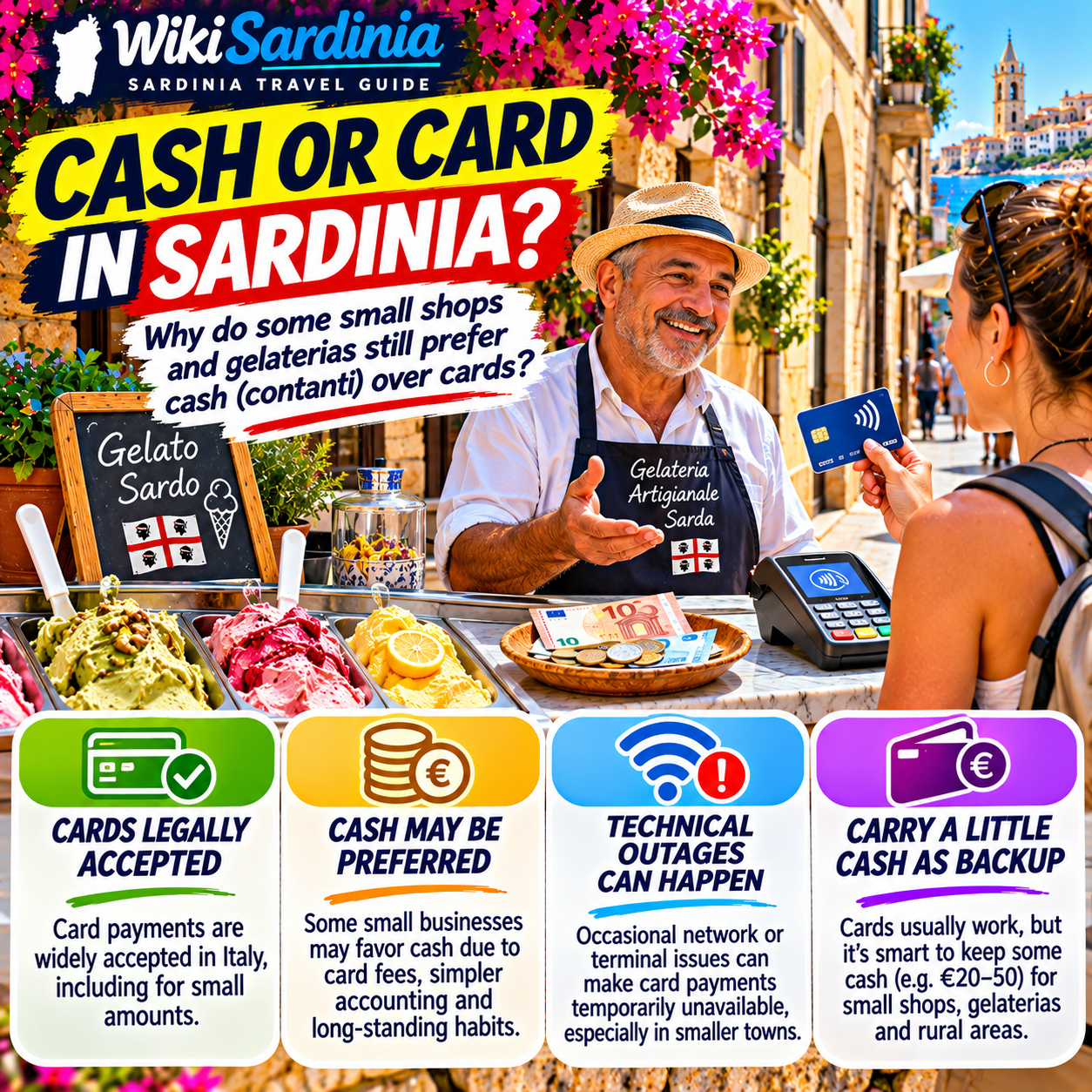
Some small businesses may prefer cash, but that does not mean Sardinia is a cash-only island. Cards are widely used in Italy, and Italian law generally requires shops, cafés and gelaterias to accept eligible electronic payments even for small purchases. The preference for cash can reflect transaction costs, familiar routines, cash-flow preferences or genuine technical problems. It is important not to assume that every business has the same reasons.
Is cash more common in Sardinia than elsewhere in Italy?
You may encounter a cash preference in small independent shops, seasonal kiosks, rural villages or traditional businesses. However, there is no reliable basis for claiming that all or most Sardinian gelaterias prefer cash, or that Sardinia is uniquely resistant to card payments. Payment practices differ between businesses and are changing across Italy.
Research published by the Politecnico di Milano's Innovative Payments Observatory in February 2026 examined the preferences and card-acceptance practices of 397 small Italian merchants. It identified different merchant attitudes rather than a single universal preference. The study was national, not a Sardinia-only measurement.
Why might a gelateria prefer cash for a small purchase?
Card-processing fees are one possible reason. Depending on the payment provider and contract, merchants may pay transaction-based fees, terminal rental costs or other charges. For a business selling many low-priced items, the fees can feel especially visible when a customer buys only a coffee or one scoop of gelato.
That said, the true economics are more complicated than “cards cost money, cash is free.” A Bank of Italy study published in 2025, using 2022 merchant data, estimated an average acceptance cost of €0.23 per cash transaction and €0.28 per card transaction. Because average transaction values were different, the estimated cost as a share of the transaction amount was 1.05% for cash versus 0.57% for cards. These are aggregate historical estimates, not the fee charged to a particular gelateria.
Cash also involves time spent counting money, obtaining change, transporting deposits and managing theft or loss risks. Some small business owners nonetheless find cash simpler for their everyday workflow, particularly if they have used it for decades.
What does Italian law say about paying by card?
Under Article 15 of Decree-Law 179/2012, as amended, businesses selling goods and services generally must accept qualifying electronic payment instruments, subject to an exception for objective technical impossibility. The obligation extends to payments of any amount. Since 30 June 2022, an unjustified refusal can trigger an administrative penalty of €30 plus 4% of the refused transaction amount.
This means there is no general legal exemption for a €2 coffee, €3 gelato or €5 souvenir. A shop cannot simply declare that cards are accepted only above €10 as though that were a universal statutory rule.
For current legislation, consult the Italian Ministry of Economy and Finance legal text and the FIPE guidance for hospitality businesses.
Can a shop refuse cards if the POS terminal is not working?
A genuine technical failure can be relevant. If the terminal is broken or the payment connection is unavailable, the law recognises an exception for objective technical impossibility. This does not mean every claim of “POS broken” can be independently verified by a tourist, nor does it mean that an operator may routinely reject cards just because cash is preferred.
Small towns and remote locations can experience connectivity issues, so keeping some cash is a practical backup. If a payment fails, politely ask whether the merchant can try another terminal or payment method, or return later if appropriate.
Do businesses have to accept Apple Pay and Google Pay?
Mobile wallets usually rely on an underlying card or other electronic payment instrument, but acceptance depends on the terminal, the payment network and the instrument involved. The general obligation to accept qualifying electronic payments should not be interpreted as a guarantee that every specific wallet, brand or app will work at every business.
Carry a physical payment card as well as a phone wallet if you rely on digital payments while travelling.
Why do some businesses like cash even when they accept cards?
Cash provides immediate physical funds and does not require a card network to authorise a transaction. It can also fit longstanding customer habits. Some owners perceive cash as easier for small purchases, even though proper accounting and cash handling still require time and effort.
It would be unfair to suggest that a preference for cash proves tax evasion. Unrecorded sales are illegal, but payment preference alone is not evidence of wrongdoing. Visitors should expect an appropriate receipt or fiscal document as required, whether paying with notes, coins or a card.
How much cash should tourists carry in Sardinia?
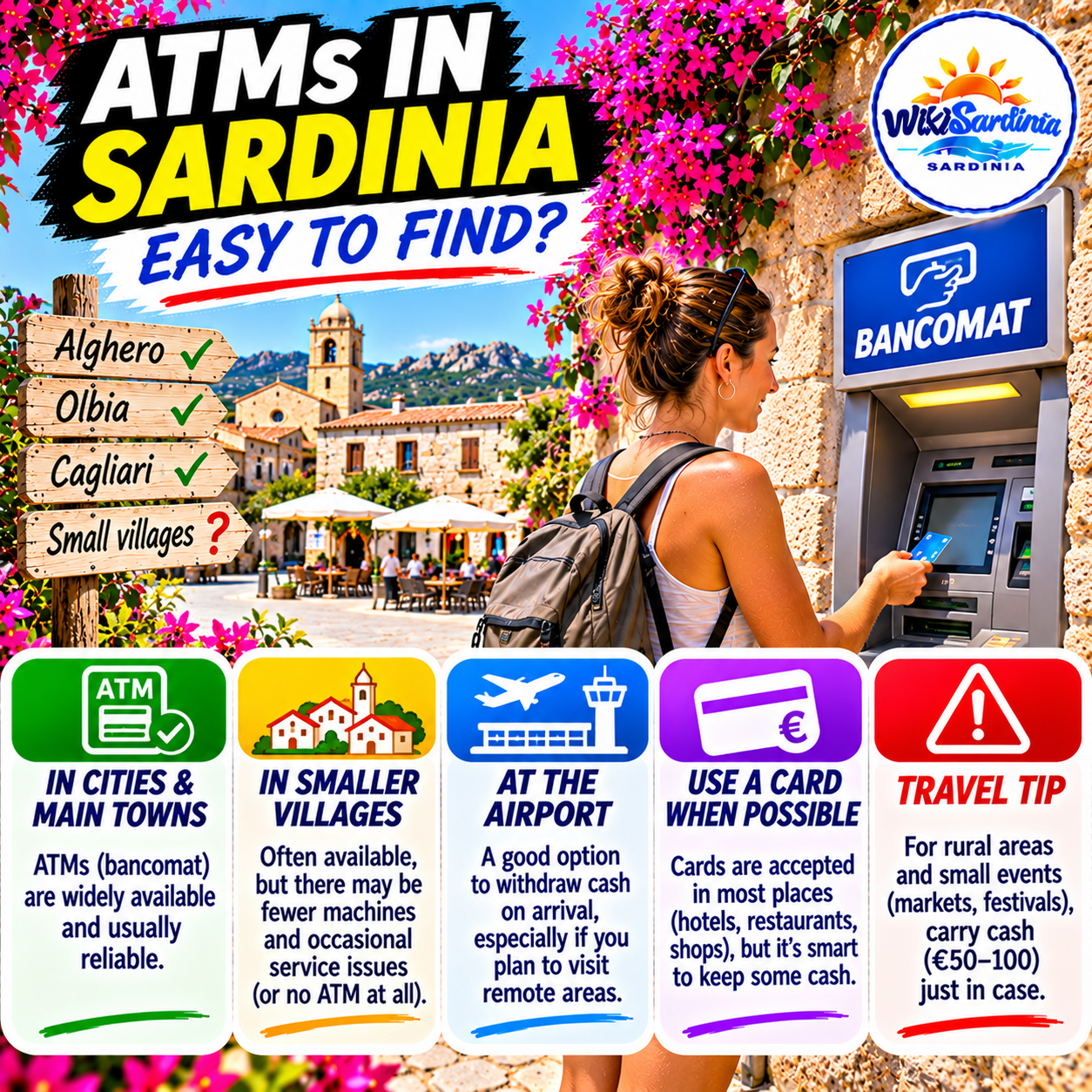
There is no fixed amount everyone needs. A modest reserve—perhaps €20–€50 in small notes and coins—can be useful for minor purchases, a temporary terminal outage or an isolated stop. The right amount depends on your itinerary and personal preferences, and there is no need to carry large sums routinely.
In cities and major tourist destinations, many visitors will be able to pay for most everyday purchases by card. In smaller villages, at temporary market stalls or during remote excursions, cash can be a convenient fallback. Ask before ordering if you have no cash and are uncertain about payment options.
Are ATMs easy to find?
ATMs are generally easier to locate in towns than in remote countryside. If you plan to explore inland Sardinia, withdraw a modest amount before leaving a larger town. Check your bank's withdrawal fees and the ATM operator's charges; if offered currency conversion at the machine, review the exchange rate carefully before accepting it.
What should you say if a shop asks for cash?
A friendly question often avoids unnecessary tension. You can say “Posso pagare con carta?” (“Can I pay by card?”) or “Accettate il bancomat?” (“Do you accept debit card?”). In Italian, bancomat is commonly used in everyday conversation to mean a debit card or card payment, although it also refers to a specific domestic payment system.
If the merchant asks for cash and you do not have any, calmly explain and ask whether another electronic payment method is available. You do not need to argue with a shopkeeper over a gelato, but you should know that a small amount alone is not a valid blanket reason to refuse an eligible card payment.
Is cash better for the local economy?
There is no simple answer. Paying a local business supports it whether you use cash or a card. The merchant may have a preferred payment method, while the customer may value convenience, security and transparent records. Both cash and digital payments have real costs and benefits.
The most meaningful way to support local Sardinian businesses is to buy from them, respect their work and pay for goods and services properly—not to assume that one payment method is morally superior.
Frequently asked questions
Can I pay for a €2 gelato by card in Sardinia?
Generally, yes. Italian card-acceptance obligations apply regardless of the small amount, subject to objective technical impossibility and the applicable payment instrument.
Is a €10 minimum for card payments legal?
There is no general statutory minimum purchase amount below which merchants are exempt from accepting qualifying electronic payments.
Will every gelateria accept American Express?
Not necessarily. Acceptance of a particular card network is not guaranteed by the general rule. A widely accepted debit or credit card can be a useful backup.
Can a POS machine genuinely be offline?
Yes. Technical faults and connectivity outages happen. If a terminal cannot function for objective technical reasons, that differs from a discretionary preference for cash.
Should I carry euros even if I use Apple Pay?
Carrying a small amount of cash is sensible for backup, especially when visiting markets, seasonal stalls or remote places.
Does preferring cash mean a business is avoiding taxes?
No. A preference for cash alone does not establish tax evasion or any other wrongdoing.
The bottom line: carry a card and a little cash
Sardinia combines modern payment systems with independent shops, family businesses and local habits. You can generally expect to use cards, including for small purchases, but a little cash may still be useful when a terminal fails or you visit remote places. Know your rights, ask politely and enjoy the gelato—whatever legitimate payment method you use.