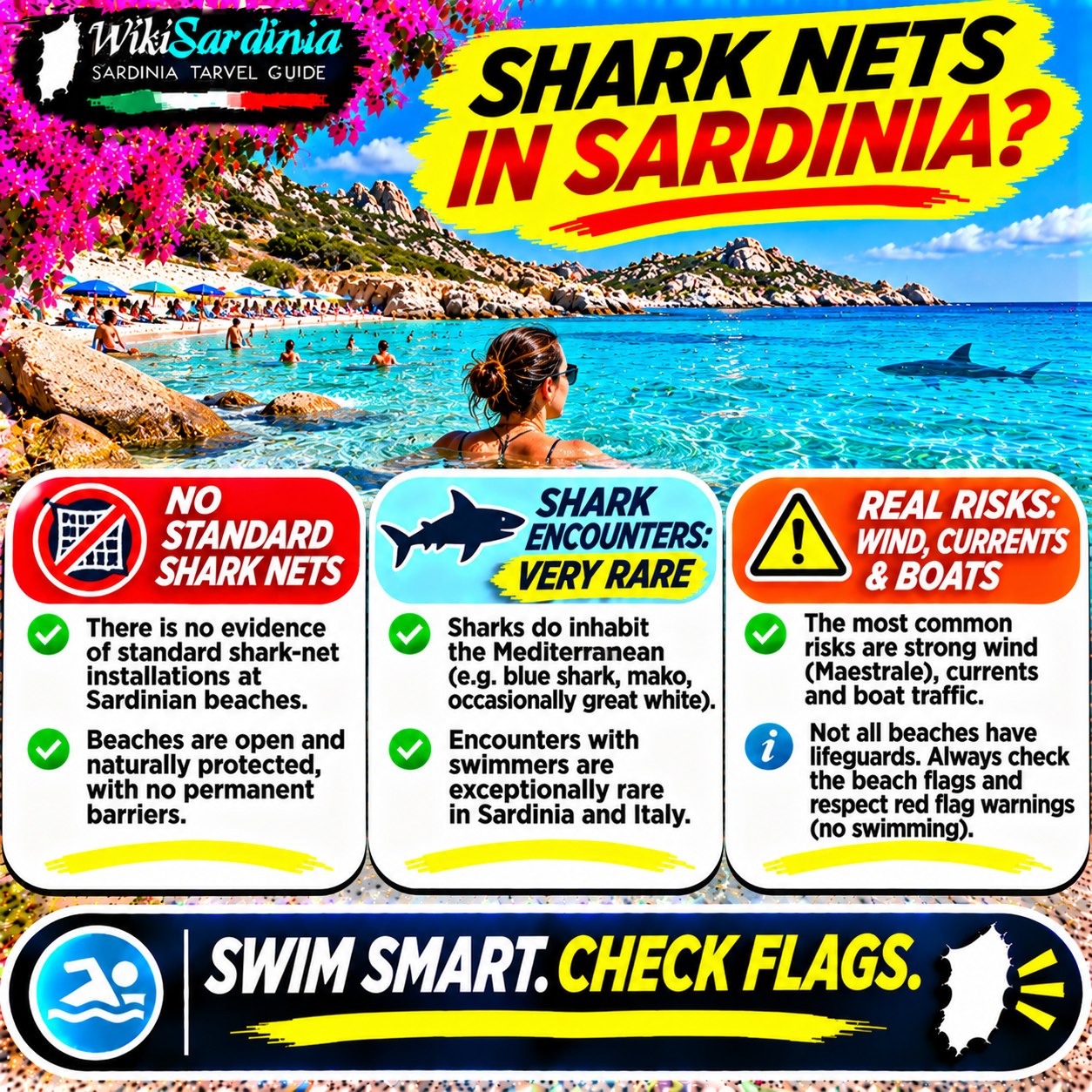
Sardinian beaches do not have a documented, standard system of shark-protection nets, and dangerous shark encounters with swimmers are exceptionally rare. Sharks do live in the Mediterranean, including species such as blue sharks and the great white shark, so the sea is not literally shark-free. But for someone swimming from a Sardinian beach, the practical safety concerns are much more likely to involve waves, strong wind, currents, boats, poor swimming conditions or a lack of lifeguards. No open sea can be described as completely risk-free.
Are shark nets installed at beaches in Sardinia?
We found no evidence of an established shark-net program at Sardinian swimming beaches comparable to systems used in certain parts of the world. The official Sardinian beach-safety guidance emphasizes flags, sea conditions and lifeguard availability rather than shark-exclusion barriers. That does not prove that no temporary local barrier has ever been installed for another purpose. Swimming-zone buoys, boat-exclusion ropes and floating markers are not necessarily shark nets, and visitors should not confuse them with predator-proof enclosures.
Are there sharks in the Mediterranean Sea?
Yes. The Mediterranean supports multiple species of sharks and rays, many of which face serious conservation threats. Italy's environmental research institute ISPRA lists the great white shark (Carcharodon carcharias) as occurring in the Mediterranean, while conservation assessments document the diversity and vulnerability of regional cartilaginous fish. Most shark sightings reported at sea involve animals going about their normal lives, often away from busy swimming beaches. The presence of sharks in a marine ecosystem does not mean tourists face a significant risk of attack.
Do sharks attack swimmers in Sardinia?
Serious encounters involving bathers are exceptionally uncommon. It would be misleading to promise that an attack is impossible, but it would be equally misleading to present Sardinian beaches as a shark-attack hotspot. News about sharks spotted from fishing boats, near fishing activity or offshore should not be confused with incidents involving swimmers at the shore. Treat dramatic social-media videos cautiously: the date, species and location may be uncertain.
Is the Mediterranean completely safe for open-water swimming?
No sea is completely safe, even where shark risk is minimal. SardegnaTurismo, the official regional tourism portal, warns that not every beach has a lifeguard and that swimmers must assess sea conditions before entering. A red warning flag means swimming is prohibited according to the regional guidance. In the absence of flags, do not assume conditions are safe: an unguarded beach may simply have no one available to display them.
What are the real hazards on Sardinian beaches?
Wind and waves: Sardinia's Maestrale (northwesterly wind) can make exposed beaches rough and change conditions quickly. Currents: Water can move strongly around headlands, channels and breaking waves, even when the surface looks inviting. Boat traffic: Stay clear of marked navigation lanes, mooring areas and motorboats; use designated swimming areas where available. Rocks and depth: Some coves become deep quickly, and underwater rocks can be slippery or sharp. Marine life: Jellyfish and sea urchins can cause painful injuries. Water quality: Temporary bathing bans may follow poor test results or pollution events. None of these hazards is eliminated by the absence of sharks.
Can you swim far offshore from a Sardinian beach?
Open-water swimming requires more planning than a short dip near shore. Know your limits, check wind and sea forecasts, identify a safe return point and avoid swimming alone. Stay out of boat-navigation channels and obey local maritime safety ordinances, which can set swimming zones and other restrictions. A brightly colored tow float may improve visibility but does not guarantee boat operators will see you. If you are unfamiliar with the coast, choose a supervised beach or a qualified guided open-water activity.
What do the beach flags mean?
The most important instruction is to obey the warning posted at your specific beach. SardegnaTurismo states that a red flag means you must not enter the water. Other flags and signs may communicate local conditions or designated areas, but do not assume every beach uses identical signals. Ask lifeguards for clarification where present. If there are no flags or lifeguards, assess the water yourself and stay out if uncertain.
Are remote coves safer because they have fewer boats?
Not necessarily. A secluded cove may have less traffic but also no lifeguard, poor phone reception, limited access for rescue teams and difficult conditions at its entrance. Boat tours can bring vessels into small bays, and the weather can change before your return. Avoid swimming into caves or around rocky headlands without appropriate local knowledge and support. Choose your swimming spot based on conditions and supervision, not simply how empty it looks.
What should you do if you see a shark?
Stay calm, avoid splashing or approaching the animal, keep it in view if possible and move steadily toward a safe exit. Do not chase it for a photograph, attempt to touch it or enter the water to get closer. If you are on a guarded beach, alert the lifeguard. If there is an immediate threat or someone is in danger, call 112, Italy's emergency number, or alert the Coast Guard through the appropriate emergency channel. A sighting alone does not establish that the animal is aggressive.
Are swimming-water quality and shark safety the same thing?
No. Sardinia's bathing-water monitoring system, supported by ARPAS and regional authorities, checks microbiological water quality and can identify temporary restrictions. A beach with excellent water quality can still have dangerous waves or currents. Conversely, the presence of marine wildlife does not automatically mean water is polluted. Check current bathing notices, posted signs and the regional bathing-water portal for relevant alerts.
What about swimming with children?
Choose a sheltered beach with suitable access and a lifeguard where possible. Keep children within close supervision, even in shallow water, and do not let an inflatable toy carry them away from shore. Check the flag, waves, wind and any underwater drop-offs before entering. For children, these everyday precautions are far more relevant than searching for shark nets.
Frequently asked questions
Does Sardinia have shark nets like Australia?
No established shark-net program at Sardinian beaches was identified in official safety guidance. Buoys or ropes marking a swimming zone are not the same thing as shark nets.
Are there great white sharks near Sardinia?
Great white sharks occur in the Mediterranean according to ISPRA, but encounters with ordinary beach swimmers are extremely rare.
Is it safe to snorkel in Sardinia?
Generally it can be an enjoyable activity in suitable conditions, but assess the sea, avoid boat lanes and do not snorkel alone. No location is risk-free.
Can I swim when the red flag is flying?
No. Official Sardinian tourism guidance states that a red flag prohibits entering the water.
Are sharks the biggest danger for open-water swimmers?
No. Wind, waves, currents, navigation traffic and lack of supervision are more practical concerns.
Do all Sardinian beaches have lifeguards?
No. Many remote or undeveloped beaches do not have a lifeguard service.
Who should I call for a swimming emergency?
Call 112 and provide the beach name, nearest access point and details of the emergency. The Coast Guard is also responsible for maritime rescue.
The takeaway
You do not need to look for shark nets to enjoy Sardinia's beaches. Sharks are part of the Mediterranean ecosystem, but dangerous encounters with swimmers are extremely rare. Focus on the risks that actually affect day-to-day beach safety: weather, currents, flags, lifeguards and boat traffic. Choose suitable conditions, stay within your abilities and never treat the open sea as completely harmless.
Official and scientific sources: SardegnaTurismo — Travelling safely; ISPRA — Great white shark distribution; Convention on Migratory Species — Mediterranean sharks and rays; Regione Sardegna — 2026 beach ordinance; Sardegna Ambiente — Bathing-water monitoring.