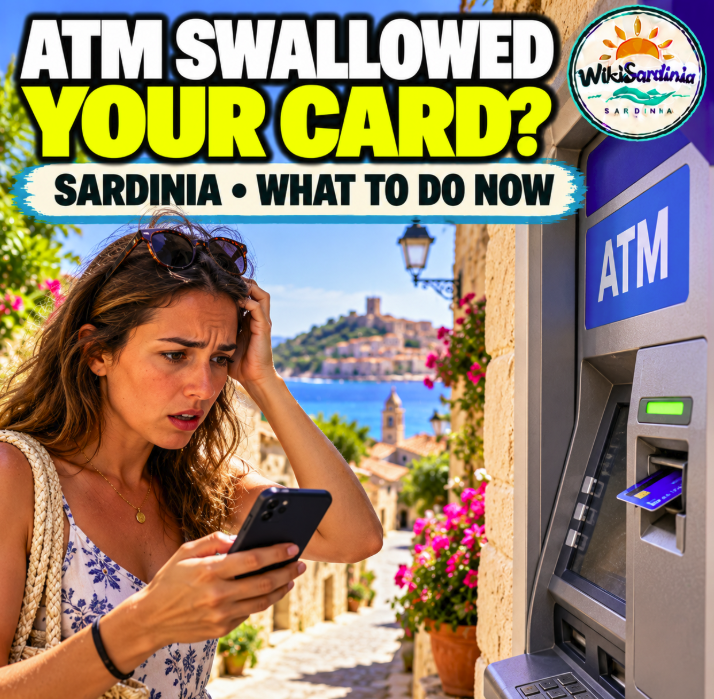
Did an ATM swallow your bank card in Sardinia? Whether you are in Cagliari, Alghero, Olbia, Pula or a small coastal town, the safest first step is to contact the bank that issued your card immediately. Use the official banking app, the bank's website or a number you have already saved. Ask whether the card should be frozen temporarily or permanently blocked. Then contact the operator of the ATM to learn its retained-card procedure.
There is no single universal Italian toll-free number that works for every retained card. Your issuing bank, the ATM owner and the payment network have different roles. This guide explains the steps, including what to do if you are a tourist from the United States, the United Kingdom or elsewhere.
What to do immediately when an ATM keeps your card
- Stay calm and check the screen. If the ATM shows an error or a card-retained message, note the wording. Do not enter your PIN again if the transaction has ended.
- Check the machine from a safe distance. Look for the bank or operator's name, ATM identification number and official support details. Do not accept help from strangers who offer to retrieve the card.
- Contact your card issuer. Use your banking app or the issuer's verified website. Ask for an immediate temporary freeze or permanent block as appropriate.
- Contact the ATM operator. If the ATM belongs to a bank branch that is open, speak to staff. If it is a standalone machine, follow the operator's official retained-card procedure.
- Record the incident. Save the date, time, location, ATM ID, transaction amount and any error message. Photograph the machine's identifying signage if safe, but never photograph or share your PIN.
- Check your account. If cash was not dispensed but the account was charged, report the disputed withdrawal to the issuer promptly.
Should you block your card immediately?
Contact the issuing bank without delay. Some banks can temporarily freeze a retained card while investigating; others require permanent blocking and replacement. The correct action depends on the bank's policy and whether the card may be recovered.
Do not assume that a card trapped inside an ATM is automatically safe from misuse. A card-capture incident can also be associated with tampering or fraud. If anything about the machine or nearby people seems suspicious, tell the bank and leave the area safely.
Who do you call in Italy?
First choice: the official emergency number for your own issuing bank, obtained from its app or website. That remains the most reliable route for a foreign-issued card.
If you cannot reach your issuer, payment networks offer emergency assistance:
- Mastercard: Mastercard Global Service lists 800 870 866 for calls in Italy and +1 636 722 7111 as an international assistance number. Availability and call charges can depend on your phone service.
- Visa: Visa offers Global Customer Assistance Services and country-specific toll-free numbers; its published international collect-call number is +1 303 967 1096. Check Visa's official support page for current options.
Important: These are network assistance contacts, not universal hotlines for retrieving a card from any Italian ATM. Confirm the latest number on the network's official site before calling. Never disclose your PIN or banking password to anyone.
What if the ATM belongs to UniCredit?
UniCredit's official guidance says that if a card is retained by a UniCredit ATM, the cardholder may ask the associated branch about retrieval, subject to verification. If the card is retained at another bank's ATM, the procedure may differ.
UniCredit's published guidance also tells its own debit-card customers to contact customer support for a temporary block. Do not assume UniCredit's customer numbers are the correct emergency numbers for a card issued by another bank.
See UniCredit's official retained-card information.
What if an Euronet ATM swallowed your card?
Euronet Italia's official FAQ explains that retained cards generally cannot be handed back directly to cardholders under its issuer and card-network procedures. It advises contacting both Euronet customer service and the issuing bank.
Euronet lists 06 20 39 39 39 as its customer-service contact on its official Italian FAQ. Check the number displayed on the actual ATM and the official Euronet FAQ before calling.
Do not pay an unknown person who promises to open the machine or return your card.
Can the bank branch give your card back?
Sometimes, but never count on it. Retrieval depends on the ATM operator, the issuing bank, security rules and whether the card has been sent for destruction. A bank may require identification and proof of ownership, and foreign-issued cards may be handled differently.
If the branch is closed, the next business day may be too late for a traveler who is leaving Sardinia. Contact the issuer immediately and arrange an alternative way to pay.
Why do ATMs retain cards?
Common reasons include a card not being removed within the allowed time, a card reported lost or blocked, security restrictions, a mechanical malfunction or a technical issue.
A retained card does not automatically mean that the machine was hacked or that you entered the wrong PIN. However, suspicious attachments, unusual instructions or strangers offering assistance should be treated cautiously.
What if you were charged but received no cash?
Report the problem promptly to the card issuer and, when appropriate, the ATM operator. Provide the location, date, time, requested amount and any receipt or error details.
The issuer may investigate or open a transaction dispute. A pending authorization is not necessarily a final debit; ask the bank how to monitor it. Do not assume the money will return instantly or promise a fixed refund deadline.
What should American tourists do?
If your US-issued debit card is retained, contact your American bank through its official app or international support number. International calls may require the +1 country code; a US domestic toll-free number may not work from an Italian mobile connection.
Ask whether your card can be locked remotely, whether a replacement can be shipped to your accommodation and whether emergency cash or a digital card is available. Mastercard and Visa may offer emergency assistance depending on the card and issuer.
If your phone still has mobile data, your banking app may be the fastest route. Use your own secure connection rather than an unfamiliar public Wi-Fi network for sensitive account activity.
What if it happens on Sunday or at night?
Bank branches may be closed, but many card issuers provide round-the-clock lost-card or fraud support. Contact that service immediately instead of waiting for the next business day.
If the ATM is inside a locked branch lobby, do not try to force access. Keep the machine details and ask the operator for its procedure when available.
What if you have no other payment card?
Ask your issuer about emergency replacement, temporary digital-card access, wallet compatibility or emergency cash services. Options vary by bank and card network.
If you are traveling with someone you trust, they may be able to pay temporarily while you arrange a replacement. Contact your accommodation if you need help finding a bank branch or making an official call.
Never share your banking login, one-time password or PIN with a hotel employee or anyone offering to help.
Can Apple Pay or Google Wallet still work?
Possibly, but do not assume a frozen or blocked physical card will continue to work in a mobile wallet. Issuers handle tokenized digital payments differently. Ask the bank whether your wallet card remains active and whether a replacement digital card can be issued.
For travel resilience, having a separate backup card from another account is useful when possible.
How to identify the ATM operator
Look for the operator's branding, customer-service sticker and machine ID. An ATM installed outside a supermarket or tourist area may be operated by a different company from the nearby business.
Do not use a phone number written on a loose sticker or supplied by a stranger without checking it against the operator's official website.
What if someone says they can retrieve the card?
Decline help from anyone who asks for your PIN, tells you to enter it again, requests a transfer or wants access to your banking app. Legitimate bank support will not need your PIN.
If you suspect a scam or theft, report it to the issuing bank and, where appropriate, the police. In an immediate emergency in Italy, call 112; do not use emergency services for an ordinary card-retention incident with no danger.
Do you need to file a police report?
For a routine machine malfunction, a police report is not automatically required in every case. If the card was stolen, fraud is suspected or your issuer requests documentation, contact the police and follow your bank's instructions.
The Italian Carabinieri advise prompt blocking and reporting in cases of stolen or lost payment cards. See their official card-loss guidance.
Useful Italian phrases
- Il bancomat ha trattenuto la mia carta. — The ATM retained my card.
- Il bancomat ha mangiato la mia carta. — The ATM swallowed my card (informal).
- Devo bloccare la carta. — I need to block the card.
- Qual è il numero dell'assistenza? — What is the customer-service number?
- Posso recuperare la carta? — Can I get the card back?
- Non ho ricevuto i contanti. — I did not receive the cash.
- Mi è stato addebitato l'importo. — The amount was charged to my account.
- Ho bisogno di una carta sostitutiva. — I need a replacement card.
How to avoid another ATM problem in Sardinia
Prefer well-maintained ATMs attached to established bank branches where possible. Shield your PIN, examine the card slot for obvious damage or unusual attachments and do not let strangers distract you.
Take your card promptly when the machine returns it. Keep a backup payment method separate from your primary wallet and store your bank's official emergency contact somewhere accessible without the physical card.
If an ATM offers currency conversion for a foreign card, review the rate and fees carefully. This is a separate issue from card retention but can affect withdrawal costs.
Frequently asked questions
What should I do if an ATM swallows my card in Sardinia?
Contact your card-issuing bank immediately, ask whether to freeze or block the card, then contact the ATM operator and document the incident.
Is there one Italian toll-free number for every retained ATM card?
No. The correct emergency number depends primarily on your issuing bank and card network.
Can the bank return my card?
Sometimes. Retrieval depends on the ATM operator's policy, security requirements and the card issuer.
What if an Euronet ATM kept my card?
Contact both Euronet and your card issuer. Euronet says it generally cannot return retained cards directly to cardholders.
Will my card be destroyed?
Possibly, depending on the operator and issuer. Ask your bank whether replacement is necessary.
Should I wait until the branch opens?
No. Contact your issuer's emergency service immediately, even if the branch is closed.
Can I still use Apple Pay?
Possibly, but ask the issuer whether the wallet token remains active after the physical card is blocked.
What if the ATM charged me but gave no cash?
Report the disputed withdrawal to your issuer and provide the ATM details, date and amount.
Can Visa or Mastercard help?
Both networks provide assistance services, but your issuing bank remains the main contact for your account and card status.
Should I call 112?
Only if there is an actual emergency or immediate danger, not for an ordinary ATM malfunction.
The bottom line
If an ATM in Sardinia keeps your card, call your own bank first. Freeze or block the card according to the issuer's instructions, contact the ATM operator, record the machine details and arrange a backup payment method. Do not trust an unverified “universal number,” and never reveal your PIN to someone offering to help.
Official sources
UniCredit — retained ATM card guidance; Euronet Italia — ATM FAQ; Visa — cardholder assistance; Mastercard — emergency assistance; Carabinieri — bank cards and loss reporting. Phone numbers and procedures can change: verify with the official operator before publication or use.