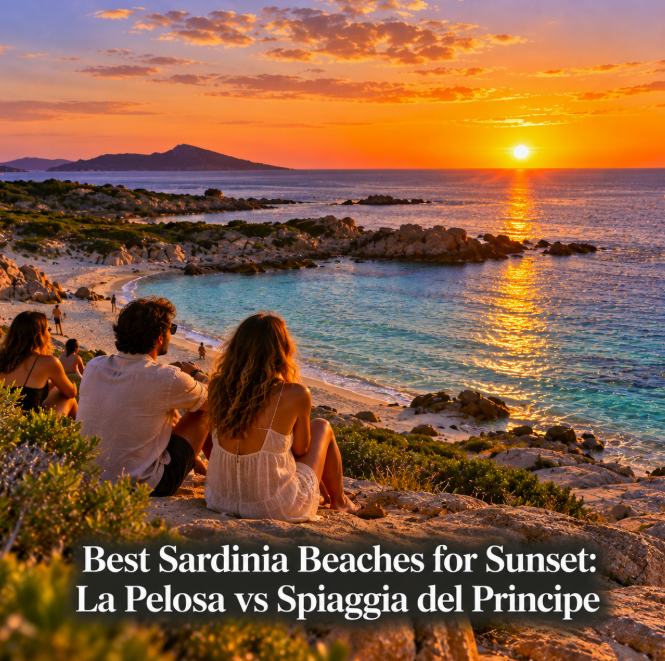
If the goal is to watch the sun sink toward the sea, Sardinia’s western and northwestern coasts generally have the geographic advantage. That makes La Pelosa near Stintino a more natural sunset choice than Spiaggia del Principe on Costa Smeralda. Both are exceptional beaches, but they face very different parts of the island: Spiaggia del Principe lies on Sardinia’s northeast coast, while La Pelosa sits at the far northwestern tip around Stintino.
This does not mean every western beach produces a perfect unobstructed sunset every evening. Headlands, offshore islands, season, clouds and the exact orientation of the shoreline all affect where the sun appears to drop. But if you are choosing a beach specifically around golden hour, west-facing Sardinia gives you more opportunities to see the sunset develop across open water.
La Pelosa: northwest Sardinia has the sunset advantage
La Pelosa is famous primarily for its shallow turquoise water, pale sand and views toward the historic Aragonese tower and the islands off Stintino. Its position in northwest Sardinia also makes the wider Stintino peninsula an attractive place to stay out for evening light.
The precise sunset composition changes through the year. Depending on the date and where you stand, the sun may align with open water, landforms or the islands around the entrance to the Gulf of Asinara rather than falling into a completely empty horizon. Photographers should therefore check the sunset azimuth for their travel date if a particular alignment matters.
Even without a textbook sun-meets-sea horizon, the northwestern orientation gives the area a strong evening atmosphere. Warm light can illuminate the tower, shallow lagoon-like water and surrounding landscape from an angle that is very different from midday.
Spiaggia del Principe is spectacular—but it is a northeast beach
Spiaggia del Principe belongs to Costa Smeralda in northeast Sardinia. Its appeal is the classic Gallura combination of granite rocks, Mediterranean vegetation and intensely colored water. It can be beautiful late in the day as the light becomes softer and the daytime crowds begin to thin.
But geographically it is not the obvious place to choose when the main objective is watching the sun disappear over an open western sea horizon. On the northeast coast, surrounding land and the orientation of individual coves play a much larger role in what you actually see at sunset.
That does not make sunset a bad time to visit. Golden-hour light can be excellent for swimming, photography and enjoying the granite landscape. The distinction is between beautiful evening light and a classic sun setting into the sea view.
Why Sardinia’s west coast is so good at golden hour
Sardinia’s western coastline faces the open Mediterranean and the Sea of Sardinia, with long stretches oriented toward the afternoon and evening sun. Beaches and coastal viewpoints around the Sinis peninsula, Oristano province, Bosa, the Argentiera coast and parts of the Stintino area can therefore offer dramatic evening skies.
The west coast is also less uniformly resort-developed than Costa Smeralda. In many areas the sunset experience is about long beaches, cliffs and broad horizons rather than beach clubs and marinas. That can be particularly appealing to travelers looking for landscape photography or a quiet final hour by the sea.
The trade-off is exposure. Western Sardinia can be windy and the sea can become rough, especially when westerly weather arrives. A beach that is ideal for sunset photography is not automatically the best place for a calm evening swim.
Other west-coast areas to consider
The Sinis peninsula is one of the strongest alternatives if you are staying around Oristano. Its coastline combines open horizons, beaches and low coastal landscapes that work well in evening light. Farther north, the road and coastline around Bosa provide a mixture of cliffs, coves and viewpoints.
Argentiera, on the northwest coast between Alghero and Stintino, is another interesting area for sunset because of its exposed western position and former mining landscape. Around Alghero itself, the orientation of the bay and the Capo Caccia peninsula creates famous evening views, although the sun’s exact position changes considerably by season.
In southwest Sardinia, the coastline around the Sulcis and Iglesias area also offers numerous west-facing viewpoints. Again, choose the exact beach or cliff based on access, weather and the position of the sun on your date rather than assuming every western location has an identical horizon.
A practical warning for La Pelosa in 2026
La Pelosa is a protected, heavily visited beach with controlled access during the main season. The official 2026 reservation system requires booking from May 15 through October 15 and currently limits access to 1,500 people per day. The published fee is €3.50 per person, with children under 12 exempt from the reservation requirement.
The official platform states that access controls requiring the QR code operate from 08:00 to 18:00. Of the 1,500 daily places, 500 can be booked in advance for dates within the regulated period, while another 1,000 are released for the second following day, with the current system opening those reservations at 09:00.
Travelers should use only the authorized La Pelosa booking platform: the official site specifically warns about fake reservation websites. Rules and operational details should be rechecked for the exact visit date.
Choose the coast according to the photograph you want
If you want turquoise water and granite in the afternoon followed by a Costa Smeralda dinner, Spiaggia del Principe is a natural fit. Stay into golden hour for softer light, but do not choose it solely because you expect a classic west-facing sunset.
If the sunset itself is the main event, La Pelosa and the wider Stintino area have the stronger geographic case between these two choices. Better still, think beyond individual famous beaches and look at Sardinia’s entire western edge. A quieter west-facing beach or cliff can produce a more memorable sunset than competing for space at one of the island’s most photographed locations.
The simplest rule is geographic rather than promotional: east and northeast Sardinia are naturally associated with sunrise and morning light, while the west and northwest are generally better positioned for evening sun. Local headlands and seasonal solar angles create exceptions, but for a sunset-focused Sardinia itinerary, west is the direction to start looking.