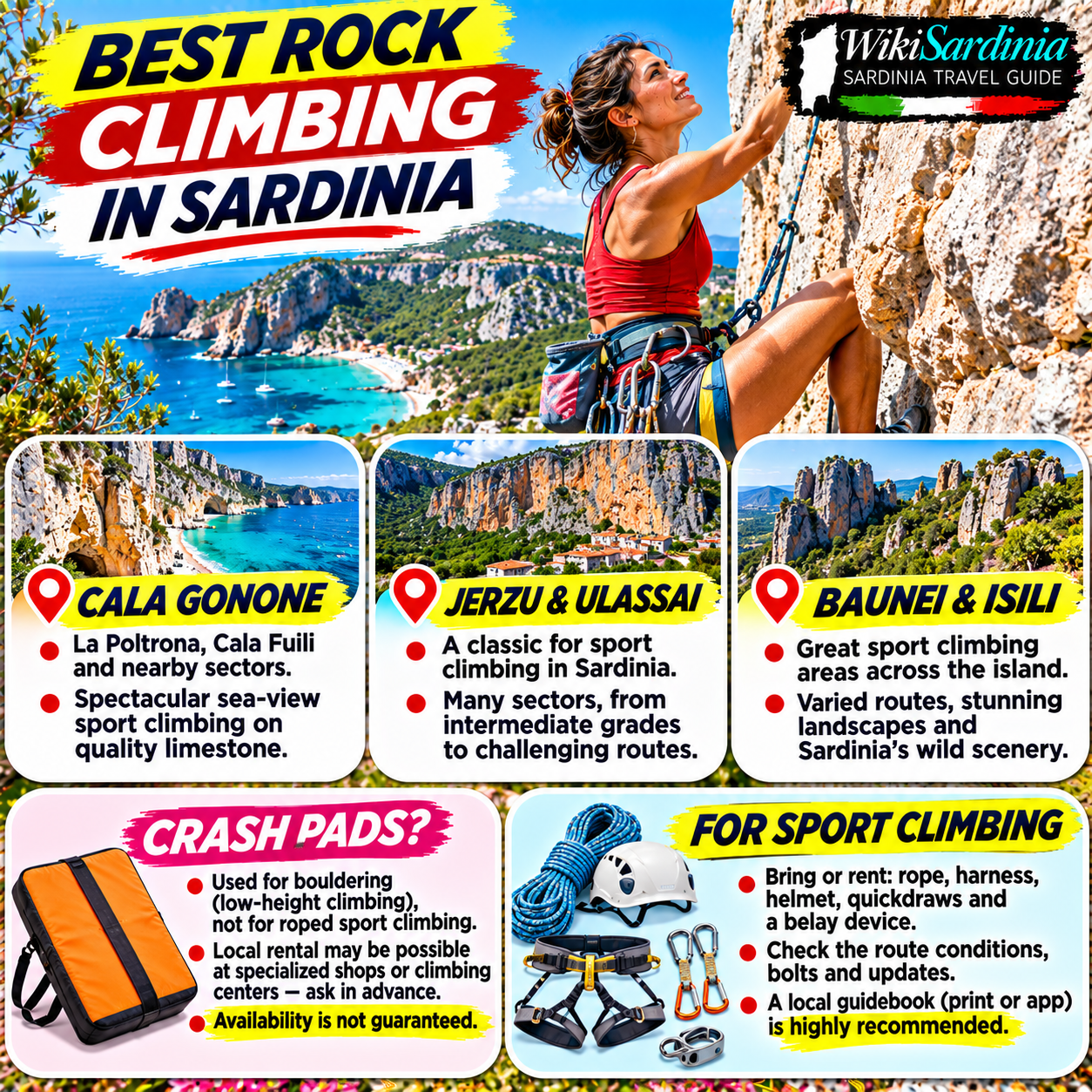
Sardinia is one of Italy’s most rewarding sport-climbing destinations, with bolted limestone routes around Cala Gonone, Jerzu, Ulassai, Baunei, Isili and Domusnovas. If you are travelling light, local guides and specialist shops may supply climbing equipment, but crash pads are for bouldering, not ordinary roped sport climbing. Do not assume that a crash pad can be rented in every climbing town: confirm availability with a specific provider before travelling.
Best sport climbing areas in Sardinia
| Area | Why go | Climbing style |
|---|---|---|
| Cala Gonone and Dorgali | Seaside limestone and an enormous variety of sectors | Bolted single-pitch routes, with some multi-pitch options |
| Jerzu and Ulassai | Concentrated Ogliastra climbing, many sectors and long vertical walls | Technical limestone sport routes, from approachable to very hard |
| Baunei | Dramatic coastal and mountain scenery | Sport crags plus serious multi-pitch objectives |
| Isili | Steep pocketed limestone and overhangs | Powerful sport climbing with easier routes also available |
| Domusnovas and Iglesias area | Extensive limestone climbing in southwest Sardinia | Slabs, walls and overhangs across grades |
| Monteleone Rocca Doria | Scenic northern alternative, near the Alghero region | Sport climbing with many moderate routes |
Cala Gonone: coastal limestone and classic crags
Cala Gonone is a natural first stop for climbers combining beaches with rock. La Poltrona is a well-known crag with varied grades and a relatively straightforward approach; Cala Fuili offers climbing near the beach; and Biddiriscottai provides dramatic cave and steep-wall terrain. Other sectors include Budinetto, Buchi Arta and the demanding Millennium cave. Guidebook selections describe hundreds of routes around Cala Gonone, but counts and grades change as routes are added, rebolted or withdrawn. Check the latest topo for the exact sector and route.
The Dorgali/Cala Gonone tourism website warns that some sea-exposed routes have experienced anchor deterioration and failures. Salt corrosion and aging fixed gear are real concerns: never treat the presence of bolts as a guarantee of safety. Seek current local rebolting information and inspect protection carefully.
Jerzu and Ulassai: a major sport-climbing hub
In Ogliastra, Jerzu and Ulassai offer a dense collection of limestone sectors. Historic Jerzu venues include Il Castello and Palazzo d’Inverno, with technical climbing and demanding routes. Nearby Ulassai has developed into a major destination with hundreds of bolted routes, many on walls approximately 25–40 metres high. The area offers both intermediate and advanced climbing, though not every sector is beginner-friendly. Choose by grade, wall orientation, approach and the latest local access information.
The 2024 English-language guidebook Eastern Sardinia Crags covers 80 crags across eastern Sardinia, including Jerzu and Ulassai, with topographic diagrams, approaches, grades and parking information. It is useful for planning but should be supplemented by current local updates.
Baunei, Isili and Domusnovas
Baunei is famous for spectacular cliffs and longer routes, with some single-pitch sport sectors. Do not mistake a dramatic sea-cliff multi-pitch route for a casual sport-climbing outing: rope length, retreat, route finding and experience matter. Isili is known for steep limestone and pockets, including physically demanding climbs. Domusnovas near Iglesias has an extensive mix of bolted limestone slabs, walls and overhangs, making southwest Sardinia a strong alternative to the east coast. Climb Europe’s Sardinia overview describes these regional differences.
Can you rent crash pads in Sardinia?
Possibly, but a specific local crash-pad rental service was not independently confirmed for every area. A crash pad is a portable impact-absorbing mat used beneath short, unroped boulder problems, normally alongside appropriate spotting and landing assessment. It is not a substitute for a rope, belayer, harness or other sport-climbing protection.
If you are bouldering, ask a climbing shop or local climbing community directly whether it rents materassini da boulder or crash pad. Dirtbag Climbing Shop in Ulassai is a relevant specialist equipment contact, and Stile Alpino in Cala Gonone sells climbing equipment. Neither listing, by itself, establishes that crash pads are currently available to rent. Book only after the provider confirms stock, dates, collection and deposit requirements.
Where can you rent sport-climbing equipment?
Climbing Sardinia publishes guided climbing days with an IFMGA mountain guide and shared technical equipment including rope, quickdraws, carabiners and belay devices. Its listed package excludes climbing shoes and offers harness and helmet rental separately. That is evidence for equipment provision within a guided experience, not necessarily a standalone walk-in rental service. See the official guided climbing offer.
Specialist local contacts include Dirtbag Climbing Shop in Ulassai, Stile Alpino in Cala Gonone and the Ufficio Guide Alpine Sardegna in Cala Gonone. Ask specifically whether the item you need can be rented independently of a guided trip.
What equipment do you need for bolted sport climbing?
Typical essentials include a suitable dynamic climbing rope, harness, helmet, appropriate belay device, locking carabiners, quickdraws, climbing shoes and a knowledgeable climbing partner. Rope length, number of quickdraws, anchor equipment and retreat requirements vary by route. Some Cala Gonone single-pitch sectors can be climbed with a 60-metre rope and roughly 16 quickdraws according to climbing guide descriptions, but this is not sufficient for every route. Always check route length and descent requirements in the latest topo; tie a stopper knot at the rope end and use appropriate partner checks. Do not assume a rented kit is complete or suitable for the route.
When is the best season?
Spring and autumn are generally excellent for many Sardinian crags. Cala Gonone can be hot in summer, so shade and timing matter. Winter can suit sunny, sheltered sectors, but rain, wind and wet rock can make climbing unsafe. Check weather, aspect, access restrictions and rock condition rather than relying only on a seasonal recommendation.
Safety and local access
Outdoor sport climbing is a high-consequence activity. Bolts and anchors can corrode, particularly near the sea. Routes may be temporarily closed, rebolted or affected by rockfall, nesting wildlife or access restrictions. Use an up-to-date topo and local advice; never assume an online route description is a safety inspection. Beginners should climb with a qualified instructor or guide. Follow local parking rules, avoid damaging vegetation and take all waste home.
Useful Italian phrases
- “Dove si trovano le migliori falesie di arrampicata sportiva?” — Where are the best sport-climbing crags?
- “Noleggiate crash pad o materassini da boulder?” — Do you rent bouldering crash pads?
- “Posso noleggiare corda, imbrago e casco?” — Can I rent a rope, harness and helmet?
- “Ci sono aggiornamenti sulla chiodatura e sulle soste?” — Are there updates about the bolts and anchors?
- “Qual è la lunghezza della corda necessaria?” — What rope length is required?
Frequently asked questions
Which Sardinian crag is best for beginners?
Some sectors at Cala Gonone and Monteleone Rocca Doria offer easier grades, but a beginner should still seek suitable instruction and verify current route conditions.
Is Jerzu better than Cala Gonone?
Neither is universally better. Cala Gonone combines sea views with extensive climbing; Jerzu and Ulassai offer a concentrated inland sport-climbing scene.
Do I need a crash pad for sport climbing?
No. Crash pads are primarily bouldering equipment. Roped sport climbing requires a different protection system.
Can I rent a crash pad in Cala Gonone or Ulassai?
Ask specialist shops in advance. Local equipment contacts exist, but specific current crash-pad inventory was not confirmed.
Can I rent ropes and helmets?
Guided climbing operators offer or rent some equipment. Independent equipment-only rentals should be confirmed directly.
Can I climb in Sardinia in summer?
Yes, at suitable shaded sectors and times, but heat can be severe. Plan around conditions and hydration.
The bottom line
For a classic sport-climbing holiday, start with Cala Gonone or Jerzu–Ulassai. Baunei, Isili, Domusnovas and Monteleone Rocca Doria offer compelling alternatives. Bring appropriate rope-climbing equipment or book a guided experience, and only seek a crash pad if you plan to boulder. Local specialist shops are worth contacting, but crash-pad rental must be confirmed before you rely on it.
Sources
- Climbing Sardinia — regional crags and IFMGA guides
- Climbing Sardinia — guided climbing and included gear
- Cala Gonone/Dorgali tourism — climbing and anchor safety information
- Climb Europe — Sardinia climbing regions
- Climb Europe — Cala Gonone sectors and equipment
- Eastern Sardinia Crags — 2024 guidebook details