
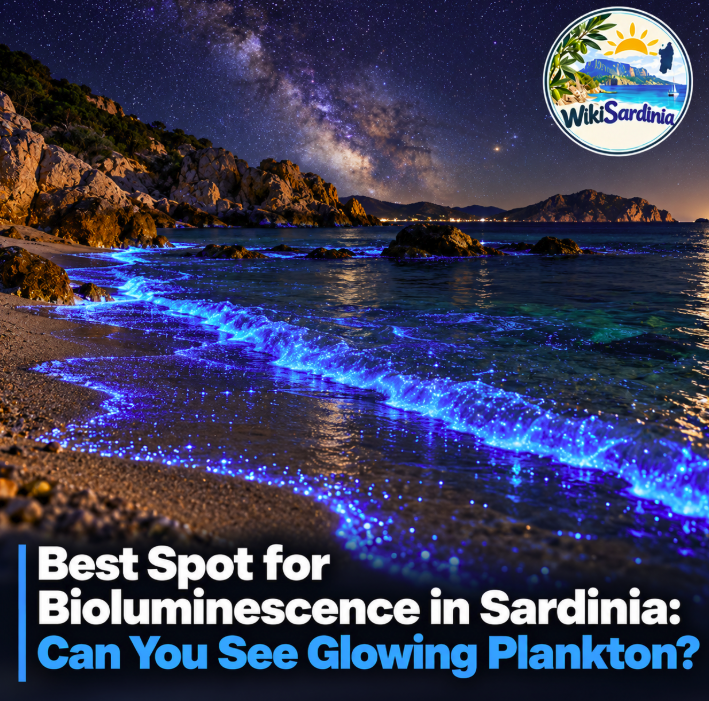
Yes, bioluminescent plankton can appear in Sardinia—but there is no beach where the glowing sea can be guaranteed on a particular night. Bioluminescence is a natural and temporary phenomenon produced by concentrations of microscopic marine organisms, and its visibility changes with blooms, currents, water conditions, wind and light pollution.
For travellers, that makes the right question less “Which Sardinian beach has bioluminescence?” and more “Where and when do I have the best chance of seeing it?” Reports and travel guides most often point to areas including Porto Pino, Bosa Marina and the Gulf of Orosei, but the phenomenon can move and may be absent even at a location where it was visible a few nights earlier.
What makes the sea glow?
Marine bioluminescence is commonly associated with microscopic plankton, particularly certain dinoflagellates. Environmental agencies describe Noctiluca scintillans as one organism capable of producing clearly visible nighttime bioluminescence when phytoplankton concentrations become high enough. Such blooms can develop rapidly when environmental conditions favour reproduction and then disappear when those conditions change.
The blue flashes become especially visible when the water is disturbed. Small waves breaking on the shore, a paddle moving through the sea or a hand passing through the water can trigger brief points or streaks of light.
Where is the best place to look in Sardinia?
There is no scientifically established “best bioluminescence beach” in Sardinia. One current Italy-focused guide identifies Porto Pino, Bosa Marina, parts of the Gulf of Orosei including Cala Luna and Cala Goloritzé, and the Cabras lagoon area among locations where the phenomenon has been reported. It also correctly cautions that plankton follows changing environmental conditions rather than remaining at one tourist spot.
For a trip planned specifically around the possibility of seeing glowing water, Porto Pino is an interesting base because the southwest coast offers long stretches of relatively dark shoreline away from major cities. Bosa and the Orosei coast are alternatives if they fit the rest of your itinerary better.
Darkness matters more than the name of the beach
Your chances of actually noticing weak bioluminescence improve dramatically under a dark sky. Choose a beach away from streetlights, hotels and illuminated promenades. A moonless or near-new-moon night is much better than a bright full moon because faint flashes are easier for your eyes to detect.
Give your eyes time to adapt to the darkness and avoid repeatedly looking at a bright phone screen. Watch the breaking edge of small waves and the water immediately around rocks, where movement can make tiny flashes easier to see.
When can bioluminescence appear?
There is no fixed Sardinian “bioluminescence season” that guarantees a sighting. Plankton blooms depend on a combination of biological and environmental factors. Official environmental information explains that favourable conditions can produce extremely high phytoplankton concentrations within hours and that blooms end when those conditions change.
Warm, calm periods are often suggested by travel guides as promising, but visitors should treat this as a probability rather than a timetable. A spectacular photograph from August does not mean the same beach will glow the following August—or even the following night.
How to tell real bioluminescence from reflections
True plankton bioluminescence reacts to movement. Look for tiny blue-green flashes in disturbed water rather than a continuous neon-blue surface. If the glow appears only where waves break, where your feet move through shallow water or where a paddle touches the sea, that is a much stronger clue.
Long-exposure photographs can make bioluminescence look dramatically brighter than it appears to the naked eye. Expecting an electric-blue beach like a heavily processed photograph is one of the easiest ways to be disappointed.
Can you swim in it?
Do not assume that every glowing or unusually coloured plankton bloom is automatically safe. Environmental authorities note that some phytoplankton species can produce toxins, while non-toxic blooms may be largely harmless to people. Without knowing which organism is present, visual appearance alone is not enough to determine safety.
If authorities have issued a bathing warning, if the water has an unusual colour or smell, or if there are signs of a major algal bloom, stay out. Sardinia officially monitors hundreds of designated bathing waters, so current local notices are more useful for safety than social-media photographs.
So, is Sardinia worth a bioluminescence trip?
Yes—provided you treat the glow as a bonus rather than a guaranteed attraction. Sardinia has exceptionally dark coastal areas, clear water and locations where bioluminescent plankton has been reported. But there is no permanent glowing beach and no reliable nightly schedule.
If we had to choose one strategy, we would stay near Porto Pino, pick the darkest calm night around the new moon, walk away from artificial lights and watch the shoreline after full darkness. If the plankton appears, you may see one of Sardinia's most unusual natural spectacles. If it does not, you still get a night beneath one of the Mediterranean's darkest coastal skies.


