
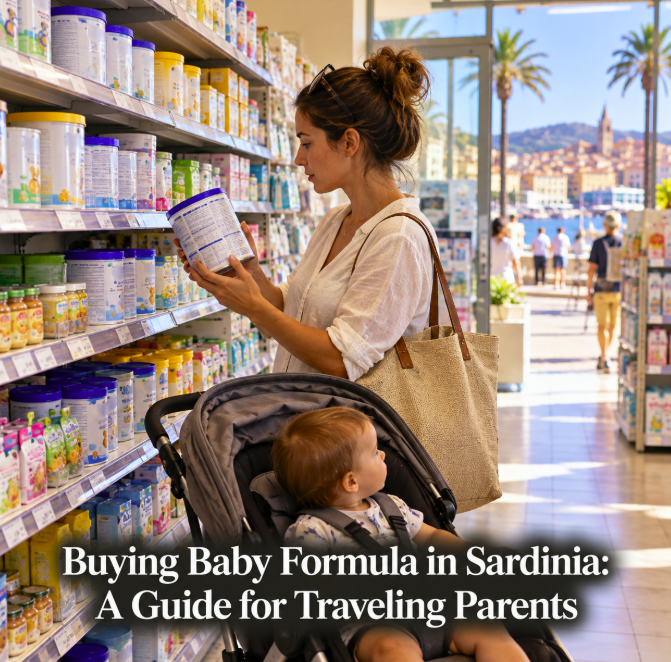
Parents traveling to Sardinia with a formula-fed baby do not normally need to pack enough powdered milk for the entire holiday. Infant formula is sold in Italy, including Sardinia, through supermarkets and other baby-care retail channels, with familiar European brands as well as supermarket own-label products. The important exception is a baby who relies on one precise formula, especially a specialist product: in that case, bringing an adequate supply from home and discussing substitutions with the child's clinician is safer than assuming the identical product will be on a Sardinian shelf.
The first useful phrase is latte in polvere per lattanti, meaning powdered infant formula. Packaging is organized by age and type, so parents should pay attention to the number and description rather than buying a tin simply because the brand looks familiar.
Where to buy baby formula in Sardinia
Large supermarkets are often the easiest first stop. Current Italian retail listings show infant and follow-on formula from brands such as Aptamil, Mellin and Nidina, alongside supermarket ranges including Coop Crescendo and Conad Baby. Coop's current online assortment, for example, lists powdered formula for infants from birth to six months as well as follow-on formula for older babies.
In Sardinia, major supermarket groups operate in cities and towns across the island. A larger store in or around Cagliari, Olbia, Sassari or another populated center will generally offer more choice than a tiny seasonal minimarket near a beach. Stock still varies by individual branch, so parents looking for a specific product should check online or call ahead rather than relying on the chain name alone.
Pharmacies and para-pharmacies are also useful, particularly when you need advice locating a less common product or a formula for a specific dietary requirement. For specialist medical formula, do not assume every pharmacy keeps it immediately in stock; ask whether it needs to be ordered.
Italian formula labels to recognize
For a young baby, look for wording such as formula per lattanti or latte per lattanti. Products marked “1” commonly indicate first infant formula intended from birth, although the package instructions should always be checked.
After six months, you will see latte di proseguimento, or follow-on formula, often marked “2.” Coop's current product information, for example, distinguishes its “1” powdered infant formula for zero to six months from “2” follow-on formula for babies over six months through 12 months.
Products marked “3” or described as latte di crescita are growing-up milks intended for older children and are not interchangeable with first infant formula. Age indications are printed on the package.
Useful shopping vocabulary includes in polvere for powdered, liquido for liquid or ready-to-feed formula, senza lattosio for lactose-free and alimento a fini medici speciali for a food for special medical purposes. A parent who needs a medically indicated formula should use the exact product information provided by the baby's clinician rather than trying to match formulas only by an Italian translation.
Will the same U.S. brand be available?
Not necessarily. Italy has a broad regulated formula market, but brand names, formulations, package sizes and product ranges differ between countries. The Italian Ministry of Health's current list of notified infant formulas includes products from numerous manufacturers and retailers, including Similac Gold 1, Novalac 1, Mellin products, Formulat and own-label infant formulas from Conad and Coop.
That does not mean the Italian version of a familiar brand is compositionally identical to the version sold in the United States or another country. Parents should compare the exact product, age range and preparation instructions rather than assuming that matching logos mean matching formula.
If your baby accepts an ordinary formula and your pediatric clinician is comfortable with an equivalent product while traveling, buying locally can reduce luggage. If the baby has allergies, reflux requiring a prescribed product, metabolic needs, cow's-milk protein allergy or another medical requirement, travel with sufficient supply and a contingency plan.
Powdered or ready-to-feed?
Both powdered and liquid formulas are sold in Italy. Ready-to-feed liquid can be convenient during flights, ferry crossings and road trips because it avoids measuring powder while traveling. It is heavier and may be less widely stocked in the exact brand or stage you want.
Powdered formula is easier to carry for a longer stay but requires careful preparation. Always follow the instructions on the specific Italian package because scoop size, powder-to-water ratios and handling instructions are product-specific. Do not reuse the scoop or mixing ratio from a different formula.
Do not wait until a remote beach village to restock
Sardinia is large and population is unevenly distributed. Families staying in Costa Smeralda, the Gulf of Orosei, Chia, Villasimius or another holiday area may have supermarkets nearby, but the range can be smaller than in a major town.
A useful strategy is to buy the next tin before leaving Cagliari, Olbia, Sassari, Alghero or another sizeable center. Keep enough formula for unexpected delays, particularly if you are taking a ferry, staying in an agriturismo or moving between rural parts of the island.
Sunday and holiday opening hours can also differ, and a small shop that appears open online may operate reduced hours outside summer. Do not plan to run out on the assumption that the nearest store will be open late.
Check recalls before using a newly purchased tin
Italy's Ministry of Health publishes official food safety alerts and recalls, including infant formula. This is worth knowing because formula recalls do occur: the ministry published a recall notice involving a batch of Aptamil powdered infant formula in February 2026 due to a microbiological risk.
A recall involving one identified product or batch does not mean a whole brand is unsafe. Parents can check the Ministry of Health's current food recall database if they have concerns and compare the product and lot information on the package.
What to pack from home
Even if you plan to buy formula in Sardinia, carry enough familiar formula for the journey and the first day or two. That prevents a delayed flight, late arrival or closed supermarket from turning into an urgent search immediately after landing.
Take a photo of the front and back of your normal formula package, including ingredients and preparation instructions. If you need help in an Italian pharmacy, having the exact product information is much more useful than trying to remember the full name.
For specialist formula, carry documentation describing the baby's dietary or medical requirement and discuss international travel with the relevant clinician in advance. Do not switch a medically necessary formula solely because a supermarket product appears similar.
A simple shopping plan after landing
If you arrive at Olbia, Cagliari or Alghero and need ordinary infant formula, look for a full-size supermarket or pharmacy before driving to a remote accommodation. Ask for latte in polvere per lattanti and state the baby's age. If you need the first stage, saying latte 1 can help, but still confirm the age information on the package.
Parents traveling with babies already have enough logistics to manage. Fortunately, ordinary infant formula is not an exotic product in Sardinia: it is part of the normal Italian baby-food market. Bring a sensible emergency supply, know the Italian terminology, shop before heading somewhere remote and treat specialist formulas differently from routine ones. That combination makes feeding logistics much easier without filling an entire suitcase with tins.


