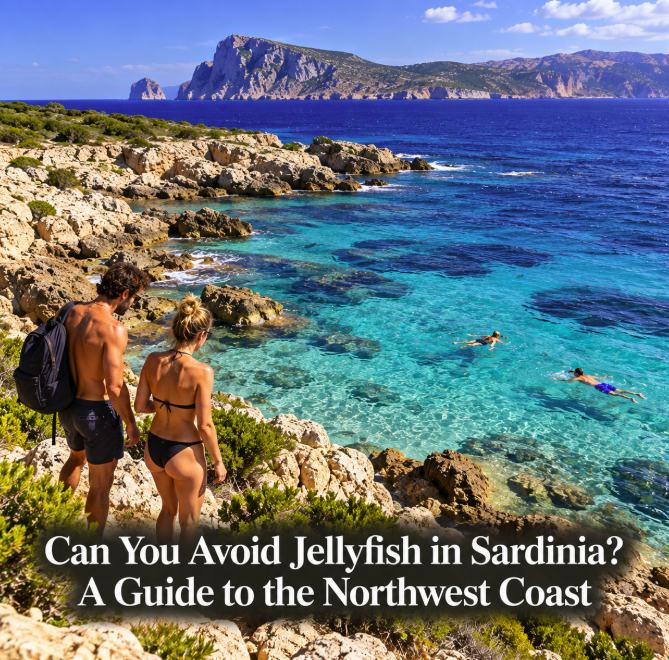
There is no reliably jellyfish-free zone in Sardinia, including the northwest. Jellyfish are mobile marine animals carried and concentrated by a combination of currents, wind and sea conditions, so a beach that is completely clear in the morning can look different the following day. For travelers who want to reduce the chance of an unpleasant encounter, the most useful strategy is not choosing one supposedly safe coast months in advance. It is staying somewhere with several beaches facing different directions and making the final choice according to conditions.
Northwest Sardinia works well for that flexible approach. Around Alghero, Porto Conte, the Nurra and Stintino, the coastline contains open western shores, sheltered bays and beaches with different orientations within a manageable area. That does not mean the northwest naturally repels jellyfish. It means travelers have alternatives when wind or currents make one stretch of coast less attractive.
Why nobody can promise a beach without jellyfish
Jellyfish distribution in the Mediterranean is variable. Their presence near shore depends on biological cycles as well as physical processes that move water and floating organisms. A report of jellyfish at a Sardinian beach is therefore a snapshot, not a permanent characteristic of that beach.
This is why claims that the north, south, east or west of Sardinia is “medusa-free” should be treated cautiously. Even neighboring coves can have different conditions because their entrances, headlands and exposure to wind are different.
Weather is particularly important on an island. Sardinia can experience strong mistral winds from the northwest, but local geography determines whether a specific beach is exposed, cross-shore or protected. Looking only at the island-wide wind direction is not enough.
Why Alghero is a practical base
Alghero gives swimmers several types of coastline without requiring a long relocation. The urban and northern sandy shore includes Lido di San Giovanni and Maria Pia, while the Porto Conte area farther northwest contains more protected water and beaches such as Mugoni. Capo Caccia and the surrounding headlands create a complex coastal geography rather than one uninterrupted exposed shore.
This variety is useful when sea conditions change. If one beach has onshore wind, rough water or visible jellyfish, another beach with a different orientation may be a better option. The decision should be made on the day rather than assuming that one named beach is always safer.
Alghero also works for travelers who want to ask locally before committing. Lifeguards, diving centers, boat operators and beach businesses are often better placed to describe what has been seen that morning than a social-media post from several days earlier.
Stintino and La Pelosa are not guaranteed jellyfish refuges
La Pelosa's famously shallow, clear water can make marine life easier to see, but its beauty does not make it immune to jellyfish. Stintino sits on a peninsula at the far northwest of Sardinia, with water on different sides and a complicated relationship with the Gulf of Asinara.
That geography again creates options. Conditions on the exposed western side can differ from those around the more sheltered waters facing the gulf. If avoiding jellyfish is a priority, flexibility between beaches is more valuable than booking accommodation on the assumption that La Pelosa itself will always be clear.
Remember that La Pelosa also has regulated summer access. It is not an ideal spontaneous backup beach if you have not checked the current reservation rules.
The open Nurra coast: useful alternative, but watch the sea
The coastline between the Alghero area and Stintino includes rugged stretches of the Nurra with beaches and rocky coves facing the open western sea. Sardinia's official coastal planning documents identify this northwest sector as a distinct coastal system running through Alghero, Sassari, Stintino and Porto Torres.
Open exposure can sometimes help disperse accumulations that develop in sheltered water, but it comes with a major trade-off: wind and waves. A beach with fewer visible jellyfish is not a better swimming choice if the sea is rough, currents are uncomfortable or lifeguard warnings are in place.
Never enter rough water simply to avoid jellyfish elsewhere. Swimming safety comes first.
Wind direction is useful, but not a magic formula
A common beach rule is to avoid shores receiving sustained onshore wind because floating material can be pushed toward the beach. This can be a useful clue, but Sardinia's coastline is too irregular for a simple “mistral equals jellyfish” or “mistral clears jellyfish” rule.
Headlands, local currents, bays and the wind direction over previous hours all matter. Instead of applying a universal formula, look at the water when you arrive. Clear shallow Sardinian beaches make visual checking relatively easy when conditions are calm.
If several jellyfish are already visible close to shore, changing beach is usually more sensible than hoping they will disappear immediately.
Jellyfish are not the same issue as Ostreopsis
Travelers researching sea conditions in northwest Sardinia may also encounter official warnings about Ostreopsis cf. ovata. This is a potentially toxic benthic microalga, not a jellyfish. ARPAS, Sardinia's regional environmental protection agency, monitors it each summer from June to September.
Three of the agency's five current monitoring stations are in northwest Sardinia: Alghero at Las Tronas, Porto Torres at Acque Dolci and Castelsardo at La Marina. The other two are in the Gulf of Cagliari. If monitoring identifies conditions requiring health attention, ARPAS communicates the results to municipalities and health authorities.
That monitoring should not be interpreted as evidence that northwest Sardinia has more jellyfish. It is a separate environmental health program concerning microscopic algae.
A better daily strategy for swimmers
If jellyfish are a major concern, choose a base such as Alghero where you can reach beaches with different orientations. Each morning, check the marine forecast and wind, then ask locally about sightings if possible. When you reach the beach, spend a few minutes observing the shallows before swimming.
Keep an alternative beach in mind rather than driving an hour to one famous location and feeling obliged to swim there. Around northwest Sardinia, that could mean switching between the Alghero urban coast, Porto Conte, parts of the Nurra and the Stintino peninsula according to the day's conditions.
Families with children should be especially cautious about telling children that a beach is “safe from jellyfish.” Teach them not to touch jellyfish washed onto the sand, because tentacles can still sting after stranding.
What to do if you are stung
Leave the water calmly and seek help from a lifeguard or medical professional if symptoms are significant. Do not rub the affected skin, because mechanical rubbing can worsen discharge from remaining stinging cells. Treatment advice can differ according to the jellyfish species, so local medical guidance is preferable to improvised internet remedies.
Call emergency services if a person develops breathing difficulty, loss of consciousness, severe widespread symptoms or another serious reaction.
So is northwest Sardinia the best choice?
Northwest Sardinia is a sensible area for travelers worried about jellyfish because Alghero, Porto Conte, the Nurra and Stintino offer a varied coastline and the ability to change beach according to wind and sea conditions. It would be misleading, however, to describe the region as naturally jellyfish-free or to guarantee fewer jellyfish than every other Sardinian coast.
The best protection is flexibility. Choose an area with several beaches, check conditions on the day, observe the water before swimming and move if jellyfish are accumulating near shore. In Sardinia, the beach with the clearest water today may be different from the one that looked perfect yesterday—and that is a much more useful principle than searching for a permanent “no jellyfish” zone.