Want to take a jar of Sardinian honey home after your holiday? In general, travellers may bring certain honey products into the United States for personal consumption, but you must declare agricultural products when entering the country. A sealed commercial jar is not an automatic guarantee of entry, and an opened jar is not necessarily prohibited solely because it has been opened. The product, its condition and the inspection decision all matter.
Can you bring Sardinian honey into the USA?
USDA’s Animal and Plant Health Inspection Service says travellers can generally bring in products such as comb honey, royal jelly, bee bread and propolis when intended for personal consumption. Honey and beeswax intended as feed for bees are subject to different rules. If you are carrying ordinary honey as a food souvenir, check the latest USDA guidance before travelling because requirements can change.
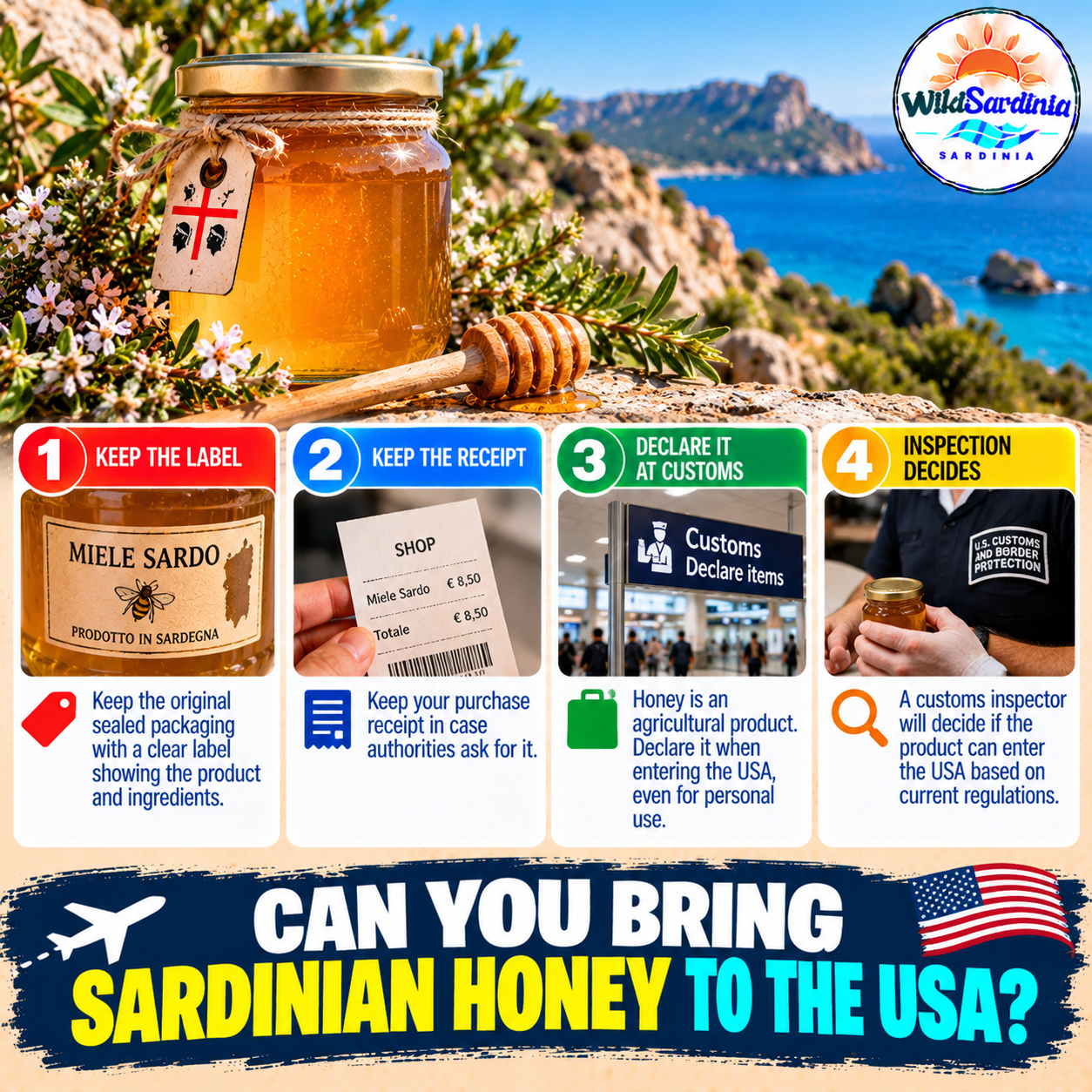
Declare it at US customs
US travellers and international visitors must declare agricultural products to US Customs and Border Protection. Tell the officer that you are carrying honey and present it if requested. Agricultural inspectors decide whether the item meets entry requirements. USDA says that if you declare agricultural products, you will not face penalties even if an inspector decides an item cannot enter.
Should the jar be sealed?
Original, clearly labelled packaging is helpful, but it should not be treated as a guarantee that the honey will be admitted. A sealed jar makes it easier to identify the product and its origin. If you buy honey directly from a small Sardinian beekeeper, keep the label and receipt and ask the producer for product details. Avoid carrying a leaking, unlabelled or poorly protected container.
There is no simple rule that all sealed honey is allowed while all opened artisanal honey is forbidden. If a jar has been opened, declare it and let the inspector assess it; for the simplest journey, choosing an intact, labelled container is the more practical option.
How to pack honey for the flight
- Check airline baggage rules: a jar in cabin baggage may be subject to liquid or gel limits; checked baggage may be more practical.
- Protect against leaks: close the lid securely, place the jar in a sealed bag and cushion it inside your luggage.
- Keep the label: preserve the product name, producer and country-of-origin information.
- Keep the receipt: USDA recommends retaining receipts and original packaging as evidence of origin.
- Declare it: do not hide honey or other agricultural products from customs.
What if customs will not allow it?
Follow the officer’s instructions. Declaring the product is important even if it turns out not to be admissible. Do not assume that a small quantity, a gift or a traditional homemade product is exempt from inspection.
A simple phrase to remember
If asked, you can say: “I’m carrying a jar of honey from Sardinia for personal consumption.” Keep the jar accessible in case an inspector wants to examine its label or packaging.
The safest way to bring home a taste of Sardinia
Choose a clearly labelled jar, keep the receipt and original packaging, check the current official guidance before departure and declare the honey when you arrive in the United States. The key point is not simply whether the jar is sealed: declaration and inspection are essential, and the final decision belongs to US agricultural inspectors.
Official guidance: USDA APHIS — Coffee, Tea, Honey, Nuts and Spices; USDA APHIS — Travelling from Another Country.