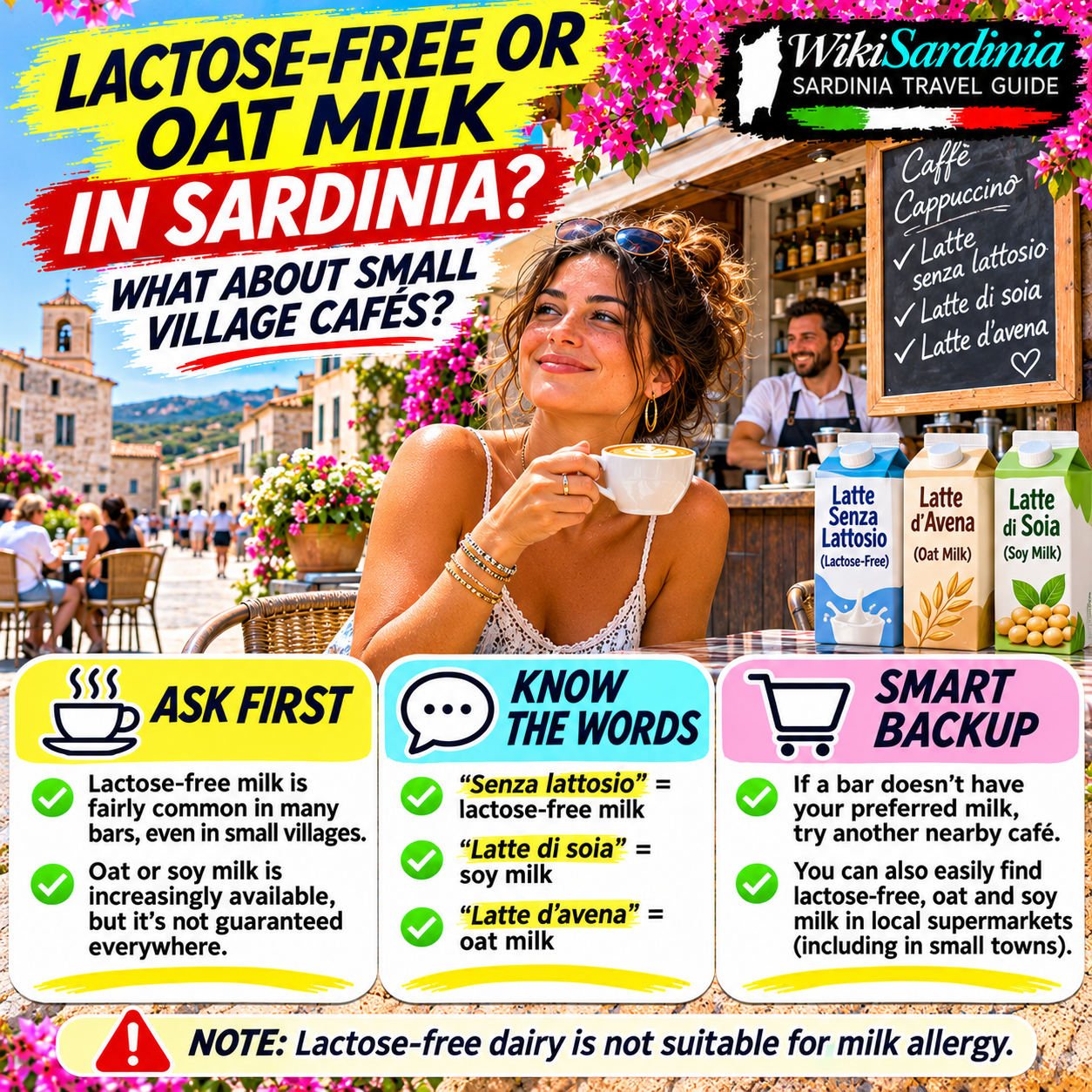
Finding lactose-free milk or a plant-based cappuccino in Sardinia is often possible, even outside major tourist towns—but it is not guaranteed in every small village bar. Lactose-free cow’s milk is a useful first thing to ask for; soy and oat drinks are also increasingly listed on Italian café menus. The smallest traditional bars may stock only ordinary milk, particularly outside the summer season.
What can you realistically expect in a Sardinian village?
There is no reliable island-wide survey showing what percentage of small Sardinian bars stock each alternative. Availability depends on the bar, its customer base, supply deliveries and season. Do not treat a tourist café in Alghero as representative of a tiny inland village. Nevertheless, a published café menu from Tuttigiorni in Lanusei provides a useful real-world example: it lists lactose-free milk for a €0.20 supplement and soy, oat or almond drinks for €0.30 extra. This proves that options are available in at least some smaller Sardinian towns, not that every local café has them.
Which milk should you ask for?
Latte senza lattosio is lactose-free cow’s milk. It still contains milk proteins and is not suitable for someone with a cow’s-milk protein allergy. Latte di soia means soy drink, and latte d’avena means oat drink. Both are naturally dairy-free, though ingredients, added flavors and allergen handling can differ by brand. Italy’s Istituto Superiore di Sanità explains that plant-based drinks are different nutritionally from cow’s milk and that soy and other ingredients can themselves be allergens.
Is lactose-free milk easier to find than oat milk?
It is a reasonable first request in a conventional bar, but there are no verified comparative stock figures for Sardinia’s villages. Some bars carry lactose-free dairy, some prefer soy, and others offer several alternatives. Ask the staff rather than assuming any particular ranking. Oat drinks can be more common in cafés with a specialty-coffee or modern breakfast offering, but this is a practical expectation rather than a measured Sardinian statistic.
Useful Italian phrases at the counter
- “Avete latte senza lattosio?” — Do you have lactose-free milk?
- “Posso avere un cappuccino con latte di soia?” — Can I have a cappuccino with soy milk?
- “Avete latte d’avena?” — Do you have oat milk?
- “È possibile farlo senza latte vaccino?” — Can you make it without cow’s milk?
- “C’è un supplemento?” — Is there an extra charge?
- “Potete usare una lattiera pulita?” — Can you use a clean milk-steaming jug?
For a lactose-free cappuccino, say “Un cappuccino senza lattosio, per favore.” For an oat cappuccino, say “Un cappuccino con latte d’avena, per favore.” The phrase “senza latte” alone can be misunderstood as no milk at all, so specify the alternative you want.
How much extra does it cost?
There is no standard surcharge. The published Tuttigiorni menu in Lanusei lists +€0.20 for lactose-free milk and +€0.30 for a plant drink. Other Italian café menus show different prices, so use these figures as a concrete example, not a fixed Sardinian tariff. A café may also charge a different base price for a specialty cappuccino.
What if the village bar has only regular milk?
You can order an espresso, an espresso lungo or an Americano without milk. If you prefer a milky drink, try another bar in the same town or check a supermarket or grocery store for sealed cartons of lactose-free, soy or oat drink. Availability in shops also varies, especially in very small settlements. If a particular milk is essential for a child or for medical reasons, buy a suitable supply when you pass through a larger town rather than relying on your next breakfast stop.
Important allergy and gluten precautions
Lactose intolerance and milk allergy are not the same. Lactose-free cow’s milk still contains dairy proteins. If you have a milk allergy, tell staff explicitly: “Sono allergico/a alle proteine del latte.” Ask whether the coffee machine’s steam wand, milk jug and other utensils are cleaned to avoid cross-contact. For coeliac disease, do not assume every oat drink is gluten-free; check the package for a suitable gluten-free declaration and discuss cross-contact with the barista. The Associazione Italiana Celiachia flags oat-based beverages among products that require careful checking.
Does the time of year make a difference?
It can. A busy summer café may stock a wider range than it does during quieter months, while some coastal businesses close seasonally. This is not a universal rule, and some year-round neighborhood cafés may have excellent choices. If you are traveling to remote villages in winter or spring, ask before ordering and keep a backup option.
Frequently asked questions
Will a tiny Sardinian village bar understand “oat milk”?
Not necessarily in English. Use “latte d’avena” and, if needed, show the phrase on your phone.
Is soy milk always available?
No. It appears on many Italian menus, but individual bars can run out or choose not to stock it.
Can I get lactose-free milk in a cappuccino?
Yes, wherever the bar stocks it. Ask for “cappuccino senza lattosio.”
Is lactose-free milk vegan?
No. It is still cow’s milk. Choose an appropriate plant-based drink if you avoid animal products.
Can I rely on oat milk being gluten-free?
No. Check the specific product and how it is prepared, especially if you have coeliac disease.
The bottom line
You can often find a lactose-free, soy or oat cappuccino in Sardinia, including some smaller towns, but don't count on all three options in every village café. Learn the Italian phrases, ask about a supplement and have a backup plan. If you have an allergy rather than a preference or lactose intolerance, make ingredient checks and cross-contact precautions your priority.