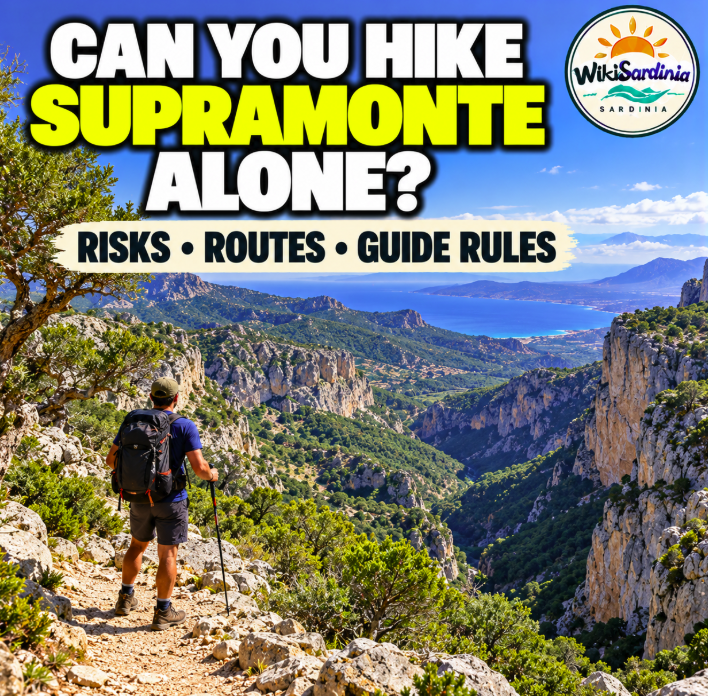
Can you hike Sardinia's Supramonte alone? Sometimes, yes—but not every trail is suitable for independent hiking, and solo travel adds significant risk. The Supramonte is one of Sardinia's wildest mountain regions, with limestone plateaus, deep gorges, steep coastal paths, caves and remote terrain. Some established walks can be tackled independently by suitably experienced hikers in good conditions. Other routes demand advanced navigation, scrambling, ropes or specialist mountaineering skills.
Is a guide legally required? There is no single blanket rule requiring a guide for every hike across the entire Supramonte. However, individual municipalities, protected areas, specific routes and activities may have their own access rules, registration requirements or restrictions. Always verify the rules for your exact itinerary before setting out.
Why the Supramonte is different from an ordinary coastal walk
The Supramonte extends across areas associated with Baunei, Dorgali, Oliena, Orgosolo and Urzulei. Its rugged limestone landscape is beautiful but unforgiving. Paths can be rocky and indistinct, vegetation may obscure old tracks, and steep ravines can make a small navigation error difficult to correct.
There may be limited mobile reception and long stretches without reliable drinking water, shade or convenient exits. A route that appears short on a map can take much longer because of steep gradients, rough ground and route-finding challenges.
Do not confuse the existence of a GPS track online with a well-marked, maintained or safe hiking trail.
Do you need a guide to hike in the Supramonte?
Not for every route. The official SardegnaTurismo guide to the Supramonte di Baunei describes some hikes that can be undertaken without a guide and notes that sections of the famous Selvaggio Blu can be approached with a local guide, independently or with technical assistance, depending on the route and experience.
However, the same official tourism information urges hikers to check municipal ordinances before departure because some excursions require prior notification for safety reasons. Its Gorropu guidance emphasizes expert accompaniment and suitable equipment for the demanding canyon approaches.
These statements are not contradictory: the Supramonte is a region, not a single trail with one difficulty level or one access rule.
Is hiking alone dangerous?
Solo hiking in the Supramonte can be particularly dangerous because no companion is present to help after a fall, injury, navigation error or sudden illness. Even a minor ankle injury can become a serious emergency when the nearest road is several hours away.
Potential hazards include:
- Getting lost: old shepherd paths and animal tracks can be mistaken for the intended route.
- Falls: exposed ledges, loose limestone, scree and steep descents require care.
- Heat and dehydration: exposed rock and limited water sources make summer hiking demanding.
- Flash flooding: rain upstream can affect gullies and canyon floors even when conditions nearby seem calm.
- Changing weather: wind, rain and poor visibility can make navigation harder.
- Limited communication: mobile signal may disappear in gorges and remote valleys.
- Delayed rescue: remote terrain can complicate locating and reaching an injured hiker.
For first-time visitors unfamiliar with this landscape, a qualified local hiking guide or an experienced group is the safer choice.
Can beginners hike in the Supramonte?
Beginners should avoid remote, unmarked or technical routes and should not start with an independent solo trek. A guided outing on an appropriate established itinerary can introduce the area's geology, navigation challenges and local safety practices.
Even an advertised “easy” route needs checking for total distance, ascent, descent, terrain, weather and the physical ability of every participant. Difficulty labels are not universal, and the return journey may be substantially harder than the outward leg.
Gorropu Gorge: can you visit without a guide?
Some Gorropu excursions are offered with or without a guide, according to the canyon's official visitor operator, Chìntula. That does not mean every approach or every section of the gorge is suitable for an inexperienced solo walker.
For example, the route from Genna Sìlana involves a significant descent into the gorge followed by a demanding uphill return. The official regional tourism website recommends expert accompaniment and appropriate equipment for trekking routes to Gorropu.
Before visiting, check the official Gorropu information for current access arrangements, opening hours, route choices and available transfers. Access arrangements can change with weather and operational conditions.
Selvaggio Blu: should you ever attempt it alone?
Selvaggio Blu is not an ordinary hiking trail. This celebrated multi-day route through the Supramonte di Baunei involves complex navigation, exposed terrain and, on demanding sections, technical rope work and mountaineering skills.
SardegnaTurismo notes that sections may be completed with a guide, independently or with technical support. That should not be read as an endorsement of solo attempts by ordinary hikers. Independence on a technical route is appropriate only for people with the necessary skills, preparation, equipment and compliance with current rules.
For most visitors, use an experienced local professional and the appropriate technical support. Never attempt a technical passage simply because an online itinerary describes the trail as famous or scenic.
What about Cala Goloritzè and Cala Sisine?
Some routes descending from the Golgo plateau toward the coast are described in official regional tourism material as possible without a guide. But independent access does not mean easy access, and beach-specific booking, capacity or environmental rules may apply.
Check current municipal requirements, trail conditions and whether your planned route involves exposed or difficult sections. A steep coastal return in afternoon heat can be exhausting, even for fit visitors.
Do you need to register before hiking?
Sometimes. Official SardegnaTurismo guidance advises checking municipal ordinances for excursions in the Supramonte di Baunei, noting that in some cases hikers must communicate their presence for safety reasons.
Requirements vary by route and date. Do not assume a rule from one municipality applies to all five areas of the Supramonte. Check the official website of the municipality responsible for your chosen starting point and destination, and verify any protected-area access requirements.
How to decide whether a route is suitable for independent hiking
Before choosing a solo itinerary, ask yourself:
- Is the route officially documented and currently accessible?
- Do I know its exact distance, elevation gain and expected duration including the return?
- Does it require scrambling, exposure, ropes, abseiling or specialist equipment?
- Can I navigate confidently without a mobile data connection?
- Do I have sufficient water and emergency supplies?
- Is the weather suitable, including conditions upstream of any gorge?
- Does someone know my precise route and when to expect me back?
- Can I turn around safely before reaching the most difficult section?
If any essential answer is uncertain, choose an easier outing or arrange professional guidance.
What equipment should you carry?
Equipment depends on the route, season and difficulty, but a nontechnical day hike should normally include:
- Supportive footwear with reliable grip on limestone
- An offline map plus a separate navigation backup
- Enough drinking water for the full route and a contingency reserve
- Food, sun protection and weather-appropriate layers
- A charged phone and portable power bank
- A headlamp, even when planning to finish in daylight
- A first-aid kit and emergency whistle
- Information about the route shared with a trusted person
Technical itineraries require additional equipment and training. Carrying a rope does not make someone qualified to use it.
Can you rely on your phone's GPS?
Do not rely on a phone as your only navigation or emergency system. GPS positioning may work without mobile reception, but downloaded maps can be inaccurate, battery life is finite and a device can be damaged or lost.
Use a reliable route from a trusted source, download maps before departure and know how to navigate when a track becomes unclear. A satellite communication device may provide an additional emergency option in remote areas, but it does not eliminate the underlying risks.
Is there drinking water in the Supramonte?
Do not count on finding potable water along your route. Springs and seasonal watercourses may be dry, difficult to locate or unsuitable for drinking without treatment.
Carry sufficient water based on the weather, effort and duration, with a reserve for delays. Summer heat can dramatically increase needs, and even autumn days can be warm on exposed limestone.
When is the best season for hiking?
Spring and autumn can be more comfortable than the hottest summer months, but they also bring variable weather. October, for example, may offer pleasant temperatures while introducing rain and flash-flood risks in narrow gorges.
Summer days can be dangerously hot, particularly on open rocky terrain. Winter can bring cold, strong winds and wet, slippery limestone. Check a mountain-specific forecast rather than relying on coastal weather for your holiday resort.
Why flash floods matter in canyons
Gorges concentrate water from a larger drainage area. Heavy rainfall upstream can produce sudden changes downstream, sometimes even when the sky directly overhead appears clear.
Never enter a canyon or dry riverbed if rain or thunderstorms are forecast in the catchment area. If conditions deteriorate, retreat early using a safe established route. Do not wait for water to rise before making a decision.
What if you get lost?
Stop before a minor navigation error becomes a dangerous descent. Check your map and surroundings, and avoid improvising shortcuts through steep gullies or cliffs.
If you cannot safely regain the route, or if anyone is injured, seek emergency assistance. In Italy, call 112. Give your coordinates if available, describe the last known trail or landmark and follow the operator's instructions.
Mobile coverage is not guaranteed. This is another reason to share your route and expected return time before departure.
Is a local guide worth the cost?
For challenging Supramonte hikes, a knowledgeable, appropriately qualified guide offers more than directions. Local professionals can assess route conditions, understand terrain and seasonal hazards, explain environmental and cultural features and help select an itinerary suited to the group.
Ask about qualifications, insurance, route difficulty, group size, required equipment and cancellation policies. For technical passages, confirm that the professional has the specific mountaineering qualifications needed for the activity.
Can you hike the Supramonte solo if you are experienced?
An experienced, self-sufficient hiker may be able to undertake some established nontechnical routes alone where access rules permit. But experience elsewhere does not automatically transfer to the Supramonte's limestone terrain, sparse waymarking and remote ravines.
Choose a conservative itinerary, verify current conditions, carry appropriate equipment and have a realistic turnaround time. Avoid committing to exposed technical routes without suitable partners and expertise.
Frequently asked questions
Is it legal to hike the Supramonte without a guide?
There is no single blanket guide requirement for the entire region. Check route-specific municipal and protected-area rules.
Is solo hiking in the Supramonte safe?
It carries substantial risks, especially on remote or technical routes. A local guide or experienced group is advisable for most first-time visitors.
Can beginners visit the Supramonte?
Yes, on suitably chosen easy or guided excursions. Beginners should avoid remote independent treks.
Can I visit Gorropu without a guide?
The official operator offers some trekking options with and without guides, but route difficulty and access conditions vary. The regional tourism authority strongly recommends expert accompaniment for demanding approaches.
Do I need a guide for Selvaggio Blu?
It is not universally described as legally mandatory, but the route is highly technical and professional guidance or technical support is strongly recommended for most hikers.
Can I hike to Cala Sisine independently?
Some official routes are described as possible without a guide, subject to current access rules, trail conditions and suitable experience.
Will my phone work in the Supramonte?
Do not assume reliable mobile reception. Carry offline navigation and tell someone your itinerary.
Are there water fountains on the trails?
Do not rely on them. Carry enough drinking water and a reserve.
Is October a good month for hiking?
It can be, but rainfall and flash flooding require particular attention in canyons.
What emergency number should I call?
Call 112 in Italy if you need emergency assistance, where a connection is available.
The bottom line
You can hike parts of Sardinia's Supramonte without a guide, but that does not mean hiking alone is a good idea. The answer depends on the exact trail, its technical demands, current regulations, weather and your skills. For Gorropu, Selvaggio Blu and remote limestone routes, treat local expertise as a major safety advantage—not an optional luxury.
Official sources and planning links
SardegnaTurismo — Supramonte di Baunei; SardegnaTurismo — Gorropu Gorge; Official Gorropu visitor operator; Sardegna Sentieri — Regional trail resources. Check municipal ordinances and route updates immediately before departure.