Yes — you can absolutely see Corsica from Sardinia.
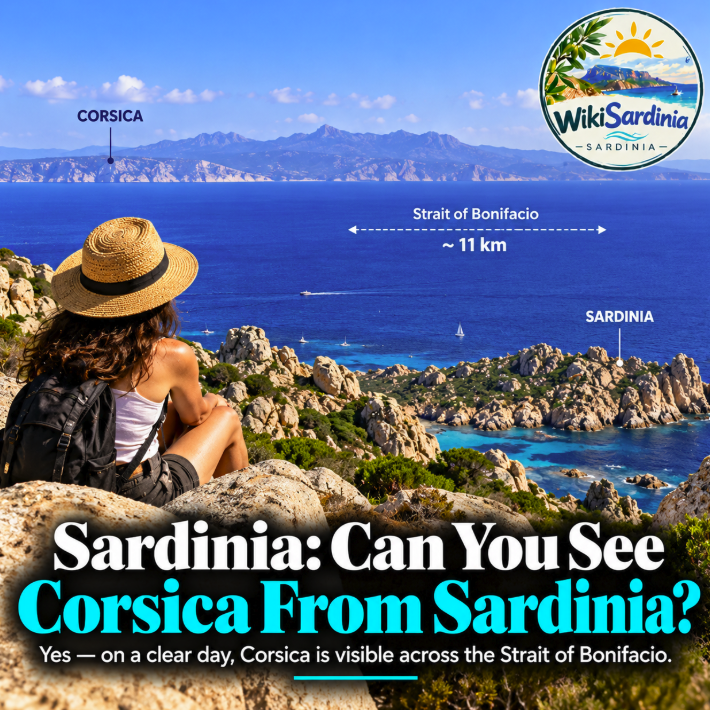
On a clear day, stand on the far north coast of Sardinia around Santa Teresa Gallura or Capo Testa and the land visible across the sea is Corsica.
The two Mediterranean islands come remarkably close together at the Strait of Bonifacio, known in Italian as the Bocche di Bonifacio.
How far is Corsica from Sardinia?
At their closest points, Sardinia and Corsica are separated by roughly 11–12 kilometres of sea.
MOBY, which operates the Santa Teresa Gallura–Bonifacio ferry route, describes the islands as approximately 11 km apart across the Strait of Bonifacio.
That is only about seven miles.
It is close enough that Corsica's southern coastline is clearly visible from northern Sardinia when atmospheric conditions cooperate.
Where is the best place in Sardinia to see Corsica?
Santa Teresa Gallura is the easiest answer.
The town occupies Sardinia's northern tip and faces directly toward southern Corsica. It is also the Sardinian port for the short ferry crossing to Bonifacio.
From elevated and exposed viewpoints around Santa Teresa, you can look north across the strait and see the Corsican coast.
Capo Testa gives you an even wilder viewpoint
Just west of Santa Teresa Gallura, the granite peninsula of Capo Testa is one of the most spectacular places to try.
The headland pushes into the sea through enormous wind-sculpted granite formations, with open horizons toward Corsica.
Walk toward the northern and western viewpoints on a clear day and the mountains and coastline beyond the strait can be strikingly obvious.
Capo Testa also gives the view a sense of scale: between the granite foreground and the distant Corsican landmass lies one of the Mediterranean's most famous channels.
Can you see Bonifacio itself?
Sometimes parts of the Bonifacio area can be picked out in exceptionally clear conditions, particularly from a good elevated position or with binoculars.
But do not expect the entire old town to look like a detailed postcard across the water with the naked eye.
What is normally much easier to identify is the Corsican landmass, cliffs and higher terrain.
Bonifacio itself sits dramatically on pale limestone cliffs at the southern end of Corsica.
Why can you see another island 11 km away?
At this distance, Earth's curvature is not a serious obstacle for ordinary coastal viewpoints, especially because you are not trying to see something at sea level.
Corsica has substantial terrain rising behind its coastline, and even modest elevation on the Sardinian side increases your visible horizon.
The bigger practical limitations are haze, cloud, sea spray and atmospheric conditions.
How far can you see from sea level?
A person whose eyes are roughly 1.7 metres above sea level has a geometric horizon of only around 4.5–5 kilometres.
But that does not mean Corsica disappears.
The horizon calculation applies to an object at zero height. Corsican hills and mountains rise hundreds of metres above the sea, so their upper portions remain visible from much farther away.
Move onto a headland or viewpoint in Sardinia and your own horizon expands as well.
Clear winter and autumn days can be excellent
Summer is not necessarily the best season for long-distance visibility.
Hot weather can produce haze over the sea, softening distant landforms.
After a weather front clears the atmosphere in autumn, winter or spring, Corsica can appear surprisingly sharp.
A cool, dry day with good visibility is more important than the month on the calendar.
Morning or evening?
Visibility depends primarily on atmospheric clarity, but changing light can make Corsica easier or harder to distinguish from the sky.
Low-angle light can increase contrast along ridges, while glare over the water can temporarily make distant details harder to see.
If photography is your goal, try more than one time of day if you are staying around Santa Teresa.
Can you see Sardinia from Corsica?
Yes. The same geometry works in reverse.
From the southern Corsican coast around Bonifacio, the northern Sardinian landmass can be visible across the strait in clear weather.
Elevated viewpoints around Bonifacio's cliffs make the effect especially easy to appreciate.
The ferry proves how close the islands really are
The regular ferry route between Santa Teresa Gallura and Bonifacio takes about 50 minutes under the published 2026 MOBY timetable.
It is one of those journeys where two culturally distinct islands feel almost like neighbours across a narrow channel.
However, ferry operations can be affected by technical issues and weather, and the Strait of Bonifacio can become rough and windy. Always check the operator's current service status before planning a day trip.
Why is the Strait of Bonifacio famous?
The strait separates Sardinia from Corsica and connects the western Mediterranean with the Tyrrhenian Sea.
Its geography funnels winds and waves through a relatively narrow passage.
The area is also scattered with islands and rocky hazards, making it historically significant for navigation.
The beautiful blue water you see from Capo Testa can therefore be much more challenging for sailors than it appears from land.
Are Sardinia and Corsica geologically connected?
The islands are separate today, but they form part of the same broader geological history.
Sardinia and Corsica are often discussed together as the Sardinia-Corsica microplate, which separated and rotated away from the European margin millions of years ago.
The narrow modern strait makes their geographical relationship particularly obvious when you stand on one island and look directly at the other.
Can you swim from Sardinia to Corsica?
The distance may look tempting to an endurance swimmer, but the Strait of Bonifacio is not an ordinary 11-kilometre coastal swim.
Strong winds, currents, waves and maritime traffic make open-water crossings a specialist undertaking requiring organization, support and appropriate authorization.
For normal travelers, take the ferry.
Can you make a day trip from Sardinia to Corsica?
When ferry schedules and operating conditions allow it, yes.
The short Santa Teresa Gallura–Bonifacio crossing makes a same-day visit geographically realistic.
Bonifacio is particularly rewarding because the harbor, limestone cliffs and fortified old town feel immediately different from northern Sardinia despite being so close.
Check the current timetable rather than relying on an older travel blog, especially outside summer.
Best places to look for Corsica from Sardinia
Start with Capo Testa for dramatic granite scenery and a wide northern horizon.
In and around Santa Teresa Gallura, elevated coastal viewpoints also provide easy access without requiring a long hike.
Other exposed points along the far northern Gallura coast can offer views too, but local terrain may block parts of the horizon.
Bring binoculars
You do not need binoculars to prove that Corsica is there on a clear day.
But a small pair makes the experience much more interesting, helping you separate ridges, cliffs, buildings and vessels crossing the strait.
A telephoto lens can make the apparent closeness of the two islands even more dramatic in photographs.
How to know whether you are really looking at Corsica
From the north coast around Santa Teresa, look north across the open strait.
The substantial landmass on the opposite horizon is southern Corsica, not one of the small islands of the Maddalena archipelago.
Using an offline map or compass makes orientation easy if visibility is hazy.
WikiSardinia's answer
Yes, you can see Corsica from Sardinia — and you do not need exceptional eyesight.
At the narrowest part of the Strait of Bonifacio the islands are only about 11–12 km apart, and Corsica's elevated terrain rises clearly above the horizon.
For the best experience, go to Capo Testa or Santa Teresa Gallura on a cool, crystal-clear day.
Standing on Sardinian granite while looking across at another island — and another country — is one of northern Sardinia's simplest and most memorable experiences.