That little bottle of white Sardinian sand you were thinking of putting in your suitcase? Leave it on the beach.
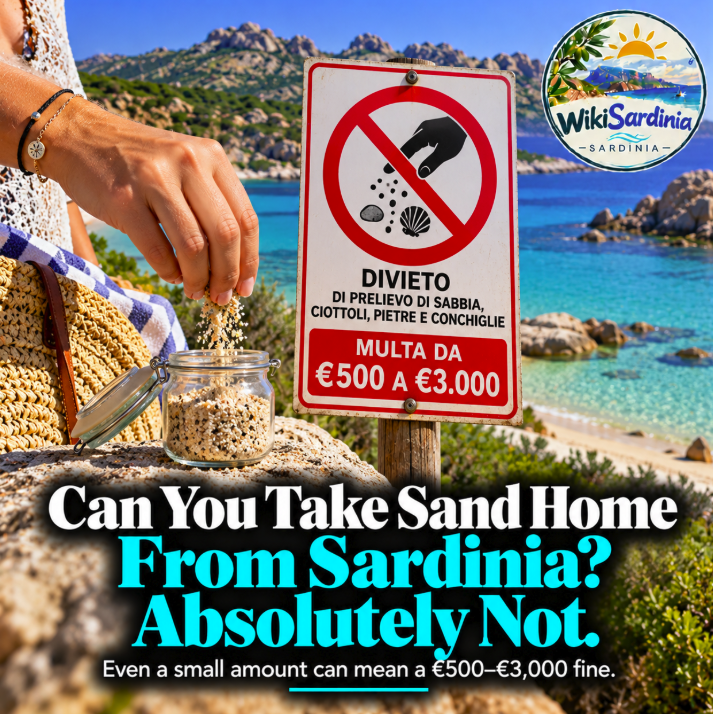
This is not a local superstition, an environmental suggestion or one of those travel rules that nobody enforces. In Sardinia, removing coastal material is prohibited, and the administrative fine can reach €3,000.
Can you take sand home from Sardinia?
No.
The Autonomous Region of Sardinia reiterated the rule in its official 2026 beach-protection campaign: it is forbidden to remove, possess or sell sand, pebbles, stones and shells originating from the coast or sea.
The stated administrative penalty is from €500 to €3,000.
Yes, even a small amount
The rule is not limited to people filling buckets or commercially removing sand.
The regional legislation applies to coastal material taken without authorization, including small quantities. Sardinia's own 2026 campaign deliberately makes the point that even a single grain of sand is precious and should not be taken away.
So “it was only a tiny bottle” is not a sensible strategy.
It is not just sand
The prohibition covers more than the famous white and pink sands that attract attention online.
Do not take:
sand, pebbles, stones or shells.
A shell picked up during a walk may feel like a harmless souvenir, but the regional rule explicitly includes shells originating from the coast or sea.
Where does the €3,000 fine come from?
The prohibition is established by Article 40 of Sardinian Regional Law No. 16 of 28 July 2017.
Official regional environmental material states that anyone who removes, possesses or sells sand, pebbles, stones or shells from the coast or sea without authorization can receive an administrative sanction between €500 and €3,000.
The rule is still in force in 2026
This is not an old regulation being recycled on social media.
On 14 July 2026, the Region of Sardinia published a new public campaign reminding tourists and residents of four basic rules for protecting beaches.
The first rule is the prohibition on taking coastal material, with exactly the same €500–€3,000 sanction.
The Region also confirmed the ban in its 2026 maritime-domain ordinance for the bathing season.
Why is Sardinia so strict?
A handful of sand looks insignificant when you are standing in front of an entire beach.
Multiply that handful by millions of visitors over many years and the logic changes.
Sand, shells, stones and pebbles are part of the coastal system. Removing them piece by piece damages a resource that forms extremely slowly and, in some locations, gives the beach its unique character.
Famous beaches are especially vulnerable
Sardinia contains beaches whose sand is one of their defining attractions. Quartz grains, pale limestone particles, shell fragments and other geological material can take thousands of years to accumulate.
Once carried away in luggage, that material does not magically return the following summer.
What if sand gets into your towel or shoes?
Accidental grains stuck to wet feet or a beach towel are obviously different from deliberately filling a container to take home.
The practical rule is simple: shake towels, shoes, toys and bags out before leaving the beach and do not intentionally collect coastal material.
If you notice a quantity of sand in your belongings later, return it to the coast when reasonably possible rather than turning it into a souvenir.
Can children collect shells?
They can look at them, photograph them and learn about them — but the safest rule is to put them back.
Explain that the shell belongs to the beach and that thousands of people taking “just one” creates the problem.
It is a useful Sardinian souvenir lesson: take photographs, not pieces of the coastline.
Can you buy Sardinian sand in a souvenir bottle?
Do not assume that something is legal merely because someone offers it for sale.
The regional rule prohibits not only unauthorized removal and possession but also the sale of coastal sand, pebbles, stones and shells.
If a product genuinely uses legally sourced commercial material, that is a different question — but a bottle marketed as sand taken from a Sardinian beach should be a major red flag.
Can you take stones from a rocky beach?
No. The rule explicitly includes ciottoli and sassi: pebbles and stones.
The fact that a beach is rocky rather than sandy does not turn its geological material into free souvenirs.
What about pink sand?
Absolutely leave it where it is.
Some Sardinian beaches and protected environments have exceptionally delicate ecosystems and additional access restrictions. Never assume the general regional rule is the only protection applying at a particular site.
Follow signs, protected-area regulations and instructions from local authorities.
Airport checks are not the point
Stories regularly circulate about sand being discovered in travelers' luggage. But whether you expect to be checked should not determine whether you obey the rule.
The material is protected because Sardinia wants it to remain on Sardinia's beaches.
The easiest way to avoid a €500–€3,000 problem is not to put it in your bag in the first place.
Other beach rules worth knowing
The Region's 2026 campaign also reminds visitors that dunes are protected. Walking on dunes and accessing them with vehicles where prohibited can lead to sanctions.
Littering and unauthorized wild camping are also subject to fines.
In other words, Sardinia's beaches may feel wild and open, but they are not unregulated spaces.
What souvenir should you take instead?
Buy something that supports the island rather than removing part of it.
A locally made ceramic, textile, carved object, food product or piece of Sardinian craftsmanship carries a much better story home than a jar of illegal sand.
And photographs weigh nothing in your suitcase.
WikiSardinia's rule is easy to remember
If nature put it on a Sardinian beach, leave it there.
No sand. No pebbles. No stones. No shells.
The official 2026 penalty is €500 to €3,000, and the ban applies across Sardinia — not only to one famous beach. The Region has reiterated the prohibition again this year, so this is not a viral myth or an outdated warning.
Enjoy the beach, take a thousand photographs and leave every grain behind for the next person.