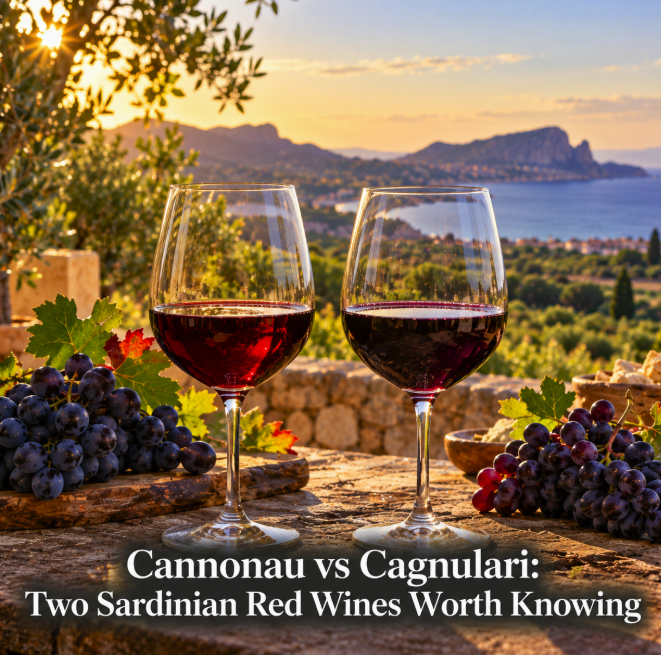
Cannonau and Cagnulari offer two very different ways to explore Sardinian red wine. Cannonau is the island’s best-known red grape and is grown across Sardinia, with particularly important traditions in the interior and Ogliastra. Cagnulari is much more geographically concentrated, associated above all with the northwest around Alghero and Sassari. For travelers choosing a bottle at dinner, the comparison is less about which wine is “better” and more about whether you want a broad symbol of Sardinian wine culture or a distinctly northwestern local specialty.
Cannonau: the Sardinian red most visitors meet first
Cannonau is closely identified with Sardinia and is cultivated throughout the island. Sardegna Agricoltura describes the inland areas, particularly Ogliastra, as an important environment for the variety. The Cannonau di Sardegna DOC covers the region and includes the subzones Oliena, also known as Nepente di Oliena, Capo Ferrato and Jerzu.
Under the denomination rules summarized by the regional agricultural authority, Cannonau di Sardegna must contain at least 85% Cannonau, while the Classico specification requires at least 90%. Standard red Cannonau di Sardegna has a minimum alcohol level of 12.5%, while Riserva and Classico start at 13%.
The style changes according to vineyard, area, vintage and winemaking, so there is no single flavor profile for every Cannonau. Regional descriptions commonly point toward red flowers and red fruit in younger expressions, moving toward riper fruit, jam and warm spice in more developed or aged wines. Good examples can feel generous and Mediterranean without necessarily being excessively heavy.
For visitors encountering Sardinian wine for the first time, Cannonau is an excellent reference point because it appears in many parts of the island and in several styles. A bottle from Jerzu can be quite a different experience from one produced around Oliena, which makes regional comparisons particularly interesting.
Cagnulari: a specialty of northwest Sardinia
Cagnulari is a more local story. Sardegna Agricoltura describes it as an ancient variety whose preferred environment is a restricted area in the northwest of the province of Sassari. It performs particularly well on sunny calcareous-clay soils and is traditionally cultivated using low training systems, including the Sardinian bush-vine form.
Under the Alghero DOC, Cagnulari wines are produced in Alghero, Ittiri, Olmedo, Ossi, Tissi, Usini and part of Sassari. The denomination requires at least 85% Cagnulari for the varietal wine. Alghero Cagnulari Riserva requires at least two years of ageing under the current specification summarized by Sardegna Agricoltura.
The regional authority describes Cagnulari as ruby red, with intense aromas recalling berries and preserves alongside delicate balsamic notes. On the palate it is characterized as intense, warm and softly textured. Its relative scarcity makes it especially interesting for travelers staying around Alghero, where ordering it provides a direct connection with the viticulture of northwest Sardinia.
How do they taste side by side?
The exact answer depends on the producer, vintage and ageing, but the official regional descriptions give a useful starting point. Cannonau often moves through red fruit, floral notes, ripe fruit and spice, particularly as the wine develops. Cagnulari is associated with darker berry and jam-like aromas, structure, warmth and balsamic nuances.
Rather than treating these descriptions as rigid tasting rules, use them to decide what to try. Someone who enjoys Grenache-family Mediterranean reds will find Cannonau an obvious Sardinian reference. A traveler who wants something less internationally familiar and strongly connected with the Alghero-Sassari area should look for Cagnulari.
What should you eat with them?
Both wines belong comfortably at a Sardinian table, particularly with savory dishes. Regional material on Cagnulari specifically recommends local combinations such as stewed snails, pasta with meat sauce, roast kid and mature pecorino cheese.
Cannonau is also commonly suited to robust Sardinian cooking: roasted meats, slow-cooked dishes, aged cheeses and substantial pasta courses are natural territory. The best pairing depends on the particular bottle. A fresher, fruit-driven Cannonau can be more flexible than a powerful aged Riserva, so asking the restaurant about the producer and style is more useful than relying only on the grape name.
Serving temperature matters too. Sardinia can be very warm, and a red wine served at hot outdoor summer temperature may taste heavier and more alcoholic than intended. A slightly cooler serving temperature can make both varieties more enjoyable, especially during a summer dinner.
What to order in Alghero
In Alghero, Cagnulari deserves particular attention because it belongs directly to the local DOC landscape. The Alghero denomination explicitly includes Cagnulari and Cagnulari Riserva alongside local and international varieties. Asking for an Alghero Cagnulari therefore makes sense for visitors who want to drink something tied closely to the territory around them.
Cannonau remains worth ordering as well, particularly if the wine list offers bottles from different Sardinian areas. A simple two-glass comparison—Cagnulari from the northwest and Cannonau from an inland or eastern producer—can reveal more about Sardinia than ordering the same familiar international grape twice.
Two reds, two views of Sardinia
Cannonau represents the broad reach of Sardinian red-wine culture. Its DOC covers Sardinia and its best-known expressions are linked to several distinctive territories. Cagnulari tells a narrower story centered on the northwest, where local growers have preserved and promoted a grape with a much smaller geographical footprint.
That makes the two wines complementary rather than competitors. Try Cannonau to understand one of the central references of Sardinian wine, then Cagnulari to explore a more local Alghero and Sassari identity. For anyone traveling through the island, tasting both is an easy way to discover how dramatically Sardinian red wine can change from one territory to another.