Sardinia is famous for its beaches, but its historic churches and rural sanctuaries are equally memorable. From Romanesque basilicas to small village chapels, many are still active places of worship. If you plan to visit between sightseeing stops—or straight after the beach—you may wonder whether your shorts, sundress or sleeveless top will be acceptable.
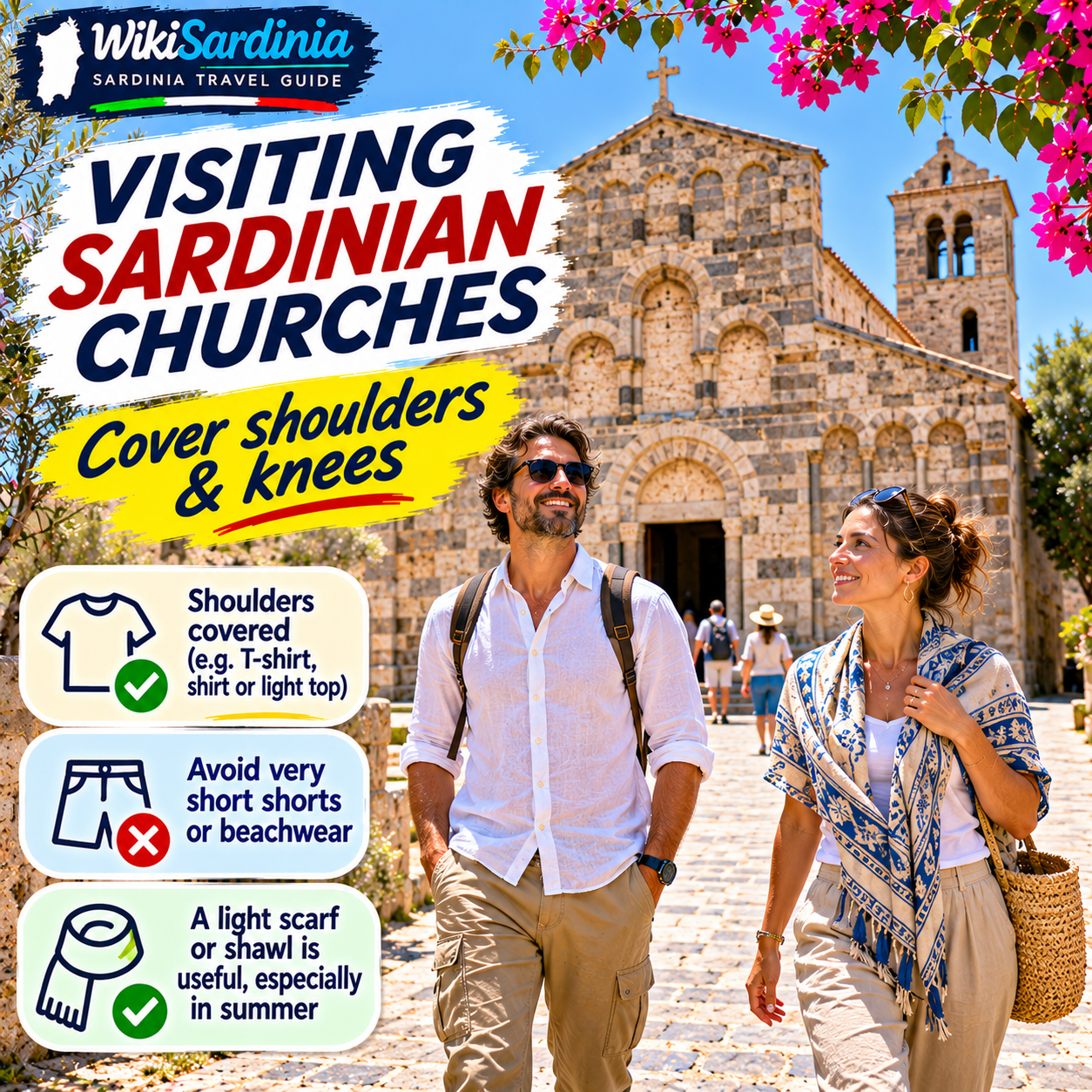
The safest rule is simple: cover your shoulders and knees, avoid beachwear and dress respectfully. This applies to men and women. Enforcement varies from church to church, and there is no single published dress code covering every historic church in Sardinia. However, following this conservative guideline helps avoid being turned away and shows respect for people who use the building for prayer.
Are church dress codes strict in Sardinia?
They can be, but the level of enforcement depends on the location, parish, occasion and staff or volunteers present. Some small churches may have no visible sign or entrance attendant, while larger religious sites may display explicit clothing rules. An absence of a sign does not mean that swimwear or revealing clothing is appropriate.
Official Italian basilica policies provide a useful benchmark. St Peter's Basilica explicitly requires shoulders and knees to be covered. Santa Croce in Florence asks visitors to cover their shoulders and legs. These are examples of Italian church etiquette, not evidence that every Sardinian church enforces identical written rules.
What should women wear to visit a Sardinian church?
A T-shirt or blouse covering the shoulders with trousers, a longer skirt or a dress reaching at least the knees is a reliable choice. A light cardigan or shawl can make a sleeveless summer outfit more appropriate, provided it covers what the site requires.
A short beach dress, very short shorts, a low-cut top or a sheer cover-up may not be suitable. If you are wearing a skirt or shorts above the knee, bring a wrap that provides adequate coverage. You do not need formal evening clothes or a special religious outfit for an ordinary tourist visit.
What should men wear?
Men should also cover their shoulders and knees as a precaution. A T-shirt or collared shirt with long trousers or knee-covering shorts is practical. Tank tops, bare chests and swim shorts are poor choices.
Some churches may accept modest shorts, while others prefer long trousers. If you are visiting an important sanctuary, attending Mass or unsure about the local rule, lightweight long trousers are the simplest option.
Can I wear shorts inside a church?
It depends on the church and the length of the shorts. Very short shorts are best avoided. Shorts that cover the knees are a safer option, though an individual site may impose stricter requirements. Do not assume that a rule used at a famous basilica in Rome automatically applies word-for-word to a village church in Sardinia.
Are sleeveless tops or tank tops allowed?
Exposed shoulders are commonly considered inappropriate in Italian places of worship. A light shirt, cardigan or shawl solves the problem for most visits. If a church has a posted dress code, follow that rule rather than relying on a generic travel recommendation.
Can I go directly from the beach to a church?
Yes, if you change into suitable clothing first. Sardinia's coastal towns make it tempting to combine a beach afternoon with a visit to a cathedral or historic chapel. But bikinis, swimsuits, bare torsos and beach cover-ups that leave the body exposed are not appropriate inside an active church.
Keep a dry T-shirt and lightweight trousers or a longer skirt in your bag. This is more reliable than assuming a towel wrapped around your waist will satisfy the entrance rules.
Do I need to cover my head?
Women are generally not required to cover their heads for ordinary visits to Catholic churches in Sardinia. Men should normally remove caps and hats when entering, unless there is a religious, medical or other legitimate reason. Follow any posted instructions and be considerate of local worshippers.
What shoes should I wear?
Comfortable shoes are recommended, particularly in older churches with uneven stone floors and steps. There is usually no requirement to wear formal shoes. However, avoid arriving barefoot from the beach, and consider whether wet or sandy footwear would be disrespectful or potentially slippery.
Are the rules stricter during Mass or religious festivals?
Religious services are not sightseeing sessions. Dress respectfully, remain quiet and follow the instructions of clergy or volunteers. If Mass is in progress, tourists may be asked to wait until it finishes before walking around or taking photographs.
During pilgrimages and religious festivals, the sanctuary may be especially busy and local expectations more visible. Plan your visit around services if your main purpose is architecture or photography.
What about famous churches and sanctuaries in Sardinia?
The general advice applies to historic churches across the island, including Alghero Cathedral, Cagliari Cathedral, the Basilica of San Gavino in Porto Torres, the Basilica of Saccargia near Codrongianos and important pilgrimage destinations such as the Sanctuary of Nostra Signora di Bonaria in Cagliari.
These examples are not a claim that each site currently posts or enforces the same written clothing rule. Opening hours, access restrictions, religious services and local visitor guidance may change. Check the individual church or sanctuary's current notices before visiting.
Are small village chapels more relaxed?
They may be less formally supervised, but they are still religious spaces. A quiet chapel without a ticket desk is not automatically a place where beachwear is appropriate. Covering up is an easy way to respect the building and the local community.
Can a church refuse entry because of clothing?
Yes. Where dress requirements are in force, staff may ask you to cover up or deny entry. For example, the official Pantheon visitor rules explicitly authorise staff to refuse access when dress standards are not met. That rule is specific to the Pantheon, but it illustrates why visitors should not assume that entrance is guaranteed regardless of attire.
If you are asked to cover your shoulders or legs, respond politely and follow the instructions. Arguing with volunteers or staff is unlikely to help.
Will churches provide scarves or cover-ups?
Some Italian basilicas provide disposable coverings, as Santa Croce does, but do not assume a Sardinian church will lend or sell you anything. Carry your own light scarf, overshirt or wrap.
Can I take photographs inside?
Photography policies vary by church. Some permit non-flash photos, others restrict photography or prohibit it during Mass and other ceremonies. Look for signs and ask permission if you are unsure. Do not use flash around worshippers or photograph people praying without consideration for their privacy.
Silence your phone, avoid loud conversations and do not treat the sanctuary as a photo studio.
Is there a difference between visiting a church and a museum?
Yes. A historic church may contain major works of art and architectural treasures, but if it remains consecrated and used for worship, religious considerations can affect visitor access and behaviour. Even when entry is ticketed or guided, follow the site's dress and conduct rules.
What if I am not Catholic?
You do not need to be Catholic to visit most churches that are open to tourists. Respectful clothing and behaviour are expected of all visitors, regardless of personal beliefs. You are not expected to participate in religious rituals simply because you enter to admire the architecture.
Practical summer packing checklist
- A lightweight T-shirt or shirt that covers your shoulders
- Light trousers, a knee-length skirt or another appropriate lower-body layer
- A compact scarf or shawl as backup
- Comfortable footwear suitable for stone steps and floors
- A small bag to store beachwear or hats while inside
This combination works well for travellers who want to explore a town in the morning, visit a church and head to the beach later.
Useful Italian phrases
| Italian | English |
|---|---|
| Abbigliamento decoroso | Appropriate or respectful clothing |
| Spalle coperte | Shoulders covered |
| Ginocchia coperte | Knees covered |
| Non si entra in costume | No entry in swimwear |
| È consentito entrare? | May I enter? |
| Va bene questo abbigliamento? | Is this outfit acceptable? |
| C'è la messa? | Is Mass taking place? |
| Si possono fare fotografie? | May I take photographs? |
| Silenzio, per favore | Silence, please |
Frequently asked questions
Do Sardinian churches require shoulders and knees to be covered?
It is the safest general rule for visitors. Individual churches may have different posted requirements and levels of enforcement.
Can men wear shorts in Sardinian churches?
Modest knee-covering shorts may be acceptable at some sites, but long trousers are safer where the local rule is unknown.
Can women wear sundresses?
Yes, if the dress provides suitable coverage. Bring a shawl if it is sleeveless or exposes the shoulders.
Can I enter wearing a bikini with a beach cover-up?
Do not rely on a sheer or short beach cover-up. Change into ordinary clothing before entering a church.
Do women need to wear headscarves?
Not generally for ordinary Catholic church visits in Sardinia.
Do men need to remove hats?
Normally yes, unless an appropriate exception applies.
Will I be refused entry if my shoulders are bare?
It is possible at churches that enforce a dress code. Carrying a light layer avoids most problems.
Can I visit a church during Mass?
Access for sightseeing may be limited during services. Follow the posted instructions and avoid disturbing worshippers.
Are dress rules the same at every sanctuary?
No. There is no single published rule that applies identically to every church and sanctuary across Sardinia.
Do children need to follow dress rules?
Families should choose respectful clothing for children too, while following any specific rules displayed at the site.
The bottom line
Historic churches and sanctuaries are among Sardinia's most rewarding cultural stops. You do not need formal clothes, but you should avoid beachwear, cover your shoulders and knees, and respect any posted rules. A spare shirt and light wrap in your day bag make spontaneous church visits easy—even during a hot Sardinian summer.