
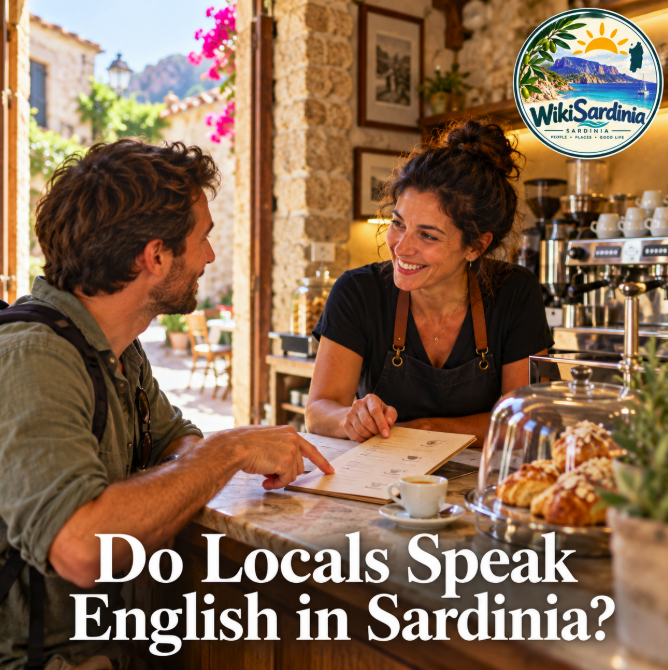
Some people in Sardinia speak English, but you should not expect every conversation to work in English. For a holiday, the practical approach is to confirm language support for important bookings, learn a handful of Italian phrases and keep written details handy. You do not need fluent Italian to start preparing a trip, and you do not need to treat every exchange as a language test.
There is no verified island-wide English-speaking percentage behind this guide. Individual ability varies, and an English-language website does not prove that every employee on every shift speaks English. The useful question is whether the particular service you need can communicate with you.
Arrange the important conversations before arrival
When booking accommodation, ask whether check-in instructions can be sent in English. Keep the address, arrival time and late-arrival arrangements in writing. A short message about the essentials is easier to translate and confirm than a long paragraph containing several requests.
For an excursion, specify that you need an English-language guide on your chosen departure, rather than merely asking whether the company “speaks English”. A bilingual booking office and an English-speaking guide are different services. Confirm the same point for a cooking class, farm visit or activity where explanations are part of the experience.
You can prepare much of your itinerary through the regional tourism board’s English-language website. It offers destination information in English, which is useful for researching places before you arrive. That availability describes an information resource, rather than a guarantee about conversations in every destination.
In Alghero, the official tourist information service describes visitor assistance including language-specific information. Its published contact is infotourist@alghero-turismo.it. Ask directly about the help you need and check current opening arrangements. This is a better starting point than assuming a passer-by can explain a complicated transport connection.
A little Italian makes everyday exchanges easier
Begin with a greeting, then ask whether English is possible. If it is not, switch to a short phrase, a written question or a clear gesture towards the item you want. Speaking louder will not make the words more understandable; simplifying the request usually helps more.
- Buongiorno. — Good morning or good day.
- Parla inglese? — Do you speak English? A polite way to address one person.
- Non parlo bene italiano. — I do not speak Italian well.
- Può parlare più lentamente, per favore? — Could you speak more slowly, please?
- Può scriverlo, per favore? — Could you write it down, please?
- Quanto costa? — How much does it cost?
- Il conto, per favore. — The bill, please.
- Grazie. — Thank you.
At a café, point to the pastry or menu item while saying what you would like. At a ticket counter, show the destination, date and desired departure time. Ask for the final price to be written down if numbers are unclear. These small habits reduce misunderstandings without demanding a long conversation from either person.
Download any translation tools you plan to use before leaving reliable internet access, and check whether their offline functions are actually available on your device. Save accommodation messages, tickets and map locations separately too. A screenshot of a confirmed booking can be more useful than translating the same explanation repeatedly.
Italian and Sardinia’s local languages
Italian is the practical language to learn for travel around the island. Sardinia also has a varied linguistic heritage. The regional cultural portal describes Sardinian, Alghero Catalan, Gallurese, Sassarese and Tabarchino among the languages it promotes and protects. Hearing a local language does not mean you have arrived somewhere that visitors cannot communicate.
Do not assume Sardinian is simply another name for Italian, or that every resident speaks the same local variety. If you are interested, ask how a greeting or place name is said locally. Curiosity can open a conversation, but there is no need to memorise several regional languages to order lunch or check into accommodation.
For anything where a misunderstanding would have serious consequences, arrange clear language support rather than relying on guesswork. For ordinary holiday exchanges, preparation can stay simple: confirmed bookings, written details, a few polite phrases and enough patience to try another way of saying something. English may be available; when it is not, you still have useful ways to communicate.


