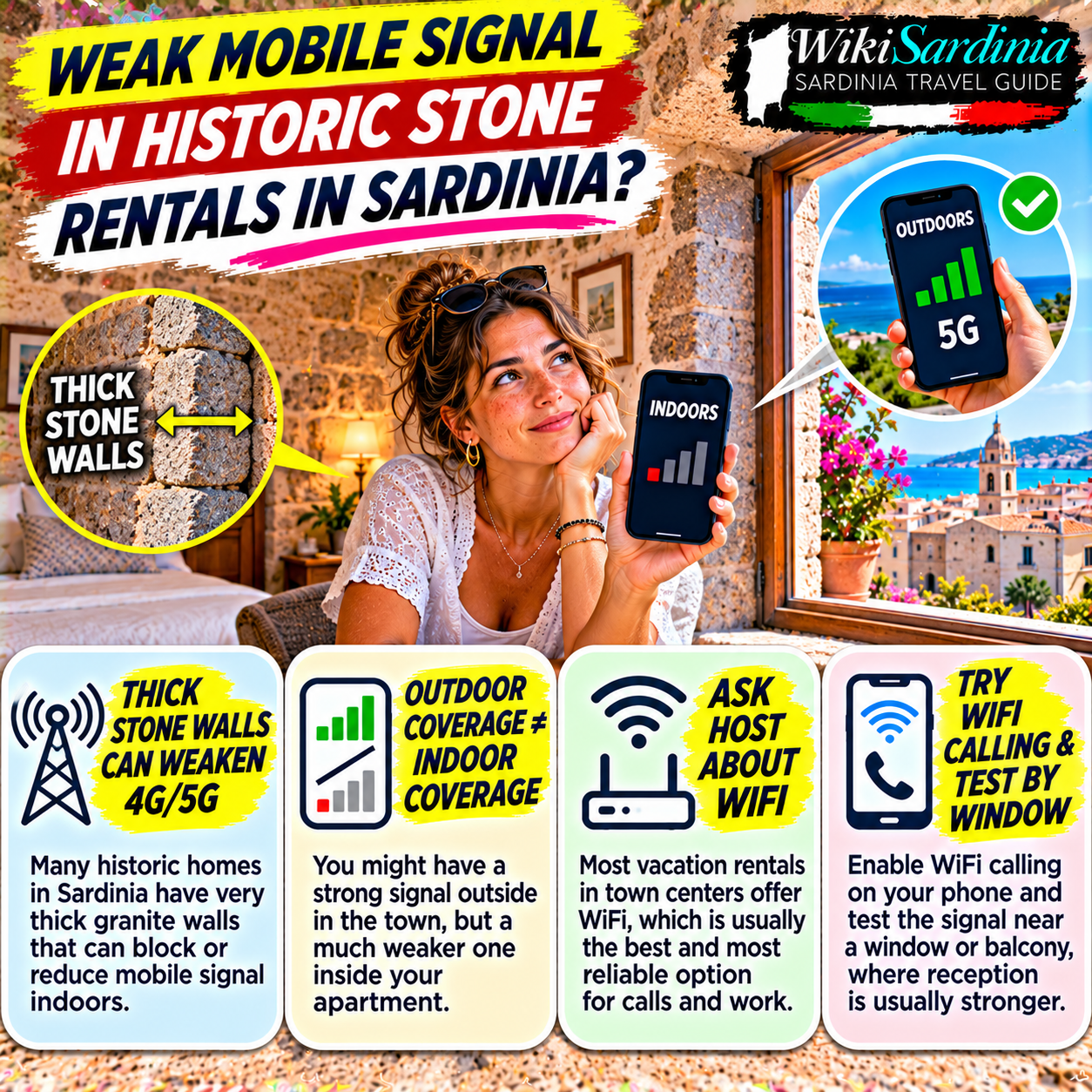
Yes. Thick stone walls in Sardinia's historic holiday rentals can weaken mobile reception indoors, even when your phone shows a good 4G or 5G signal in the street. This is a real radio-propagation effect, not a Sardinian myth. However, not every historic home is built from granite, and poor reception depends on the outdoor signal, wall construction, windows, room location and mobile operator.
Why can a stone house block mobile signal?
Mobile networks use radio waves. When those waves enter a building, walls, roofs, windows and other obstacles can absorb, reflect and weaken them. Thick masonry may cause more signal loss than a lightweight internal partition. The UK communications regulator Ofcom explicitly identifies traditional thick stone walls and slate roofs as possible causes of poor indoor reception. A joint BEREC/RSPG European report likewise explains that older buildings with thick stone walls can be particularly challenging for mobile connectivity.
The result can be surprising: you may stream a video in the square outside your accommodation but struggle to make a voice call from the bedroom. This does not necessarily mean the operator has poor outdoor coverage.
Are all Sardinian historic houses made of granite?
No. Sardinia's traditional building materials vary by area and local geology. Historic houses may incorporate granite, limestone, sandstone, volcanic stone, brick or combinations of masonry and plaster. The important issue for mobile reception is the building's actual construction, not the assumption that every old wall is granite. Even modern buildings can reduce signal through reinforced concrete, foil-backed insulation or metallised energy-efficient glazing.
Does 5G penetrate stone walls worse than 4G?
It depends on the frequency band, not simply the generation label. Lower-frequency mobile bands often penetrate buildings better than higher-frequency bands, all else being equal. Both 4G and 5G can operate on different frequencies, and network design, antenna placement and outdoor signal strength matter. Therefore, a 5G symbol outside does not guarantee usable 5G indoors; conversely, stable indoor 4G can be perfectly adequate for messaging, maps and many work tasks.
Where might reception be weakest in a rental?
Rooms deep inside a building, basement bedrooms, internal courtyards and spaces separated from the street by multiple thick walls may have less reception. A window facing an outdoor signal source may offer better reception, although special coated glass can also attenuate signals. There is no universal rule that every window or balcony will be better: test several locations safely.
How much signal can a building lose?
Signal attenuation is measured in decibels (dB). A peer-reviewed study of outdoor-to-indoor mobile reception in Rome measured building-related attenuation ranging from 6 to 27 dB across several building types, including historic buildings. These figures are research results from Rome, not measurements of Sardinian granite houses and not a fixed loss to apply to your accommodation. A reduction of 10 dB corresponds to one-tenth of the received signal power, but perceived service quality also depends on interference and network conditions.
How to stay connected in a historic Sardinian rental
- Ask the host about fixed broadband and Wi-Fi. Request recent evidence of download and upload performance if you will be working remotely, rather than assuming 'Wi-Fi included' means a fast connection.
- Enable Wi-Fi Calling if supported. With a compatible phone, operator and plan, ordinary mobile calls can be carried over Wi-Fi when cellular coverage is weak. Check support and activation before travelling.
- Test different rooms. Try near an exterior window or on a balcony where it is safe; compare actual calls and internet speed, not only signal bars.
- Check another network. A second SIM or eSIM can help if one operator has poor local outdoor coverage, but switching networks cannot guarantee penetration through thick walls.
- Use reliable indoor Wi-Fi for work. If Wi-Fi itself struggles across thick internal walls, a properly installed access point or mesh system may help, subject to the host's permission.
- Download essential information. Keep offline maps, booking confirmations and arrival instructions available in case both mobile data and Wi-Fi fail.
Wi-Fi versus Wi-Fi Calling: what's the difference?
Ordinary Wi-Fi gives your phone and laptop internet access through the property's router. Messaging apps can use it for internet calls. Wi-Fi Calling is a carrier-supported feature that may let your phone make and receive normal calls using your mobile number over Wi-Fi. Support varies by phone, plan, carrier and roaming circumstances. Check whether SMS and emergency calling are supported in your situation; do not assume that Wi-Fi Calling always works abroad or substitutes for reliable emergency access.
What should remote workers ask before booking?
If you need video meetings, large uploads or tethering, ask the host: Is there fixed-line broadband or only a mobile hotspot? What speeds have been measured inside the apartment? Does Wi-Fi reach the bedroom or desk? Is there a wired Ethernet option? Have guests reported dropped calls? Can the host provide a recent speed test taken from the room where you will work? These questions are more useful than asking only whether the town has 5G coverage.
What about signal boosters?
Do not buy or install a random mobile repeater in a rental property. Radio repeaters are subject to technical and regulatory requirements, and unsuitable equipment may interfere with mobile networks. Ask your operator and host about compliant solutions. For a short holiday, Wi-Fi Calling or a different legal connectivity option is generally simpler.
Useful Italian phrases
- “C'è campo dentro l'appartamento?” — Is there mobile reception inside the apartment?
- “I muri sono molto spessi?” — Are the walls very thick?
- “Il Wi-Fi funziona bene in tutte le stanze?” — Does the Wi-Fi work well in every room?
- “La connessione è in fibra o tramite rete mobile?” — Is the connection fibre or mobile-based?
- “Posso fare videochiamate senza interruzioni?” — Can I make video calls without interruptions?
- “Vicino alla finestra prende meglio?” — Is reception better near the window?
Frequently asked questions
Can granite walls block 5G?
Yes. Thick, dense masonry can significantly attenuate mobile radio signals, including 5G. The actual effect depends on construction, frequency and network conditions.
Does a strong signal outside mean strong reception indoors?
No. Outdoor coverage and indoor coverage are different. Building materials can cause substantial additional signal loss.
Are old Sardinian houses always made of granite?
No. Building materials vary widely by region, geology and construction period.
Is 4G sometimes more reliable indoors than 5G?
Yes. A lower-frequency 4G service can sometimes work better than a higher-frequency 5G service, but performance depends on the bands and network.
Can I use Wi-Fi Calling in Sardinia?
Potentially, if your carrier, plan and device support it. International visitors should verify roaming-related limitations before travel.
Will an eSIM solve the problem?
Not automatically. An eSIM changes your subscription or network access, not the physical effect of thick walls. It may help if a different operator has stronger coverage.
Can thick walls also weaken the rental's Wi-Fi?
Yes. Wi-Fi is also radio-based, so masonry and room layout can reduce coverage away from the router.
The bottom line
Weak indoor mobile reception is a plausible downside of staying in a beautiful historic stone rental in Sardinia, but it is not inevitable. Thick walls can reduce 4G and 5G signals, while local network coverage and building layout determine how much you notice. Before booking, ask about tested indoor Wi-Fi and mobile reception—especially if you need to work remotely—and consider Wi-Fi Calling where supported.
Sources
- Ofcom — Improving your indoor coverage
- BEREC/RSPG — Facilitating mobile connectivity in challenge areas
- ComReg — Building materials and indoor mobile performance
- Sapienza University of Rome — Outdoor-to-indoor attenuation measurements
- NHS England Digital — Building factors affecting wireless propagation