A traditional stone cottage surrounded by olive trees can be one of the most memorable places to stay in Sardinia. But when you book a countryside villa, renovated farmhouse or rural agriturismo for July or August, one practical question matters: will the bedrooms actually stay cool at night?
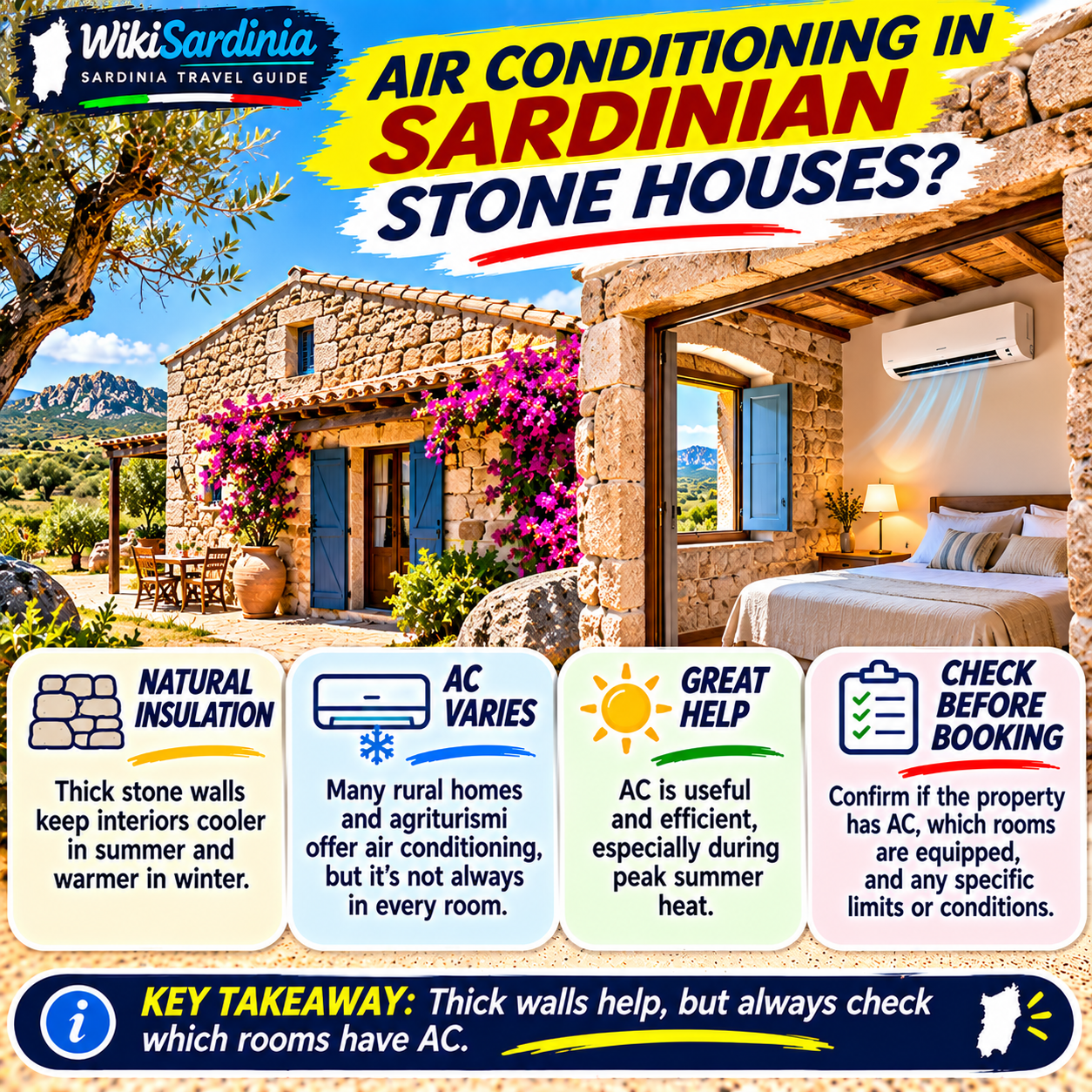
Some Sardinian stone houses and rural properties have excellent air conditioning; others have only a unit in the living room, fans or no mechanical cooling at all. Thick traditional walls can help moderate indoor temperatures, but they are not a substitute for confirming the equipment and comfort of the particular accommodation you intend to book.
Do traditional stone houses in Sardinia have air conditioning?
There is no island-wide rule. Sardinian rural accommodation ranges from carefully restored farmhouses with modern heating and cooling systems to simple country homes that rely on shutters, shade and natural ventilation. Some agriturismi have air-conditioned guest rooms; others provide cooling in only certain spaces.
The fact that a property is advertised as “traditional,” “rustic” or “authentic” tells you little about its cooling system. Equally, a historic-looking house may have discreet, modern split-unit air conditioning installed during renovation. Always assess the exact listing and ask the host to confirm.
Why do thick stone walls sometimes keep houses cooler?
Traditional stone and masonry walls often have high thermal mass. That means they can absorb, store and release heat gradually, reducing sudden indoor temperature changes. Heavy walls may delay the impact of daytime outdoor heat and help a shaded interior feel more stable than an exposed, lightweight structure.
Historic England's guidance on traditional buildings explains how stone and other natural materials can buffer heat and moisture fluctuations. Research on Mediterranean traditional buildings also identifies benefits from thermal mass when combined with appropriate ventilation.
But there is an important limitation: thermal mass is not the same as insulation or air conditioning. Walls can eventually accumulate heat during prolonged hot weather, and they need opportunities to cool down. Roof construction, window orientation, shading, ventilation, occupancy and the local climate all influence comfort.
Can a stone house become hot during a heatwave?
Absolutely. Sardinia can experience extreme summer heat, including in inland areas. The regional environmental agency ARPAS validated a maximum temperature of 48.4°C at Orani on 19 July 2026, an island record at the time of its report. That was an exceptional outdoor reading, not a typical daily temperature or a prediction for every part of Sardinia.
During sustained heatwaves, even thick-walled homes can become uncomfortable, particularly when night-time temperatures remain high, rooms are exposed to the afternoon sun or ventilation is limited. SNPA's account of the July 2026 heatwave is a reminder that travellers should take summer cooling seriously.
Does “air conditioning” mean every bedroom has AC?
No. This is perhaps the most important detail to verify before booking. A holiday-rental listing may truthfully say “air conditioning” even if the only unit is in the lounge or a main bedroom. It may not effectively cool other bedrooms, especially when doors are closed.
Ask the host exactly where the units are installed, whether each sleeping area has its own cooling, and whether the system is fully operational for your dates. If you are travelling with children, older relatives or a group using separate rooms, a single split unit may not meet everyone's needs.
What types of cooling might a rural property offer?
You may encounter wall-mounted split air conditioners, central or ducted cooling, portable AC units, ceiling fans or simple standing fans. These are not equivalent.
A properly sized, functioning split system can cool a room effectively. A portable air conditioner may provide more limited cooling and can be noisy. Fans move air and can improve perceived comfort, but they do not lower room temperature in the way a refrigeration-based air conditioner does. Open windows and cross-ventilation can help when outside air is cooler, but are much less effective during very hot nights.
Ask for the type of equipment, not just the words “cooling available.”
Are rural agriturismi less likely to have air conditioning than hotels?
Not necessarily. Accommodation categories do not provide a reliable answer. Some modernised agriturismi have excellent guest-room cooling; some small hotels or B&Bs have older or limited systems. Likewise, a luxurious-looking villa may have air conditioning in only part of the building.
Rather than assuming that hotels are always better equipped, compare room-by-room amenities, recent guest feedback and the host's written confirmation. The age and maintenance of the system can matter more than the type of property.
What should you check before booking?
- Room coverage: Is there an AC unit in every bedroom or only in shared areas?
- System type: Is it a fixed split system, ducted cooling, portable AC or a fan?
- Operation: Is the equipment working and available throughout the stay?
- Controls: Can guests set the temperature independently?
- Charges: Is electricity and AC usage included in the rental price, or is there a separate charge or allowance?
- Restrictions: Are there usage hours, timer settings or house rules?
- Back-up: Are fans available, and what is the process if the system stops working?
- Windows: Can bedrooms be ventilated safely, and are insect screens fitted?
Ask these questions through the booking platform or by email so you have the answers in writing. If cooling is essential for your health or sleep, say so before paying.
Is air conditioning always included in the accommodation price?
No universal rule applies to every holiday rental. Some properties include electricity and AC use in the nightly price; others may specify a metered charge, an energy allowance or other conditions. The agreed booking terms should explain what is included.
Do not assume that a listed air-conditioning amenity automatically means unlimited electricity consumption at no additional cost. Check the total price and any usage policy before confirming the reservation.
What about properties in the mountains or countryside?
Altitude, exposure and local weather can influence night-time comfort. A shaded home at higher elevation may feel different from a sun-exposed villa in a low-lying inland valley, but no location guarantees cool nights during a heatwave.
Rural houses may also have shutters, courtyards, pergolas and trees that reduce direct solar gain. These features can help, particularly when combined with sensible ventilation, but they do not tell you whether the bedrooms will be comfortable during an exceptional hot spell.
How can you keep a traditional house cooler without AC?
When it is safe and practical, close shutters or curtains on sun-facing windows during the hottest hours. Use exterior shade where available. Open windows for cross-ventilation when outdoor air is genuinely cooler than indoor air, typically later in the evening or early morning, and close them when outdoor temperatures rise again.
Historic England notes that night ventilation can help release heat stored in traditional building fabric. However, open windows may not be appropriate because of security, insects, smoke, noise or poor outdoor air quality. Fans can improve airflow but should not be treated as a guarantee of safety during dangerous heat.
If your accommodation is too hot to sleep comfortably, contact the host promptly rather than trying to endure several nights of excessive heat.
Is air conditioning essential in July and August?
That depends on your tolerance for heat, the property and the weather. Many visitors will be more comfortable with reliable bedroom air conditioning in the peak summer months, especially in inland locations and during heatwaves.
People who are particularly vulnerable to heat should be cautious about relying solely on thick walls or a fan. If you require a reliably cool indoor environment, choose accommodation with clearly documented cooling in the sleeping areas and ask the host about contingency arrangements.
What about May, June, September and October?
These months can offer more moderate conditions than peak summer, but warm spells are still possible. Some visitors may be comfortable with good natural ventilation and shutters, while others prefer air conditioning regardless of season.
Do not assume that an AC system is operating outside July and August. Some properties have seasonal policies, and a unit may be used for heating as well as cooling. Confirm availability for your exact travel dates.
How can I spot an unclear holiday listing?
Look carefully at the amenities and photographs. “Air-conditioned property” is less informative than “individually controlled AC in both bedrooms.” A photo of one unit does not establish that every room is cooled.
Recent guest reviews may mention bedroom temperatures, weak cooling or noise. These can be helpful signals, but a direct, dated confirmation from the host is more reliable than assuming that old reviews still describe the current equipment.
Useful Italian phrases
- C'è l'aria condizionata in tutte le camere da letto? — Is there air conditioning in every bedroom?
- Il climatizzatore funziona anche di notte? — Does the AC work at night?
- L'aria condizionata è inclusa nel prezzo? — Is air conditioning included in the price?
- Ci sono costi extra per l'elettricità? — Are there extra electricity charges?
- È un climatizzatore fisso o portatile? — Is it a fixed or portable air conditioner?
- Ci sono ventilatori o zanzariere? — Are there fans or insect screens?
- Potete confermare quali stanze sono climatizzate? — Can you confirm which rooms have air conditioning?
Frequently asked questions
Do all traditional stone houses in Sardinia have AC?
No. Equipment varies by property and renovation. Some have modern systems, while others rely on passive cooling or fans.
Are stone houses naturally cooler in summer?
Thick masonry can help moderate indoor temperature swings, especially with shade and effective night ventilation. It does not guarantee comfortable temperatures in a prolonged heatwave.
Does an AC icon in a listing mean every bedroom is cooled?
No. Ask which rooms contain units and whether the system can adequately cool all sleeping areas.
Is a fan as good as air conditioning?
No. Fans circulate air but do not refrigerate a room. They can improve comfort under suitable conditions but are not equivalent to AC.
Are agriturismi usually air-conditioned?
Some are, some are not. Verify the exact property and rooms rather than relying on the accommodation category.
Can landlords charge extra for AC?
Booking terms vary. Check whether electricity and cooling are included, metered or subject to stated conditions before reserving.
Will a countryside location be cooler than the coast?
Not necessarily. Altitude, wind, building exposure and weather all matter; some inland areas can experience extreme summer heat.
Should I book AC for an August holiday?
If you are sensitive to heat or want predictable sleeping comfort, confirmed bedroom air conditioning is a sensible priority.
Can I rely on open windows at night?
Only when outside air is cooler and opening windows is safe and practical. Very warm nights, insects, smoke and security concerns can limit this option.
The bottom line
Traditional Sardinian stone houses can be beautiful places to stay, and their thick walls may help soften the heat of the day. But architecture alone cannot promise a cool bedroom during a summer heatwave. Some rural properties offer excellent modern air conditioning; others offer limited cooling or none. Before booking, confirm exactly which rooms are cooled, how the equipment works and whether any extra charges apply. That small check can make a big difference to your holiday.
Sources and further reading
- SNPA / ARPAS — July 2026 Sardinian Temperature Record
- ARPAS — July 2026 Exceptional Heatwave
- Historic England — Thermal Properties of Traditional Buildings
- Historic England — Managing Overheating in Historic Buildings
- Institution of Structural Engineers — Thermal Mass and Night Ventilation
- Sardegna Houses — Holiday Home AC and Utility Questions