You have booked a summer holiday in northern Sardinia, with turquoise coves, granite cliffs and long days on the beach in mind. Then you notice the forecast: wind. Does that mean your beach holiday in Gallura or the Costa Smeralda is ruined?
No. Northern Sardinia can be windy, sometimes very windy, but a windy forecast does not automatically mean a lost beach day. The key is understanding which wind is blowing and choosing a beach with the right exposure. One cove may have uncomfortable gusts and choppy water while another, only a short drive away, is comparatively sheltered.
Is northern Sardinia really windy?
Yes. Wind is a defining part of Sardinia's Mediterranean weather, and Gallura's coastline is particularly varied. The area includes exposed headlands, the islands around La Maddalena, narrow straits and deeply indented bays. Wind conditions can therefore differ significantly over short distances.
There are pleasant calm days, light sea breezes and episodes of strong wind. It would be misleading to promise that every July or August day will be windy, or to assign a single wind speed to the entire Costa Smeralda. Conditions vary with weather systems, local terrain and the precise beach.
What is the Maestrale?
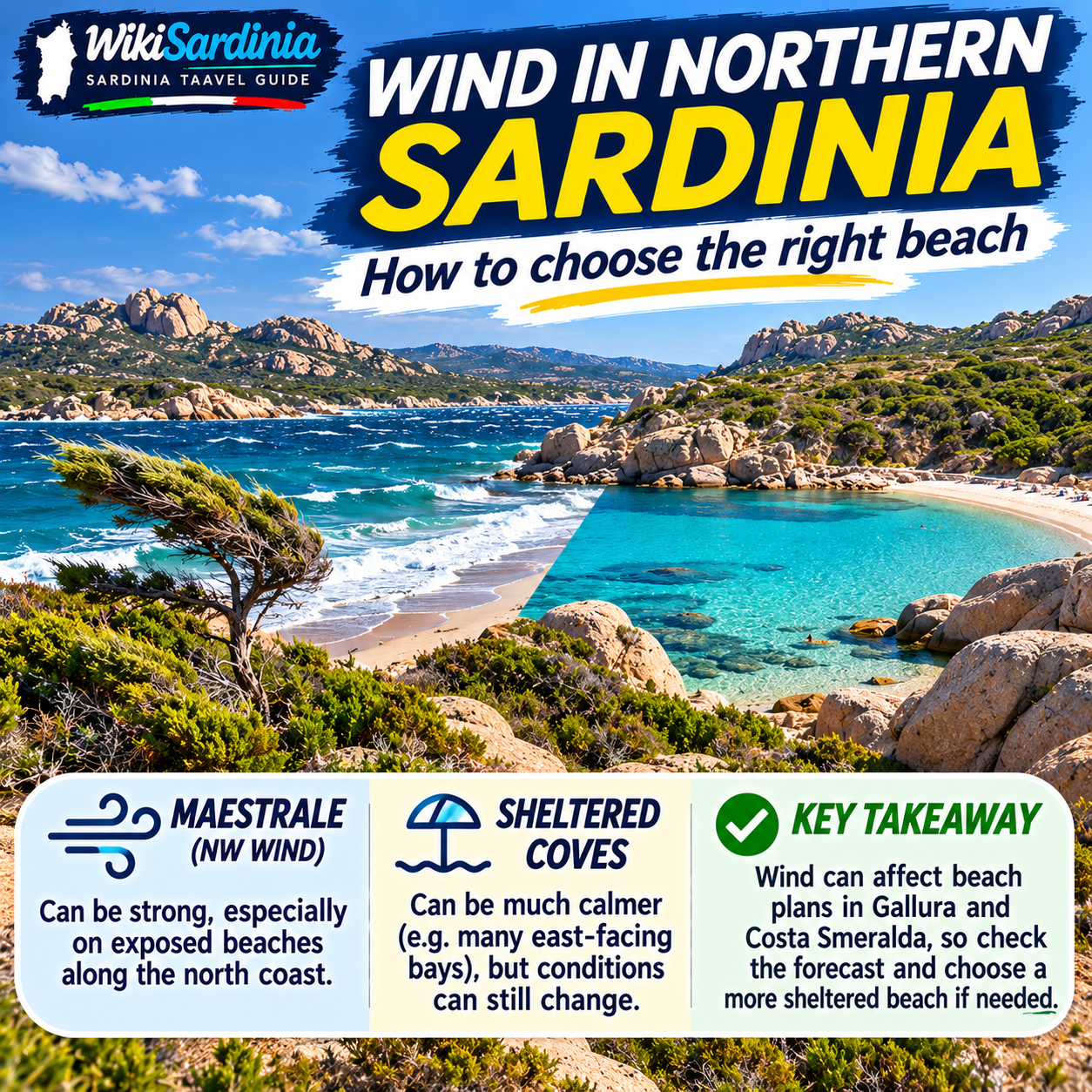
The Maestrale, or Mistral, is a wind that blows from the northwest. It is especially important in Sardinia because it can bring fresh, dry air and sometimes powerful gusts. It is not restricted to winter: episodes can occur during the summer beach season too.
The regional environmental agency ARPAS discusses Maestrale episodes in its weather reports, while local guides describe how it influences beaches in Gallura. The Olbia.it guide to Gallura and the Maestrale explains why the orientation of coves can make a major difference.
For travellers, the crucial detail is that northwest describes the direction the wind comes from, not the direction it travels toward.
How windy can it get in summer?
Some days have only a gentle breeze. Other days bring sustained wind and stronger gusts, enough to blow sand, make umbrellas unstable and produce rough water along exposed shores. Strong Maestrale episodes can last more than a few hours and occasionally affect several consecutive days.
There is no dependable fixed wind-speed figure for every summer day in Gallura. Look at a location-specific forecast for average wind, gusts, direction and sea state, rather than relying on a general icon showing sunshine or clouds.
Does wind ruin beach days?
Sometimes it makes a particular beach uncomfortable or unsafe, but it does not necessarily spoil the day. Light wind can feel refreshing during summer heat. Moderate wind may be manageable in a protected bay. Strong gusts can turn an exposed beach into a poor choice, especially if sand is blowing into faces or waves make swimming difficult.
The difference is often the beach's orientation and surrounding land. A bay with hills or a promontory behind it may be sheltered from one wind direction but exposed to another. That is why experienced local beachgoers often decide where to go after checking the morning wind forecast.
Which beaches are better when the Maestrale blows?
With a northwest Maestrale, east-facing or southeast-facing beaches and coves protected by headlands are often worth checking first. In and around Costa Smeralda, possible options include Romazzino, the eastern side of Capriccioli and Liscia Ruja. Further south, the shape of Cala Brandinchi can offer protection from some northwesterly conditions.
These are possible sheltered alternatives, not guaranteed safe beaches. Wind can bend around headlands, local gusts can remain strong and swell can arrive from a different direction. A detailed Gallura wind-exposure guide and SardegnaSummer's local recommendations discuss these differences.
What about Capriccioli?
Capriccioli is especially useful for understanding how beach orientation works. Its small coves face different directions around a granite promontory. Under a northwesterly wind, the eastern coves may be more sheltered than exposed alternatives; when an easterly wind blows, the balance can change.
Do not assume that the name “Capriccioli” alone identifies one uniform set of conditions. Check the specific cove and observe the sea before entering.
Are Romazzino and Liscia Ruja sheltered?
Both are commonly suggested as options to investigate during a Maestrale because of their orientation on the eastern Costa Smeralda coastline. However, their size, beach access, local gusts and wave exposure differ, and conditions may change during the day.
A beach described as “sheltered from the Maestrale” is not sheltered from every wind. With Levante or other easterly conditions, the same coast may be more exposed.
What about La Cinta, Lu Impostu and Cala Brandinchi?
These famous beaches near San Teodoro do not respond identically to the wind. Local guidance identifies Cala Brandinchi as a potential shelter in certain Maestrale conditions because of nearby Capo Coda Cavallo. By contrast, the long, open stretch of La Cinta can be uncomfortable when strong gusts whip up sand. Lu Impostu is more exposed in some conditions than its neighbour Cala Brandinchi.
Even if a beach has relatively calm water, strong wind onshore can still make sunbathing unpleasant. Choose based on both comfort and safety.
Is Palau or La Maddalena windier than Costa Smeralda?
The Palau and La Maddalena area includes channels, exposed coastal sections and islands where wind can be particularly noticeable. The local geography creates a patchwork of sheltered bays and windier stretches. A ferry or boat excursion may feel very different from sitting on a protected beach.
If you plan a boat trip around the archipelago, follow the operator's marine forecast and safety decisions. Do not assume that sunshine guarantees calm water or that a trip will operate as scheduled in strong wind.
What if the wind comes from the east?
When Levante blows from the east or Grecale from the northeast, many east-facing beaches that are comfortable in a Maestrale may become exposed. In that case, a west-facing or otherwise sheltered cove may be a better candidate.
With Scirocco from the southeast, another pattern of exposed and sheltered shores emerges. The right choice is not a permanent “best beach for wind,” but a beach whose orientation and protection suit that day's conditions.
Quick guide to common winds in northern Sardinia
| Wind | Direction it comes from | What to consider |
|---|---|---|
| Maestrale | Northwest | Check east- and southeast-facing protected coves |
| Ponente | West | Look for shelter behind western headlands |
| Tramontana | North | North-facing beaches can be exposed |
| Grecale | Northeast | Northeast-facing shores may see waves |
| Levante | East | East-facing beaches may be exposed |
| Scirocco | Southeast | Check southeast exposure and local sea conditions |
These are orientation clues, not swimming forecasts. Offshore swell, currents, seabed shape and local terrain can change conditions substantially.
How do I choose a beach on a windy day?
First, check a reliable forecast for the exact area you plan to visit. Note the wind direction, sustained speed, gusts, waves and any official warnings. Then examine a map to see which way the beach faces and whether a promontory or hillside may block the wind.
Next, consider how far you are willing to drive. Gallura's winding coastline offers alternatives, but changing beaches may mean extra travel and parking challenges in high season. Finally, once you arrive, assess the real conditions: blowing sand, strong gusts, breaking waves, currents and lifeguard instructions matter more than an optimistic forecast.
Can you swim safely when it is windy?
Not always. Wind can generate waves and currents, and offshore winds can push inflatable toys, paddleboards and inexperienced swimmers away from the beach. A calm-looking surface near shore does not prove that conditions are safe farther out.
Observe beach flags and lifeguard instructions. Avoid swimming when conditions are rough or warnings are in force. Never rely solely on the fact that other people are in the water, and be particularly cautious with children, inflatables, SUPs and small boats.
Does a sheltered beach mean there is no wind?
No. A beach may be sheltered from the main wind direction yet still experience gusts, eddies and blowing sand. The sea may be calmer because the wind has less open water over which to build waves, but the air can remain windy. Shelter is relative.
Can the wind actually improve a summer holiday?
Yes. A light breeze can make a hot day more comfortable and contribute to the area's appeal for sailing and wind sports. Places such as Porto Pollo are well known among windsurfing and kitesurfing enthusiasts. The conditions that delight experienced water-sports participants, however, may be unsuitable for casual swimmers or families looking for calm water.
Respect designated sport areas and local beach rules, and do not enter the water with unfamiliar equipment in strong wind without appropriate training.
Which month is least windy in Gallura?
There is no month that reliably guarantees wind-free beaches. June, July, August and September can all have pleasant calm spells and windy episodes. Wind frequency and intensity vary from year to year.
Choose travel dates based on the broader holiday you want, not a promise that one summer month will eliminate the Maestrale. A flexible itinerary and access to beaches with different orientations are usually more valuable than trying to predict a perfectly calm week months in advance.
Should I avoid booking accommodation in northern Sardinia because of the wind?
No. Gallura and Costa Smeralda remain excellent destinations for beach holidays. If beach time is your priority, a base that makes it easy to reach several coastlines can be especially practical. Having a rental car may give you more flexibility than relying on one beach within walking distance.
When booking a seafront villa or apartment, remember that an exposed terrace can be windier than a sheltered garden or courtyard. Ask your host about local exposure, especially if you are travelling with young children or planning to spend a lot of time outdoors.
What if the weather is too windy for the beach?
Keep an alternative plan: explore a Gallura village, visit archaeological sites, enjoy a long local lunch or discover inland landscapes. Strong wind can affect boat trips and exposed viewpoints, so choose activities that remain suitable for the actual weather and follow any local warnings.
Useful Italian wind vocabulary
- Vento: wind
- Maestrale: northwesterly Mistral wind
- Raffiche: gusts
- Mare mosso: rough or choppy sea
- Mare calmo: calm sea
- Spiaggia riparata: sheltered beach
- Vento forte: strong wind
- Da che parte soffia il vento? Which direction is the wind blowing from?
- Quale spiaggia è riparata oggi? Which beach is sheltered today?
- È sicuro fare il bagno? Is it safe to swim?
Frequently asked questions
Is Costa Smeralda very windy in summer?
It can be, particularly during Maestrale episodes, but there are also calmer days and sheltered coves. Conditions vary considerably by location.
Does the Maestrale blow every day?
No. It is an important recurring wind, not a daily certainty.
Which Costa Smeralda beaches are worth checking in a Maestrale?
Romazzino, eastern Capriccioli coves and Liscia Ruja are possible candidates, subject to the day's forecast and actual sea conditions.
Is Cala Brandinchi sheltered from wind?
Its setting can provide protection from certain northwesterly winds, but it is not sheltered from every direction or guaranteed calm.
Can I still swim when it is windy?
Sometimes, but only if sea conditions are safe. Check flags, lifeguard advice, waves, currents and official warnings.
Is Palau especially windy?
Parts of the Palau and La Maddalena area are exposed, especially around channels and headlands. Other bays can be more sheltered.
Does wind make Sardinian beaches cold?
Wind can make you feel cooler, particularly when wet, but air and sea temperatures depend on the season and weather. Strong wind does not automatically mean cold water.
Is September less windy than August?
There is no reliable guarantee. Both months can have calm spells and windy periods.
Are boat excursions cancelled when it is windy?
They may be delayed, changed or cancelled when conditions are unsuitable. Follow the operator's decision and marine warnings.
Can I use a beach umbrella in strong wind?
Strong gusts can make umbrellas dangerous. Follow local rules and remove or avoid using umbrellas when they cannot be safely secured.
The bottom line
Wind is part of the northern Sardinian experience, but it does not have to ruin your holiday. The Maestrale can make exposed beaches unpleasant while nearby protected coves remain comparatively comfortable. Learn the wind direction, keep your beach plans flexible and check actual swimming conditions before entering the water. In Gallura, knowing which beach to choose today matters more than hoping for a completely wind-free week.